
.png?width=50&name=34C0AE28-DE08-4066-A0A0-4EE54E5C1C9D_1_201_a%20(1).png)
This week, Halcyon shipped the 12th monthly update to its Gas Power Plant Tracker.

Earlier this month, Halcyon released the 12th monthly update to its Large Load Tariff Tracker.
We began shipping this data subscription in July 2025 with 35 tariffs from 33 utilities across 25 states. At that time, 20 of these tariffs were brand new and had minimum size thresholds, long-term contract requirements, minimum take-or-pays, and collateral and exit fee requirements that were explicitly crafted to serve large data centers. The remainder were a mix of tariffs that had been crafted earlier to serve either cryptocurrency miners or large industrial customers like factories and steel mills.
Twelve months later, the Large Load Tariff Tracker (or LLTT as we’ve come to call it) now contains 218 filings by 79 different utilities across 39 states. 124 of these filings are tariffs (nearly quadrupling the total from the original release), and encompass not only tariffs that are already in effect or that are awaiting PUC approval, but also include ones that have been superseded by newer versions, canceled, rejected, withdrawn, closed to new customers, or placed into interim (but not full) service.
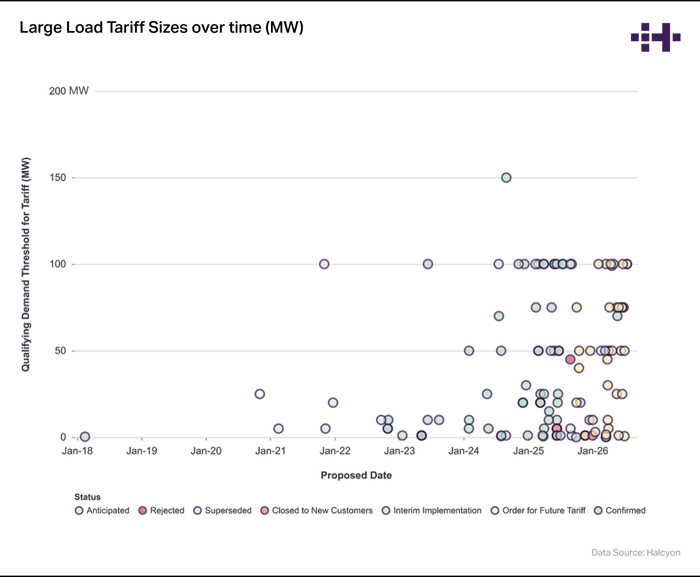
In addition to tariffs, the LLTT now also includes riders, frameworks (such as line extension policies and large load customer terms and conditions), and bilateral contracts between utilities and data center developers. We’ve also added large load-specific proceedings at the state, RTO/ISO, and federal levels, such as the FERC ANOPR on Interconnection of Large Loads to the Interstate Transmission System or ERCOT’s Batch Zero Process. The growth of this core data, which now spans two expansive excel sheets and nearly 300 precisely formatted rows, reflects both the impetus at all levels of the regulatory system to build and accommodate large loads, as well as Halcyon’s increasingly sophisticated ability to track and synthesize these efforts.
Bilateral contracts offer a particularly unique lens by which to analyze the interaction between large loads and the grid. While tariffs are generalizable, contracts give a discrete, authoritative view into what has actually been agreed between utility and hyperscaler. They paint a picture of a system in acceleration — of the 61 contracts in the tracker, 50 were filed since the first release of the tracker; 35 were filed since the start of 2026.
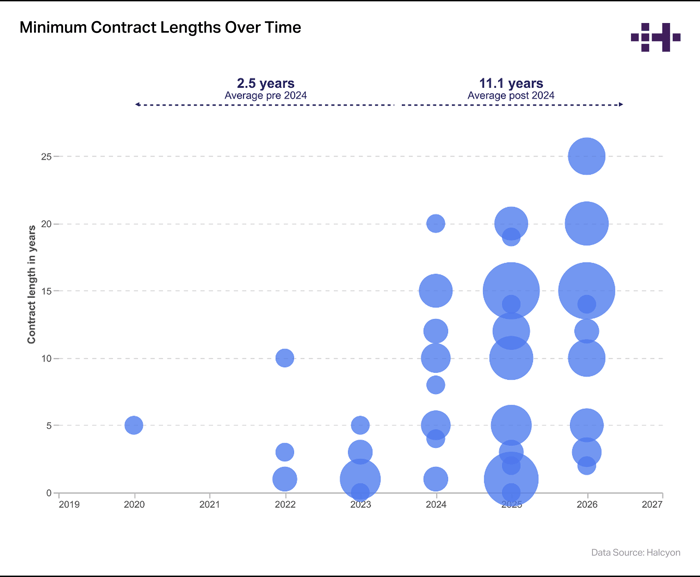
Beyond the change in magnitude, the LLTT captures subtle shifts in how utilities are responding to the new load growth paradigm. The data show a clear step change in minimum contract term requirements between the periods of pre- and post-2024. Pre-2024, the average minimum contract length among anticipated and confirmed tariffs in our dataset is 2.5 years; post-2024, it balloons to 11.1 years.
What’s less obvious is that this figure has continued to creep upwards year-over-year. In 2025, among 43 proposed tariffs, the average minimum contract length was 9 years, while in 2026, the average is 12 years (among what is still a robust sample size of 23 tariffs).
This shift to longer, more utility-friendly terms is mirrored in other tariff provisions, too. Collateral requirements have grown increasingly stringent, with many recent tariffs including ratcheted terms based on a customer’s credit rating and liquidity. Virginia Electric and Power Company’s GS-5 tariff, for instance, sets collateral requirements at $1.5 million/MW but allows for an up to 70% reduction if a customer has at least a BBB- from S&P or a Baa3 from Moody’s, a backstop from a guarantor that meets those ratings, or available liquidity equal to at least 10x the collateral amount.
Other utilities have set even higher standards. Collateral for Wisconsin Electric’s Very Large Customer (“VLC”) Tariff and Bespoke Resources Tariff (“BRT”) are calculated based on the net book value of dedicated facilities provided for a customer, as well as two years’ worth of charges for VLC. Customers are only exempt if they maintain at least an A- from S&P or an A3 from Moody’s, in addition to tangible net worth commitments of at least 2x the required amount or liquidity of 10x the required amount. These terms are responsible for the over $7 billion in collateral that Oracle must post for its Lighthouse campus in Port Washington.
Many utilities have also become more sophisticated in how they differentiate between different classes of large loads. In May 2026, Otter Tail Power Company filed a proposal with the Minnesota PUC to split its existing Large General Services class into three tiers: Tier I for customers greater than 200 kW and less than 25 MW, Tier II for customers greater than 25 MW and less than 75 MW, and Tier III for customers of at least 75 MW of firm data center load. Otter Tail proposes to create a new very large customer class for all loads above 25 MW, but its terms for the data center customers to be served under Tier III (also called High Power Compute, or HPC) are far more prescriptive than those under Tier II. Case in point, Tier II occupies just four pages in the tariffs sheet, while Tier III sprawls 16 pages. Otter Tail’s new tariffs, like many others proposed in the last 12 months, recognize that the network and incremental generation needs of modern AI data centers differ materially from those of cloud data centers or traditional industrial consumers and deserve their own specific guardrails.
As this information flow continues to increase in volume and complexity, the Large Load Tariff Tracker will continue to evolve, as well. This will mean not just a volume-driven increase in magnitude, but also the deliberate addition of new fields and linkages: coverage of emerging trends like capacity reassignment, Bring Your Own Generation (BYOG), and fast lanes, more granular detail for existing fields like collateral requirements, and explicit connections between hyperscaler contracts and the gas power plant, battery storage, and substation assets that Halcyon also tracks. Taken together, these data points constitute the regulatory underpinning of a system that is being made anew, one ruling at a time.
The Halcyon Large Load Tariff Tracker is here.
Subscribe for more content like this; reach out with questions: sayhi@halcyon.io; follow us on LinkedIn and Twitter