Skip to content

State-level market intelligence on how utilities are engaging with data centers and other large load customers


LAST UPDATED *

Feb 12, 2026

RECENT UPDATES

12 new tariffs and 6 new proceedings added

TOTALS

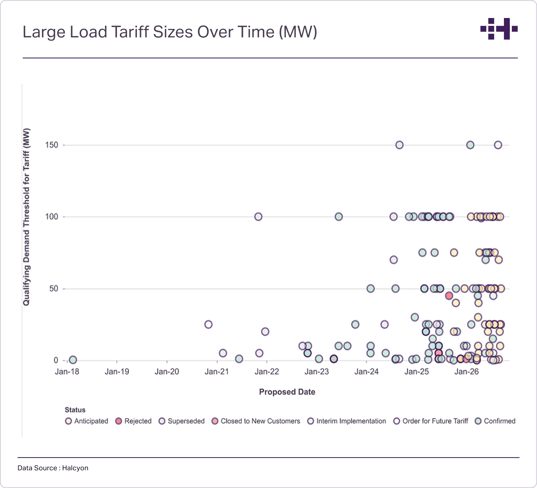
108 tariffs covering data centers, telecom infra, and crypto-miners

LLTT - Jan 12 2026

* Updated monthly

How We Help Energy Professionals

DATA CENTER DEVELOPERS datacenter

Better understand the regulatory landscape nationwide, compare costs, and find the best places to build

UTILITIESplug

Benchmark proposed tariffs against what's already been approved, streamline regulatory approval, and maximize revenue

Law firmslaw

Analyze previous tariff proposals and comments to gain clarity on what's persuaded state regulators

CONSULTANTSconsultants

Help clients better understand the dynamic tariff landscape and recent trends

Data Inputs

Halcyon’s Large Load Tariff Tracker provides regularly updated, comprehensive tariff information, including Utility Data, Technical Parameters (operational thresholds), and Market Context (exploration of tariff proposal legislative drivers). We are continuously adding new data and new data fields based on your feedback.

Utility Data

Field

Description

Utility

Investor Owned utilities over TK MWh served

Tariff Name

Name of plan offered to customers (“Large load rate”)

Parent

Parent company owning the regulated utility

DBA

Tradestyle/does business as names of the utility subsidiary or other business unit

EIA Utility ID

Utility ID used by EIA reporting sources

State

State this tariff is active in

BA Code

Relevant balancing authority

Total Megawatt Hour Sales

Disposition MWh as reported in EIA form 861 in 2023

Utility Customer Count

Number of residential, commercial and industrial customers served in the state by the Utility, per EIA form 861 in 2023

Docket

Identifier used by state Commission

DPP Link

Halcyon AI generated Docket Profile Page 

Docket Name

Name of docket (Petition for approval of “Large load rate”)

Docket Status

Flag for whether this docket active/open/ongoing

Description (From Docket Profile Page)

Halcyon generated summary of the docket proceedings

Docket Start date

First document publication data

Active date

Start date of tariff for customers

Tariff Proposal Date

The date on which the utility first proposed the tariff or the amendment to the tariff

Tariff Status

If "Anticipated", active date for tariff is not yet confirmed through Commission approval. If "Confirmed", active date for tariff has been confirmed through Commission approval.

Type

If "Tariff", then the row is an instance of a tariff that is either commission approved or undergoing approval. If "Contract", then it is an individual service agreement between a utility and a large load source that requires commission approval. If "Rider", then it is a supplemental rate mechanism and not a formal tariff. If "Framework", then it is a hypothetical arrangement for a future tariff or contract.

Update Type 

Identifying whether the update reflects a net new tariff/rider/contract/rulemaking or a revision to an existing tariff.

Revisions

A list of the changes made to an existing tariff if it is a revision; blank if it is new.

Final Tariff Filing Link 

A link to the final tariff document.


Technical Parameters

(operational thresholds)

Column Header

Data Source

Qualifying Demand Threshold for Tariff (MW)

Minimum megawatt demand threshold for single or aggregated loads on a site to be served by the utility; a null response indicates a threshold demand has yet to be proposed, or is not relevant to the tariff.

Voltage Threshold (kV)

Minimum kilovolt interconnection on a site to be served by the utility; a null response indicates the tariff does not require primary or transmission interconnection voltage.

MW Threshold for Crypto and/or Mobile Applications

Megawatt threshold specified for crypto and/or mobile applications; a null response indicates a threshold demand has yet to be proposed, or is not relevant to the tariff.

Minimum Demand Threshold / Load Factor

% of maximum load that the facilities has to maintain (if specified).

Long Term Contract Years

Where specified by tariff, the minimum number of years a large load service contract must be committed to.

Ramp Period

Where specified by tariff, the maximum number of years from the time a large load service begins to receive a minimum service level to the time it must bring its 100% demand online.

Market Context

(exploration of tariff proposal legislative drivers)

Column Header

Data Source

Long Term Contract Requirements

Duration of contract in years, with additional commentary where tariff provides specific guidance.

Rules on Renewals and Amendments

Any rules specified in the tariff around renewals or amendments to the contract.

Minimum Monthly Demand Payments

Minimum payments associated with capacity demand (if required).

Exit Fees

Payments required from a developer to a utility if a datacenter does not meet its contractual obligations.

Exit Fee Time Period (Months) 

The number of contract months used to calculate exit fee payments.

Collateral Requirements

Posting requirements for any collateral, credit, or securitization described in proposed/enacted tariff.

Riders

Any listed riders relevant to the tariff.

Pre-Existing Tariffs

Any relevant tariffs that a large load would receive service under prior to this proposed tariff becoming effective.

Recent Legislative Driver (TRUE/FALSE) 

True / False used to flag whether any recent legislation drove proposal of the tariff; TRUE only if there is positive evidence to indicate a legislative driver, otherwise FALSE.

Legislation Details

Any legislation which appears to drive the proposal of the tariff.

Legislation Flexibility Flag 

Flag for load flexibility requirements.

Load Flexibility

A description of any unique requirements of large loads to respond to curtailment through this tariff, if applicable.

Onsite Generation

Any mention of requirement for, preferential treatment for, or unique rules around onsite generation other than emergency back-up generation.

Bring Your Own Power — Offsite 

Details for whether customers are able to procure their own power through energy markets.

Bring Your Own Power — Onsite 

Details for whether customers are able to procure their own power via customer-owned onsite generation, including emergency back-up generation.

Time to Power

Any details on how quickly the utility can provide electric service once a customer commits to building.

Power Factor %

Any mentioned percentage power factor requirement.

Power Factor

Any rules proposed/enacted for a minimum power factor maintenance requirement, or additional charges for power factor deviations.

Proposed Timeline

The timeline of events proposed by the utility to see a decision on the tariff.

Commenting Organizations

Number of distinct organizations that submitted a comment on the tariff docket.

Intervenors

Number of distinct intervenors that formally intervened in the tariff docket.

Contribution in Aid of Construction (CIAC) Flag

Identifies whether certain infrastructure costs to serve a customer are paid by a customer (or developer) versus the utility and if CIAC is mandatory (flag = yes paid by customer) or may be used at the discretion of the utility and/or customer (flag = conditional).

Contribution in Aid of Construction (CIAC) Details

Provides specifics on how CIAC applies, including triggering threshold or facilities, cost responsibility, payment timing, and other terms.

Expedited Interconnection / Fast Lane Flag

Indicates whether an expedited interconnection or fast-lane process is established within the tariff.

Expedited Interconnection / Fast Lane Details

Details the terms, conditions, and procedural requirements governing expedited interconnection or fast-track review.

Flexible Interconnection Flag

Flags the discussion or approval of flexible interconnection options, such as non-firm or conditional service.

Flexible Interconnection Details

Outlines the terms, limitations, and operational requirements associated with proposed or approved flexible interconnection options.

Data Preview

Showing three (3) of 108 Large Load Tariffs. Updated monthly.

Utility Name Halcyon Query Type Parent DBA EIA Utility ID State BA Code Total Megawatt Hour Sales Utility Customer Count Docket Follow this Tariff DPP Link Docket Name Docket Status Description Docket Start Date Proposal Date Active Date Status Update Type Revisions Filing Link Qualifying Demand Threshold (MW) Voltage Threshold (kV) MW Threshold for Crypto and/or Mobile Applications Minimum Load Factor Long Term Contract Years Ramp Period Long Term Contract Requirements Rules on Renewals and Amendments Minimum Monthly Demand Payments Flag Minimum Monthly Demand Payments Details Exit Fee Details Exit Fee Time Period (Months) Collateral Requirements Details Collateral Requirements Calculation Collateral Calculation Method Riders Pre-Existing Tariffs Recent Legislative Driver (TRUE / FALSE) Legislation Details Load Flexibility Flag Load Flexibility Details Bring Your Own Power – Onsite Bring Your Own Power – Offsite Time to Power Power Factor % Power Factor Details Timeline Number of Comments Unnamed: 50
Union Electric Company Large Load Customer Service (LLCS) https://app.halcyon.io/queries/7be86231-14d8-47a2-9cc3-20b46ff83e36/analysis Tariff Ameren Ameren Missouri 19436 MO MISO 30,764,248 1,264,469 ET-2025-0184 https://app.halcyon.io/alerts/subscribe/16d4572a-f212-4444-b291-5a099be9a929 https://app.halcyon.io/processes/b43b1c01-62be-40a2-9cdb-013f755400f4 In the Matter of the Application of Union Electric Company d/b/a Ameren Missouri for Approval of New Modified Tariffs for Service to Large Load Customers Open/Active The LLCS program creates a new tariffed Large Load Customer Service allowing very large customers (≥75 MW peak or expansions adding ≥75 MW) to take service under long-term written service agreements that include contract capacity, ramp periods, and automatic five-year extensions. It offers optional renewable energy subscriptions (RSP‑LLC), clean capacity, nuclear credits, and other riders, plus alternate time‑based energy billing and specific demand/billing rules intended to align cost... Dec 12, 2024 May 14, 2025 Dec 4, 2025 Confirmed New - https://app.halcyon.io/documents/9f478bcc-bdc5-4504-b98c-00b69154395c/attachment 75 115 - 75% 15 5 Large load customers shall enter into one or more electric service agreements (ESAs). The term equals the ramp period plus at least twelve years after the end of the ramp period such that the total is at least fifteen years; the ramp period may be up to five years. - Yes 80% of contracted capacity If a data center (large load customer) terminates its contract early, it must provide 24 months' written notice and pay substantial termination payments. These payments are calculated as follows:
- During the ramp period: Payment covers all minimum demand charges for the remainder of the ramp period.
- After the ramp period: Payment covers the lesser of five years or the remaining term of the contract, based on the minimum demand obligation, plus any commitments to clean energy programs...
Lesser of five years
or remaining months
Customers must meet certain credit ratings (at or above A- from S&P Global Ratings and A3 from Moody's) and liquidity requirements (10x 50% of the customer's minimum capacity and clean energy commitments for remaining term of service), or else post collateral such as cash, a letter of credit, or a guaranty from a creditworthy affiliate. The required collateral is based on the customer's minimum capacity and clean energy commitments over the remaining term of service Minimum non-fuel bill for remaining months Minimum demand charge - Renewable Solutions Program – Large Load Customers (Rider RSP-LLC)
- Clean Capacity Advancement Program (Rider CCAP)
- Nuclear Energy Credits (Rider NEC)
- Clean Energy Choice (Rider CEC) 2.
Large load customers (100 MW or more) would be served under the existing Large Primary Service (LPS) tariff, specifically within a new subclass of the LPS tariff that would be subject to new terms and conditions only for large load customers. The LPS tariff reflects the embedded cost of service and applies to large retail customers prior to the establishment of a specialized large load tariff. True The proposal is directly driven by recently enacted legislation—specifically, Missouri Senate Bill 4 (SB 4). SB 4 requires that electric utilities serving more than 250,000 customers develop and submit tariff schedules for customers projected to have annual peak demands of 100 MW or more. The legislation mandates that rates for such customers reflect their representative share of incurred costs and prevent unjust or unreasonable costs from being shifted to other customer classes. This new legal standard is guiding the... Not Required - Large load customers must not exceed their maximum contract capacity; if they do and such exceedance threatens system integrity or reliability, they are required to reduce load to or below the maximum capacity within 15 minutes of notice from the company.
- There is no explicit mention of penalties for failing to shed load, nor are there stated duration limits for load shed events beyond the requirement to comply within 15 minutes...
- Customers are given the option to take part in the Renewable Solutions Program, which allows them to subscribe to their preferred wind and/or solar resources, as well as the Nuclear Energy Credit Program, which provides customers with ownership of nuclear energy credits associated with the Company's own nuclear generation. Utilities face challenge of "building enough generation in a timely manner to provide capacity and energy to reliably serve all customers while meeting the timelines for ramping up to full demand that the new customers desire." No specific numeric time-to-power or speed-to-power for new applications under LPS is provided. - - - May 14: Application and testimony were due.
- June 13: The Commission scheduled a prehearing Webex procedural conference.
- June 23: Deadline for parties to file a proposed procedural schedule and for Ameren Missouri to respond to Evergy Metro and West’s intervention request.
- June 27, 2025: Deadline for Evergy Metro and West to reply to Ameren Missouri's response...
7  
AEP Ohio Schedule DCT (Data Center Tariff) https://app.halcyon.io/queries/250fce96-f6e2-46ee-be22-73e2bc9d9eed/analysis Tariff American Electric Power (AEP) - 14006 OH PJM 44,314,671 1,523,794 24-0508-EL-ATA https://app.halcyon.io/alerts/subscribe/111186fc-fd82-4588-a239-995a922499a9 https://app.halcyon.io/processes/f86744b3-4727-49ef-a830-591988aee2f6 ATA-Application for tariff approval Open/Active The docket concerns AEP Ohio's proposal to create a new customer classification and tariff structure specifically for large data centers. Key issues addressed include:
- AEP Ohio’s request for new tariff terms for large loads, especially data centers, proposing requirements such as long-term contracts, minimum demand provisions, exit fees, and higher minimum billing demand.
- Recommendations that tariff changes should apply to all large...
May 13, 2024 May 13, 2024 Jul 23, 2025 Confirmed New - https://app.halcyon.io/documents/c6a05869-c40b-4e51-a77b-2e6968c8c97d/attachment 25 - 25 85% 8 4 8 years plus a 4 year maximum load ramp allowed. Load ramp as minimum % of final capacity is defined Contracts remain in effect unless terminated by either party with written notice no less than 3 years prior to termination date. New contracts required fo rload additions in excess of 100kW. Yes The greater of 85% of highest previously established monthly billing demand over prior 11 months, or customer's Minimum Demand calculation based on named capacity, with some variation for capacity between 25MW and 75MW, and above 75MW. Exit fee equal to three years of minimum charges if the customer terminates after five years following the load ramp period. Early termination is prohibited during the first five years after the load ramp period. The exit fee is credited for the benefit of ratepayers. Customers may assign up to 25% of contract capacity to another data center customer in lieu of paying some or all of the exit fee. Exit fee revenues will be held for future refunds or offset transmission costs. 36 Data centers (or their financial sponsor) with credit ratings below A- from S&P or A3 from Moody’s are required to provide either a parent company guarantee or collateral such as a letter of credit or cash. The security must equal 50% of the minimum demand charge for the full contract term, based on AEP Ohio’s rates at the time the electric service agreement is signed. Acceptable forms of collateral include: (1) a guarantee by the corporate parent or an affiliate with sufficient credit metrics; (2) a standby letter of credit... 50% minimun demand charge for contract period Minimum demand charge Monthly charges computed under Schedule DCT are adjusted in accordance with commission-approved riders on sheet number 104-1 that apply to demand metered commercial and industrial service. Nothing in this tariff excepts eligible customers from other riders or applicable tariffs. The primary pre-existing tariff for large loads is Ohio Power's General Service (GS) tariff, under which customers enter into one-year electric service contracts, though Ohio Power has the option to require a longer initial term. The GS tariff requires contracts to specify a 'contract capacity' (the maximum power delivered to the customer) and imposes a minimum demand charge set at 60% of contract capacity. These terms apply to large loads, including data centers, prior to the adoption of any new, data center-specific... False The process motivating these tariffs is rooted in regulatory proceedings before the Public Utilities Commission of Ohio, rather than any specific new legislation. The cited statutes (e.g., R.C. 4903.221) pertain to intervention rights in commission proceedings, not direct legislative mandates for the tariff itself Required for BTM Generation The Schedule DCT/MDC/FLT materials include terms requiring customers with behind-the-meter generation to have equipment that can "instantaneously curtail load equal to or greater than the behind - the - meter generation output" and require customers to attest they will follow applicable technical operating requirements (including not cycling load in a way that creates unacceptable system frequency). Schedule DCT allows customers the right to net behind-the-meter generation (onsite generation) against contract capacity, provided certain conditions are met. - Schedule DCT allows for a load ramp period of up to four years, commencing upon energization, to reach full contract capacity. There is also a provision allowing customers to petition the commission for adjustment if electric infrastructure is not in place by the estimated in-service date - - - May 13, 2024: AEP Ohio filed its application to establish new tariffs for data centers and mobile data centers (cryptocurrency miners).
- June & July 2024: Multiple parties, including Walmart, intervened and filed initial and reply comments.
- July 11, 2024: The Public Utilities Commission of Ohio (PUCO) established a procedural schedule with deadlines for testimony and an evidentiary hearing...
158  
Appalachian Power Company Schedule L.P.S. (Large Power Service) https://app.halcyon.io/queries/767ecf67-4979-4a38-b114-f40d69064e59/analysis Tariff American Electric Power (AEP) - 733 VA PJM 14,307,492 549,270 PUR-2025-00057 https://app.halcyon.io/alerts/subscribe/c6017de6-aa5b-4f51-85d6-5865c0d01574 https://app.halcyon.io/processes/9f42cb63-d33c-49bf-b952-55ebd7bb2ada Appalachian Power Company - Petition for approval of Revisions to the Terms and Conditions of Rate Schedules L.P.S. Open/Active Appalachian Power Company proposed significant revisions to its existing Schedule L.P.S. (Large Power Service) tariff for new large load customers, such as data centers, involving loads greater than or equal to 100 MW at an individual site or 150 MW on an aggregated basis. The proposed changes include a 12-year initial contract term, a five-year notice period to discontinue or modify service, an 80% monthly minimum billing demand, and increased collateral requirements. These changes do not affect current... Mar 24, 2025 Mar 24, 2025 - Anticipated Revision Revises terms and conditions of existing Schedule L.P.S. to add specific large-load provisions: increases initial contract term to 12 years (after any ramp period), allows a load ramp period up to 5 years, raises enhanced requirements for new/expanded large loads (≥100 MW single site or ≥150 MW aggregated), clarifies 42‑month notice timing so termination/reduction cannot take effect until 8.5 years into initial contract term, limits contract reductions >20% absent company agreement or payment of... https://app.halcyon.io/documents/7bc6533c-d181-4bf6-8652-177f2da5eea3/attachment?page=29 100 - 100 - 12 5 New large load customers (over 100 MW at a site or 150 MW aggregated) must enter into a contract with an initial term of at least 12 years, which begins after an optional ramp period of up to 5 years. The contract includes requirements for a minimum billing demand, collateral, and an exit fee for early termination. After the initial 12-year term (plus any ramp period), contracts remain in effect until cancelled or modified according to the tariff terms. Customers must provide at least 42 months' written notice to reduce capacity or terminate the contract, but may not do so during the first 5 years of the initial term. Amendments or reductions in capacity are limited to after the first 5 years, with a maximum reduction of 20% of contracted capacity allowed with proper notice. Renewals or continued service are automatic... Yes The customer is subject to a minimum monthly charge equal to the sum of the basic service charge, the product of the demand charge and the monthly billing demand, all applicable adjustments, and the product of the base billing energy and the monthly base energy charge. The monthly billing demand is not less than 80% of the greater of the customer's on-peak contract capacity or highest previously established monthly billing demand during the past 11 months. Base billing energy is calculated as contract capacity ... A large load customer may terminate or reduce its contract capacity beyond 20% (after the first five years of the initial contract term) by giving at least 42 months' written notice prior to the PJM delivery year for which the reduction/termination is sought, subject to payment of an exit fee. The exit fee is calculated as the nominal value of the remaining minimum charge for the terminated/reduced capacity in excess of the allowed 20% reduction for the first year of the exit fee period; for any... Lesser of five years or remaining months but not less than one year Customer must provide collateral in a form acceptable to the company based on creditworthiness. The amount is equal to 24 times the customer's previous maximum monthly non-fuel bill (or for the first year, the maximum expected bill). This is recomputed annually and updated if the value increases by 10% or more. 24 months of maximum non-fuel bill Maximum non-fuel bill Each kilowatt-hour of energy and each kilowatt of demand billed is subject to all applicable riders and surcharges, in addition to base rates and demand charges. - Schedule L.P.S. (Large Power Service): Large loads would be served under Appalachian Power Company's existing Schedule L.P.S. This tariff is available to customers with large loads and was deemed sufficient for high load factor customers, including data centers, prior to the proposed modifications. The main distinction between the proposed changes and the pre-existing tariff relates to the scale and risk posed by extremely large loads (e.g., 100 MW+), not the fundamental rate structure itself... False APCo proposed revisions to its existing 'Schedule L.P.S. (Large Power Service)' to address new large load customers (e.g., data centers) with aggregated loads of 150 MW or more, or 100 MW at an individual site. The proposal was made pursuant to sections 56-236 and 56-237 of the Code of Virginia. The motivating factors include the growing interest from very large load customers and the associated risks of stranded investments if such customers cease or curtail operations. The petition references the... Not Required - All other customers having sources of electrical energy supply other than the Company shall take service under Schedule S.B.S. Customers with cogeneration and/or small power production facilities shall take service under Schedule COGEN/SPP or by special agreement with the Company. All other customers having sources of electrical energy supply other than the Company shall take service under Schedule S.B.S. - - - - March 24, 2025: Appalachian Power Company (APCo) files a petition with the Virginia State Corporation Commission (SCC) for approval of revisions to the terms and conditions of Rate Schedule L.P.S. (Large Power Service), applicable to new large load customers (≥100 MW at a site or ≥150 MW aggregated). No new 'Schedule K.P.S.' is proposed; the revisions are to existing Schedule L.P.S.
- May 16, 2025: SCC issues Order for Notice and Comment...
21  
Plus 115 more Tariff rows


Reach out to access the full dataset

Other Data Products

UPDATED - Feb 18 2026

Gas Power Plant Tracker

201 Plants 104.2GW Capacity

UPDATED - Feb 16 2026

Rate Case Tracker

259+ Rate Cases 84M Utility Customers