
For years I have been warning that rising demand forecasts and the failure to retain existing generators or build adequate new power generation is threatening resource adequacy and the reliability of our power grid. I look forward to addressing this important topic with my colleagues and others who can contribute important information and give their views on how we move forward on this critically important issue.
.png?width=50&name=34C0AE28-DE08-4066-A0A0-4EE54E5C1C9D_1_201_a%20(1).png)
Regular readers know that Halcyon does not shy away from the energy sector alphabet soup. We’ve got another one for you: FERC’s proposed ANOPR in docket RM26-4-000, Interconnection of Large Loads to the Interstate Transmission System.
For those not so deeply in the soup: that’s the Federal Energy Regulatory Commission’s proposed Advance Notice of Proposed Rulemaking, meant to speed up and otherwise ease the interconnection of significant new sources of electricity demand in the US grid - mostly, but not exclusively, data centers.
At the moment, 175 unique organizations have filed notices or comments in the docket. More will be coming, as reply comments will be filed through December 5. Parsing the comments already received is an unstructured data problem of the sort that Halcyon regularly tackles for customers.
We have identified six core topic areas across proceedings and analyzed each commenter’s position on each topic. Here is a preview of two areas.
The first concerns the 20 megawatt threshold, which constitutes ‘large load’ in the proceeding. Most commenters think that this 20MW threshold is too low, while those supporting the 20 MW threshold say things like "20MW is a place to start", or "PG&E is not opposed to using 20 MW as a threshold… ". The distribution of what should constitute a large load is worth noting (charted below).
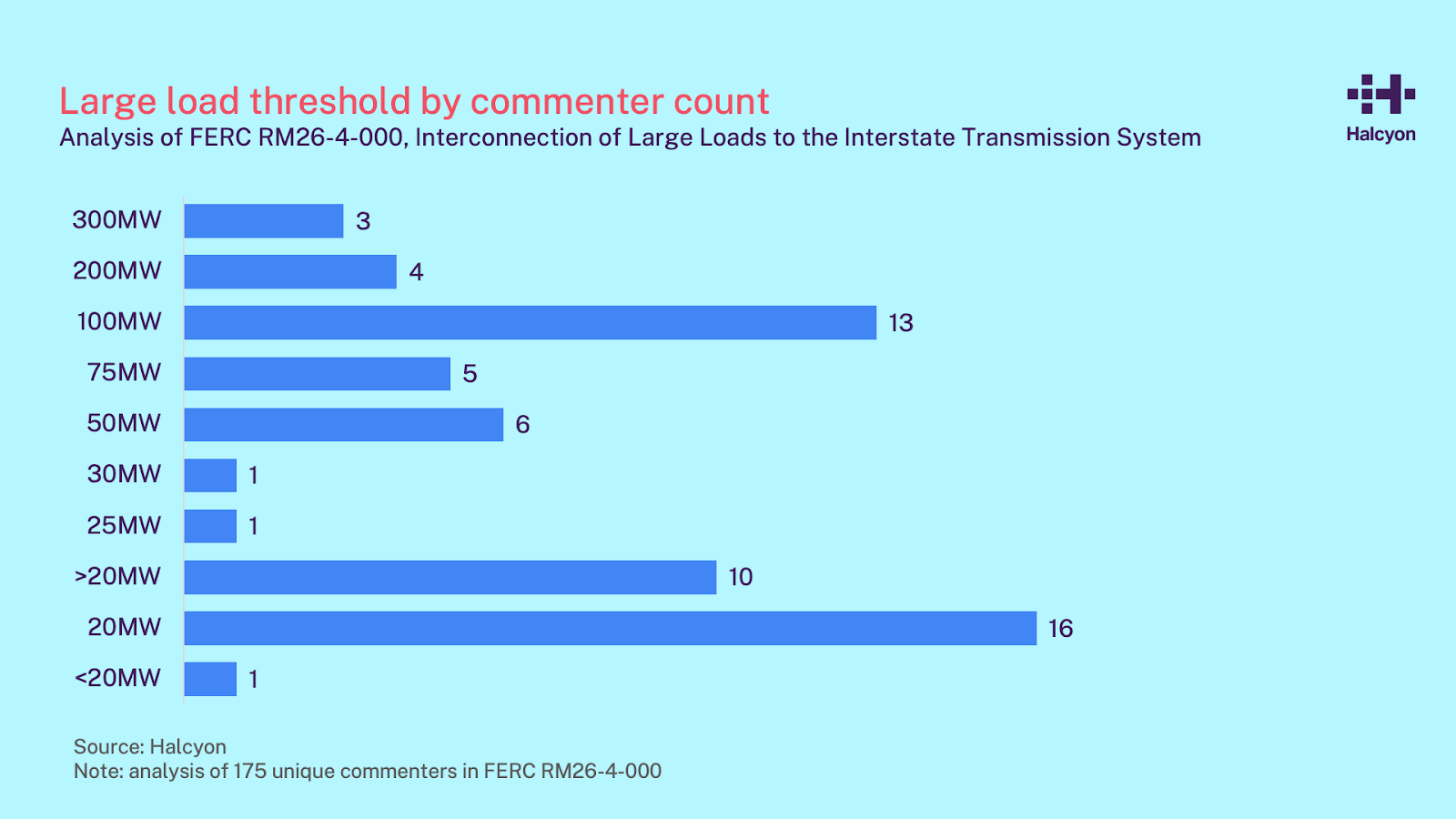
Several commenters say that the threshold should be both capacity (in megawatts) and voltage (in kilovolts), as high-kV loads apparently give FERC greater jurisdiction because of their more apparent implication for the transmission system. On that note, many commenters, such as Southern Company, say that state and regions already act in this fashion, and that FERC should leave that activity and responsibility at this state/regional level.
The second concerns jurisdiction, and jurisdictional issues abound. FERC's 20 MW threshold is based on the requirements for large generator interconnection agreements. Still, many commenters noted that much larger "bundles" of load are already being handled effectively at the state and regional levels. Southern Company, again, points out that the proliferation of data centers in its vertically integrated territory shows that there is no problem warranting federal oversight. The Southwest Power Pool (SPP)’s and the New York Independent System Operator (NYISO)’s treatment of large loads indicate that a final rule should allow regional authorities flexibility to create their own tailor made solutions.
There is much more within the 175 comments filed so far in FERC RM26-4-000, and in Halcyon’s analysis of those comments. If you’d like to know more about what we have delivered to customers, let us know here.
We look forward to hearing from you.
Subscribe for more content like this; reach out with questions: sayhi@halcyon.io; follow us on LinkedIn and Twitter