Everyone talks abstractly about the grid buildout, transmission constraints, and interconnection queues; much like a microwave oven and non-dairy powdered creamer, “no one really knows how it works.” There is an aura of mystery surrounding our electrical grid that energy professionals don’t necessarily discourage.

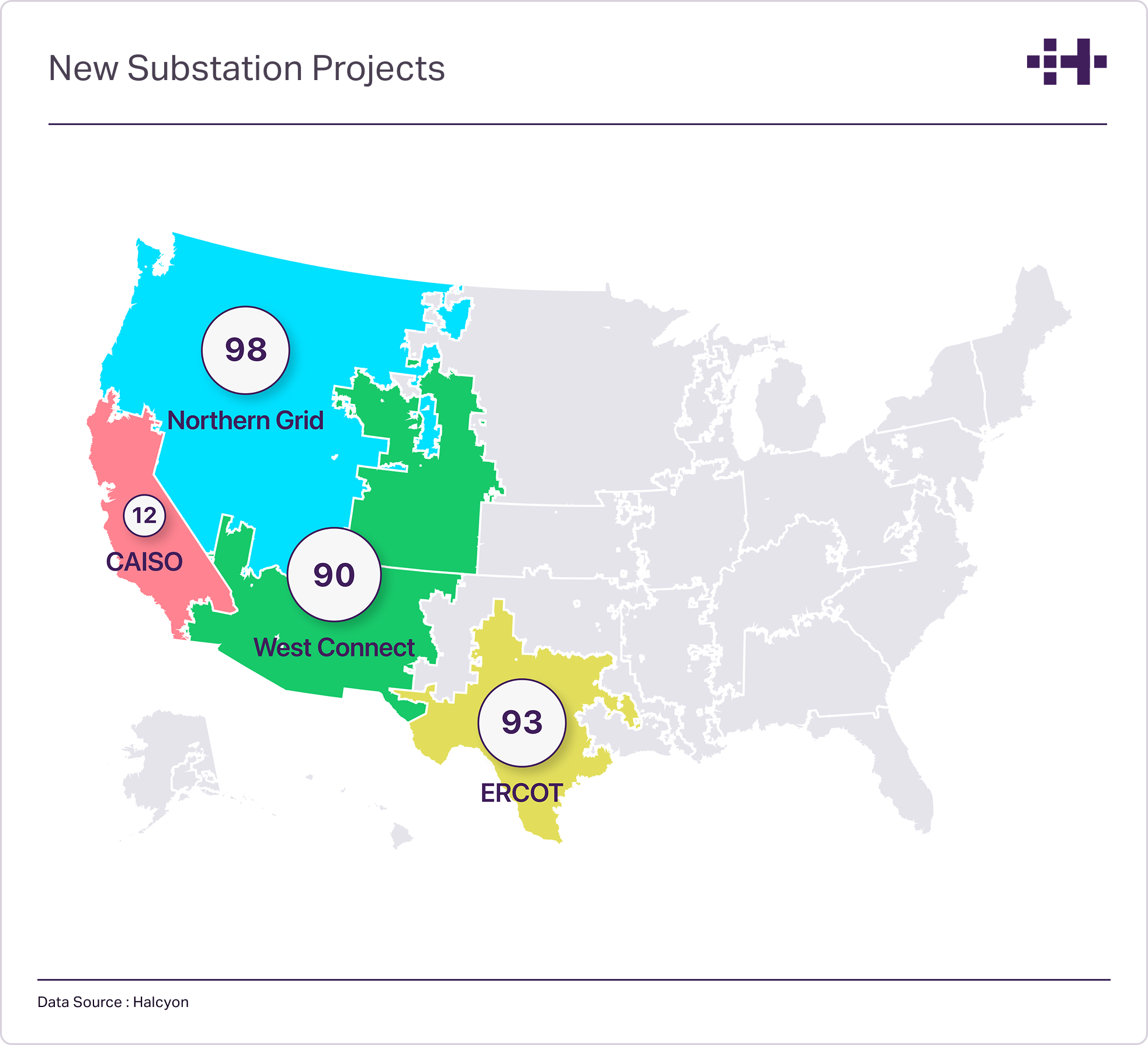
Last week, we issued our latest update to the New Substation Development Tracker. This edition adds 93 net new projects — all built under the purview of the Electric Reliability Council of Texas (ERCOT) — bringing the total from roughly 200 to 293 substations and switching stations tracked across ERCOT, Northern Grid, West Connect, and CAISO.

The Texas additions include 57 new or upgraded substations and 36 new or upgraded switching stations, representing the tracker's first major expansion into the ERCOT market. These 93 projects represent the top three tiers (projects that cost more than $25M and have a Certificate of Public Convenience and Necessity) of all substation/switching stations in Texas. It's this tracker’s first major update since launch, and it reflects something we've been hearing from subscribers and the market more broadly: the grid buildout story in Texas is massive.
Why Texas, and why substations
Everyone is watching the generation and interconnection queues. Fewer people are paying attention to the substations and switching stations that actually make new load and new generation possible. A 500-megawatt data center or gas plant doesn't connect to the grid in the abstract — it connects through physical substation infrastructure that has to be planned, approved, and built.
(Data centers are also unique in that they individually trip the need for new substations. Previously, only large industrial facilities — an automobile factory, an aluminum smelter — would meet that threshold, and those were never being built at anything like the pace we're seeing with data centers today)
Nowhere is that more visible than in Texas. Oncor Electric Delivery Company, a subsidiary of Sempra, accounts for 26 projects in the tracker — and the combined capex across those projects totals roughly $7 billion in planned substation investment. To put that in context: Oncor's parent company recently outlined a $47.5 billion five-year base capital plan for 2026–2030, with 68% — over $32 billion — allocated to transmission. Key drivers include the Permian Basin Reliability Plan, which alone represents approximately $8 billion in projects targeting 2030 completion, as well as continued electrification in West Texas and annual premise growth of roughly 2%.
The tracker data maps directly onto that plan. Projects like Drill Hole ($1B, 765-kV transmission structures, December 2029), Culberson ($725M, new 345/138-kV transformers, December 2027), and Dinosaur ($475M, 765-kV switchyard, December 2029) aren't speculative — they're planned infrastructure with identified equipment, developers, and target operation dates. Several are part of the broader Permian Basin Reliability Plan that anchors Oncor's capital outlook.
And because Oncor is a subsidiary of Sempra (NYSE: SRE), delays or accelerated deployments on these projects can materially impact the parent's earnings and rate base growth — meaning this data isn't just relevant to utilities, equipment providers, and Texas consumers. It's relevant to equity analysts and traders with a stake in whether $7 billion in planned infrastructure proceeds are on schedule.
What's in the tracker
Every project in the substation tracker includes region, state, construction status, parent company, developer, operation year, equipment descriptions, capex estimates, and source documentation. You can see the full methodology and field list on the tracker page.
Beyond Oncor, the tracker's top parent companies by project count include El Paso Electric (34 projects across TX and NM), Berkshire Hathaway (27 projects across CO, ID, NV, OR, UT, and WY), and Bonneville Power Administration (26 projects across ID, MT, OR, and WA). This reflects the currently covered states in ERCOT, Northern Grid, West Connect, and CAISO — we anticipate that places like Virginia, Illinois, Georgia, and Ohio will materially impact these rankings.
If you're tracking where grid infrastructure is being built, who's building it, and on what timeline, reach out to learn more about subscribing.