
[Editor’s note: Halcyon’sGas Power Plant TrackerandLarge Load Tariff Trackercan help energy professionals keep track of the planned and in-development infrastructure powering this capex boom.]
.png?width=50&name=34C0AE28-DE08-4066-A0A0-4EE54E5C1C9D_1_201_a%20(1).png)
I have just published my annual deck on the prime movers of our changing energy/industrial/technology system. I’ve been doing it for years, and as ever, it is a useful chance to take stock of our current moment, and hopefully enable us to think about the future.
The deck is free, and if you’re reading this through Halcyon, you’re one of the very first to see it.
And if you’re a regular follower of what we’re building at Halcyon, you will see some familiar throughlines on climate, energy, electrification of the global economy, and (in particular) the complex and critical meeting ground of artificial intelligence, information technology, and electricity. I’ve pulled some of my highlights here.
Electrification is real
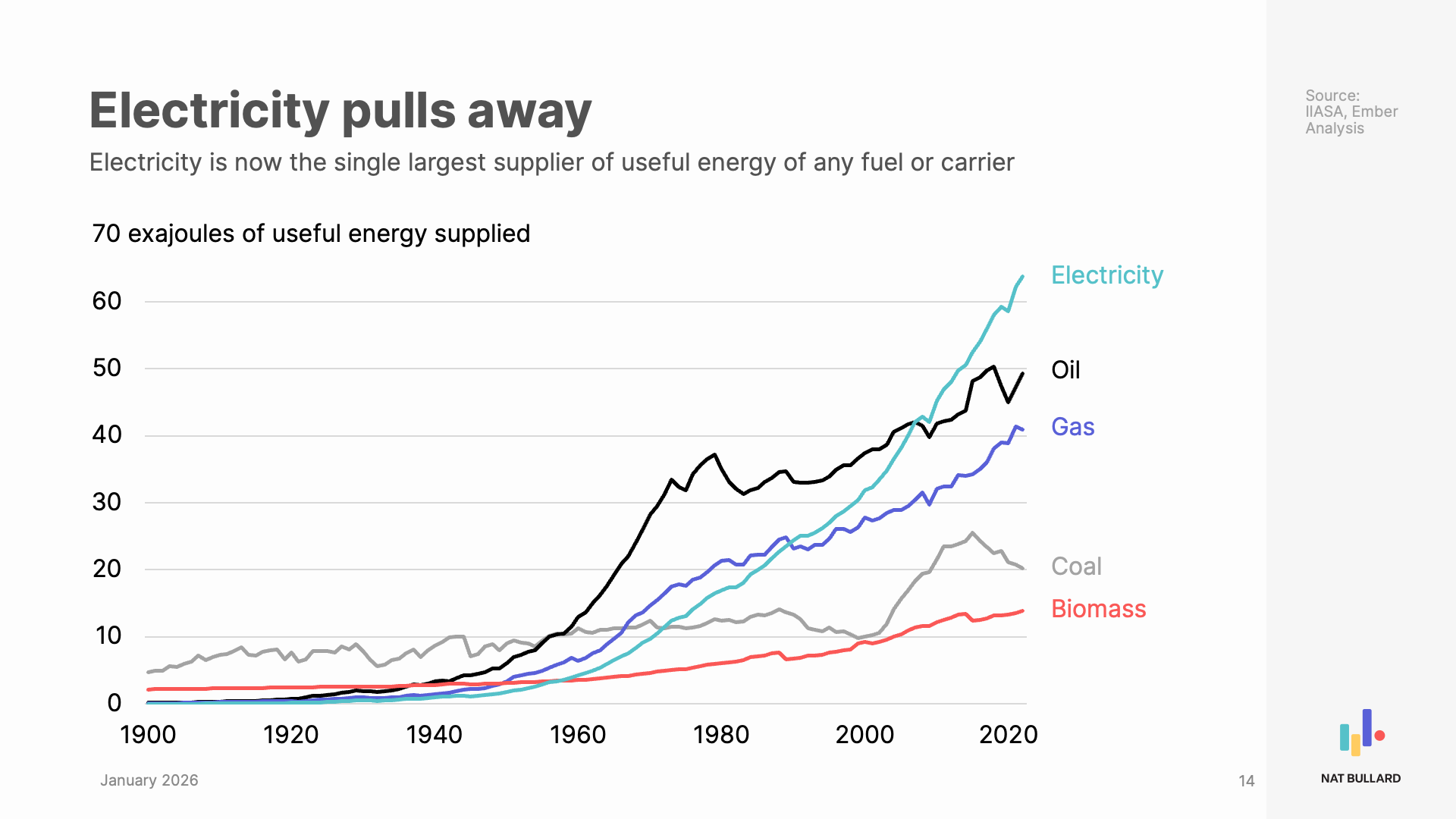
Something profound happened in energy early this century: electricity pulled away from oil as the main source of useful energy supplied to the global economy. Useful energy is an important distinction: it’s energy that we actually put to productive use (illumination, computation, locomotion, refrigeration) rather than, to put it plainly, things that we burn. Electricity is the big kid at the table, and it’s only getting bigger too.
More capex than ever before
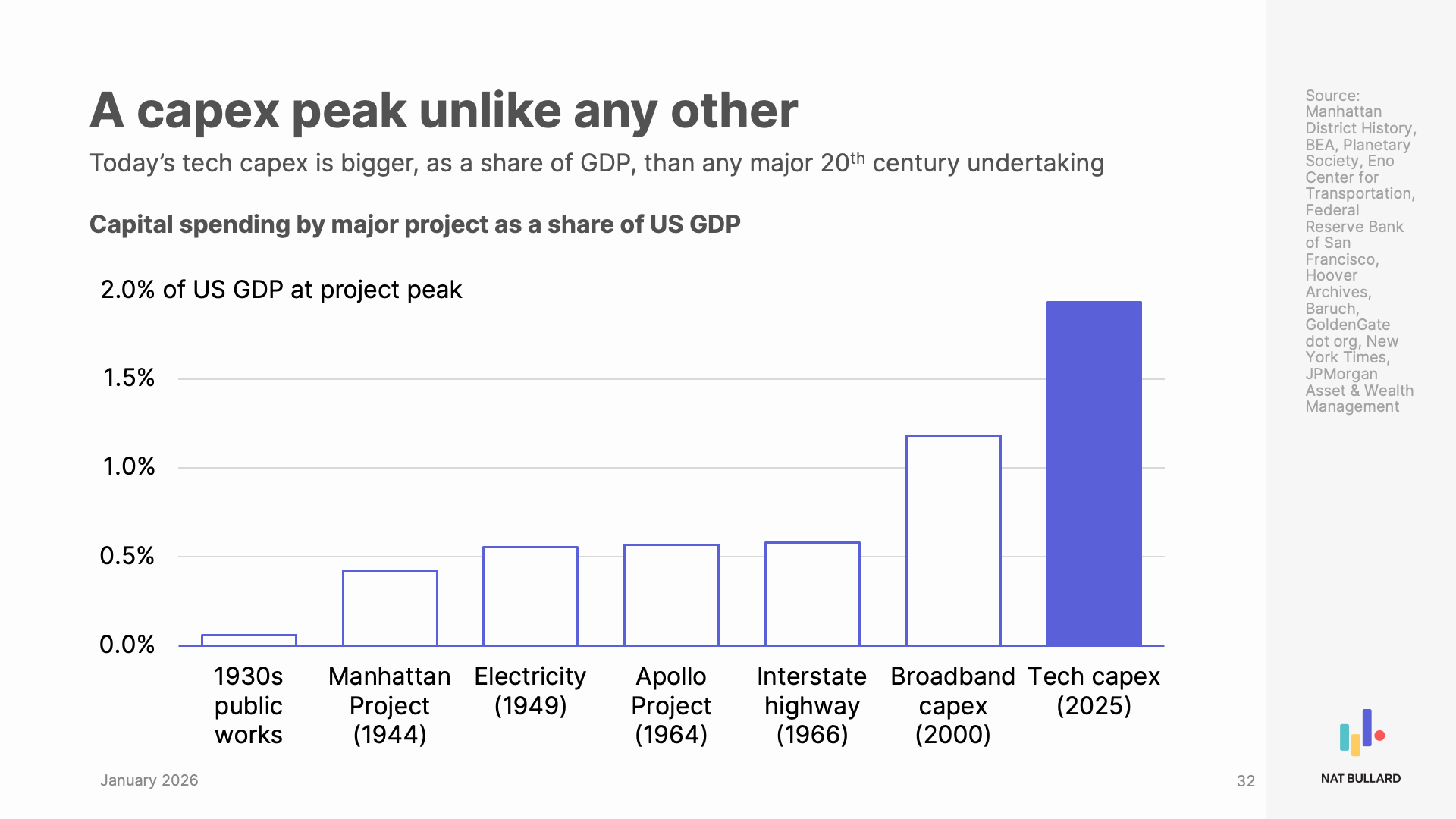
The US experienced five major, economy-shaping capital expenditure booms last century: public works like the Hoover Dam in the 1930s; the Manhattan Project and the electricity grid in the 1940s; The Apollo Project and the interstate highway system in the 1960s; and the broadband capex boom of the late 1990s. The last of those was bigger than any other, and was more than 1% of US GDP at its peak.
Last year, tech capex — mostly, but not entirely, AI-driven — was equal to just under 2% of US GDP. It will probably be higher this year. It’s extraordinary, and it’s transformational, with major implications upstream and downstream, so to speak. Upstream, in what builds and powers all of this new compute; downstream, in terms of what people will build with its outputs.
Gas plant costs, to the moon
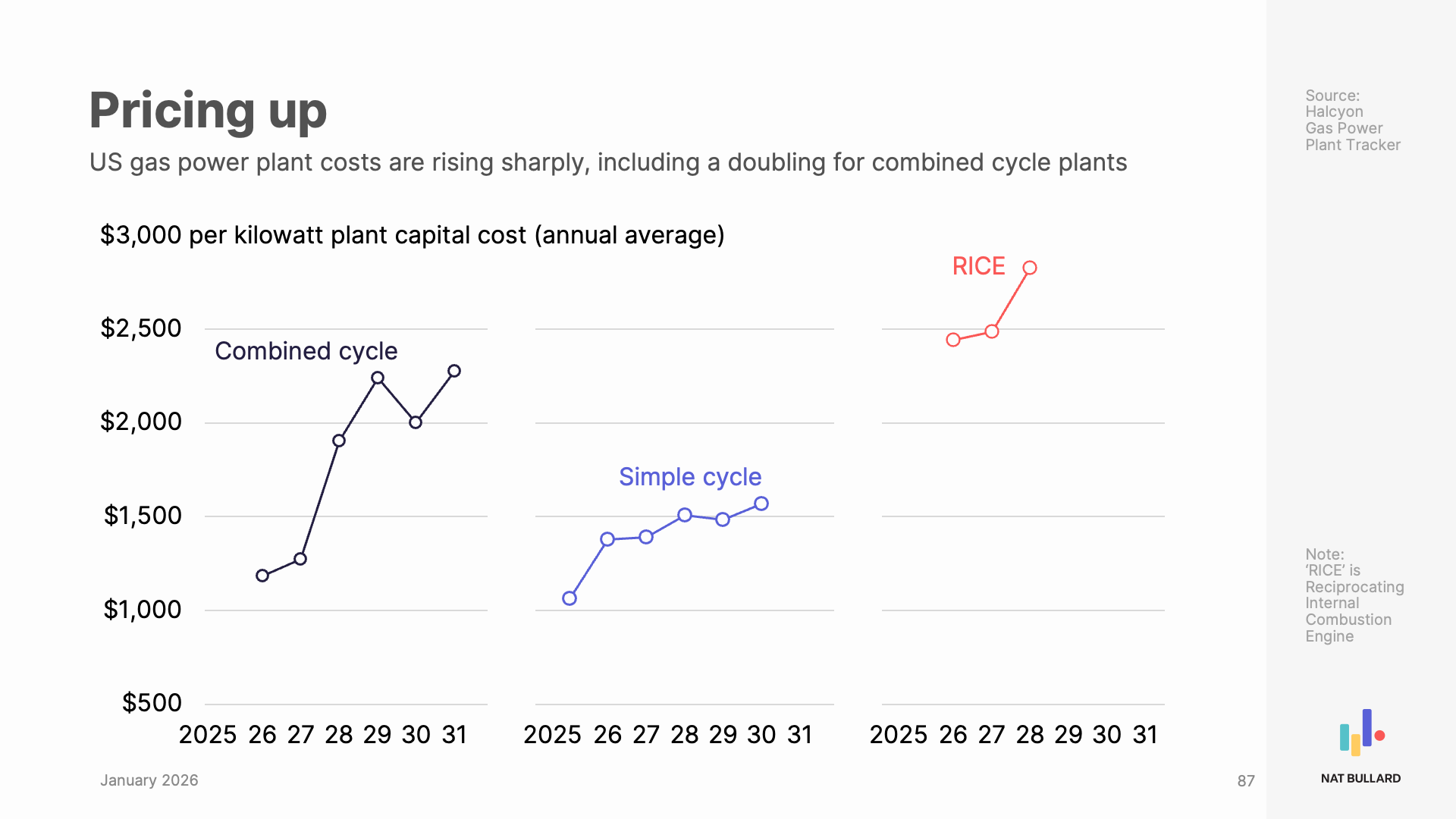
Gas-fired power plant costs are spiking thanks to soaring demand and structural under-supply. Halcyon tracks these costs across more than 180 US assets under development, with more than 90 gigawatts of generating capacity, and the data are quite clear. Prices are rising; they show no signs of coming down; that’s not stopping project developers at all.
And a final thought…
AI is both pervasive and still nascent, and that can be a bit of a brain-breaker. It’s an enormous change agent, but what is it changing? And what will it change, and how, and for whom, and when? That’s why I finished the deck with a very non-energy slide, but one that tells a clear story: the rise and fall of Stack Overflow (if you know, you know…if not, maybe you’re already in the AI era). Here’s what large language models have done to Stack Overflow’s coding question volume:
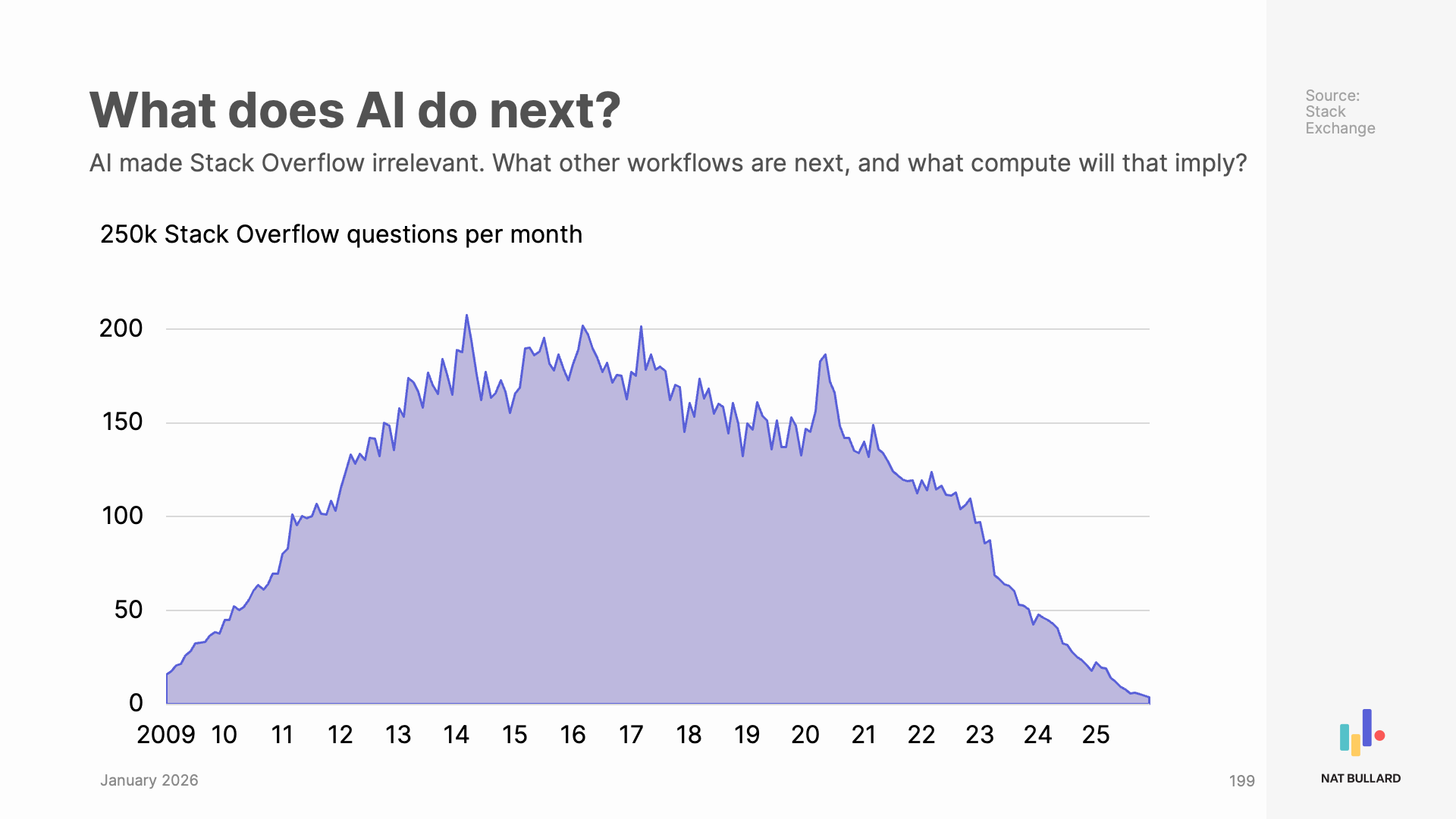
As I write in the slide, AI made Stack Overflow irrelevant. What workflows are next, and what does that imply for compute — and what, upstream and downstream of that, does this capability mean for energy, industry, and infrastructure?
My presentation is here. And, my annual (and exclusive!) launch podcast with Shayle Kann is here. As ever, thank you for reading.