


Earlier this month, we launched Halcyon Search. Try it now, for free: https://app.halcyon.io/search — you can also read about why and how we built it.

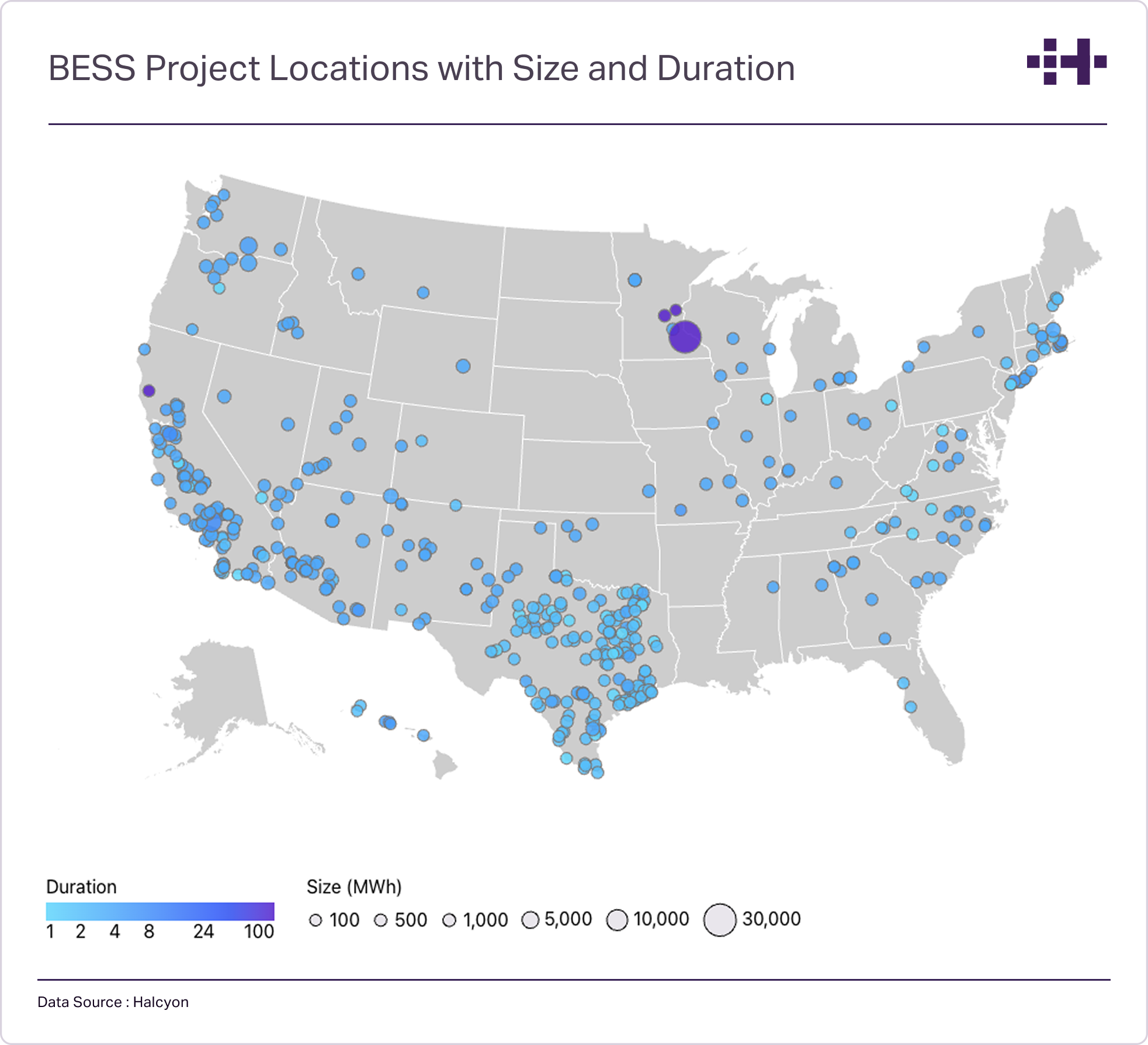
Last Friday March 6, we at Halcyon issued our fourth update to our Battery Energy Storage Systems (BESS) Tracker. Since launch in December, we have nearly doubled the total number of projects tracked, going from 257 projects representing 155 gigawatt-hours (GWh) to 569 projects representing 275 GWh tracked in this latest edition. [Editor’s note: Halcyon’s Chief Data Officer Alex Klaessig will be presenting at CERAWeek’s Agora Innovation program on March 25. Let us know if you’ll be there: sayhi@halcyon.io]
Why batteries, and why now
For most of the last decade, when a utility needed to add new dispatchable capacity, natural gas-fired generation was the default answer. The economics were simple: gas plants had the lowest Net Cost of New Entry (Net CONE) of any firm source, and that math reliably won in resource planning proceedings.
That math is changing. A surge in planned gas capacity, driven by AI load growth, industrial expansion, and coal-fired power retirements, has collided with a manufacturing bottleneck. According to RMI, the three companies that supply the majority of the U.S. gas turbine market have reported extended delivery timelines (2028-2030). Meanwhile, gas plant construction costs are rising sharply, with combined-cycle costs showing an average annual growth rate of 16% from 2025 to 2031 (we track over 200 planned and in-development gas plants).
Batteries don’t solve everything — they typically discharge for a few hours, not the round-the-clock output of a gas plant. But for the use cases that matter most right now, they are increasingly competitive on both cost and timing. A battery project that breaks ground today can be operational in only two or three years.
For hyperscalers and AI infrastructure developers, the math is even simpler: speed to power is now a competitive advantage. Utility interconnection queues are clogged (for years, in some instances), and batteries have emerged as a tool to bridge that gap. Data centers can deploy behind-the-meter (BTM) BESS to help with load flexibility, not only potentially accelerating grid interconnection, but also providing backup capacity; batteries are becoming the faster — and in many cases, cheaper — path to power.
You can see all this directly in this month's data. Three projects — Four-Mile Mesa, Star Light, and Windy Lane — are supporting Meta's data center campus in Los Lunas, New Mexico. Three more — Cold Creek Energy Center, Fish Creek Energy Center, and Pine River Energy Center — support Stargate's 1.4 gigawatt (GW) data center complex under construction in Michigan. These aren't batteries backstopping a wind farm in the abstract; they're specific assets tied to specific load commitments from named buyers.
The scale of individual projects is also growing. This edition adds the Prairie Song Reliability Project in Palmdale, California — a 9.2 GWh system that ranks among the largest battery storage projects in the country and reflects California's continued push to replace retiring thermal capacity with storage.
Also new this month: four iron-air battery projects, all from Form Energy. The largest is the Google-Form Iron-Air Battery Energy Storage Project, a data center-linked system that marks one of the most prominent real-world deployments of iron-air technology to date. The other three — East Road Storage Project (1,000 megawatt-hours), Cambridge CT Hybrid (500 MWh), and Sherco LDES (150 MWh) — continue to build Form Energy's commercial footprint. Iron-air batteries are designed for long-duration discharge and use abundant, low-cost materials, making them a potentially important complement to the lithium-ion systems that dominate the rest of the tracker.
What's new in this edition
In our BESS announcement, we talked about our intention to add links to projects' Large Generator Interconnection Agreement (LGIA), Standard Generator Interconnection Agreement (SGIA), and Exempt Wholesale Generator Request (EWG). We've since added all three, plus the project's corresponding Certificate of Public Convenience and Necessity (CPCN) and the utility service territory.
You can see a full list of all the information our BESS tracker currently covers here.
If you're tracking where storage capacity is being sited, who's building it, and how it connects to the grid, reach out to learn more about subscribing.
.png?width=50&name=34C0AE28-DE08-4066-A0A0-4EE54E5C1C9D_1_201_a%20(1).png)