
What's Happening in Energy highlights the most interesting findings from public utility commission filings.
.png?width=50&name=34C0AE28-DE08-4066-A0A0-4EE54E5C1C9D_1_201_a%20(1).png)
What's Happening in Energy highlights the most interesting findings from public utility commission filings.
Hey there, it's Nat –
This week’s WHiE covers:
- Concerns from transmission providers on assigning incremental network upgrade costs directly to large loads in a comment to the FERC,
- A record year in energy efficiency savings for an electric utility in New York,
- New renewable penetration records and incentives for grid-forming inverters in Texas,
- Plans for seven more 754 MW combined cycle combustion turbines to support a hyperscaler in Louisiana,
- And much more!
Read at your leisure and choose your own adventure — skim the surface, or dive deeper with linked filings and Halcyon's suggested queries. Here is a Halcyon query to start you off:
- In Illinois, Ameren filed nearly 40 documents updating its 2028 grid plan. Read a summary of changes or a summary of the new Appendix X, optimizing grid efficiency and reliability through EV rates and managed charging for $16.6M.
What's Happening in Energy — Apr 3
Powered by Halcyon
____
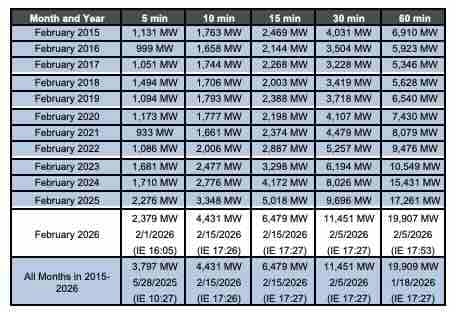
In ERCOT, a renewable penetration record of 82.95% (IRRs, or intermittent renewable resources, as a percentage of load) was set on Feb 28 per the February 2026 Monthly Operations Report. By the same token, higher renewable penetration drives steeper net-load ramps (definition), also at all-time highs. The table below shows February net-load ramps since 2015. On Feb 5, almost 20 gigawatts (GW) of generation ramped up in 60 minutes to meet demand!
____
In Wisconsin, Public Service Commission staff summarized a “Blackstart Service Agreement” between Wisconsin Power and Light (WP&L) and its transmission affiliate American Transmission Company (ATC). Under the agreement, WP&L would construct resources that sit idle under normal conditions, activating only to restart the grid following a total blackout.
From the staff memo, “WP&L will construct, own and operate seven Reciprocating Internal Combustion Engine (RICE) units with a cumulative potential capacity of 17.5 megawatts at an existing WP&L generation facility. The total estimated cost of construction is $52.78 million...”
The Commission has until May 5, 2026, to approve the agreement.
____
Back to ERCOT, stakeholders are working on an incentive program for renewable resources for providing advanced grid support (AGS) services (concept overview). Inverter-based resources would deliver AGS via “grid-forming inverters” that dynamically synchronize with the grid – helping, per ERCOT, to “mitigate the existing stability constraints and reduce future grid stress, aiding resource and load interconnection.”
The presentation included an example timeline for the program if it were to take effect by 2027.
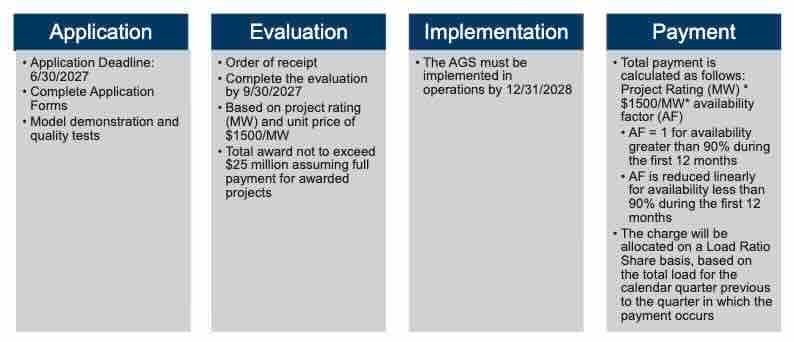
ERCOT will submit the Nodal Protocol Revision Request (NPRR) to implement these changes in Q2 2026.
Halcyon angle: Did you know that Halcyon tracks ERCOT NPRRs and Planning Guide Revision Requests (PGRR)? We filtered “Any of” NPRR and PGRR keywords to see what ERCOT is working on. Check out the list here.
____
In Wisconsin, Madison Gas & Electric (MGE) filed plans to spend $500,000 in 2026 on thermostat installation programs to reduce energy bills for low-and moderate-income households — a commitment made in its rate case settlement with the Citizens Utility Board (CUB) and Blacks for Political and Social Action (BPSA). MGE will coordinate a 2027 spending plan with both groups by March 1, 2027 (2026 expenditure plan).
____
In PJM, the Connect and Manage Senior Task Force presentation contains two flowcharts, three process diagrams, and coverage of curtailment priorities, Bring Your Own New Generation (BYONG), and more! Our favorite? The Large Load Pathway to Interconnection: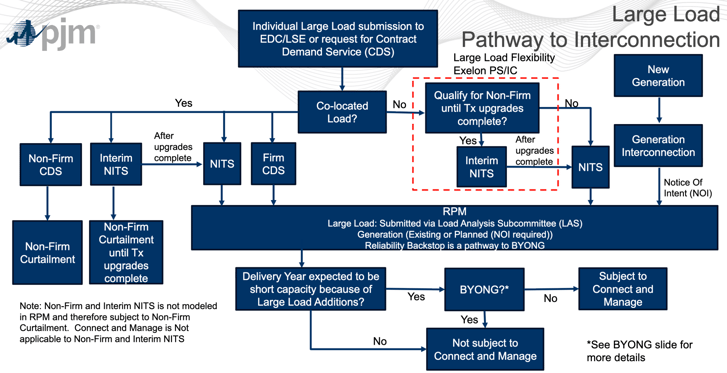
____
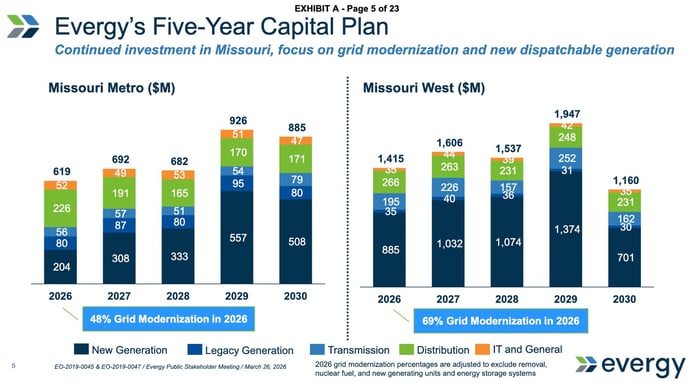
In Missouri, Evergy presented its annual and five-year capital investment plans, which contained these highlights.
-
“Planning $11.5B of infrastructure investment in Missouri 2026-2030
-
More than 62% of 2026 spend will go directly to grid modernization
-
2026-2030 spend will include investment in new, efficient, dispatchable natural gas generation and renewables.”
Here’s the bar chart breakdown across Evergy Metro and Evergy West. Across both these service territories, new generation investments jump $200-300M from 2028 to 2029.
____
At the FERC – WIRES, an association representing transmission providers, submitted a comment and white paper from Concentric Advisors outlining the risks of assigning 100% of network upgrade costs to large loads (a method of cost allocation floated by stakeholders in FERC’s Advanced Notice of Proposed Rulemaking, or ANOPR). The paper argues that FERC’s long-standing policy against charging customers both a “rolled-in” and incremental rate for interconnection upgrades could justify an argument that large loads do not need to pay ongoing operations and maintenance costs of the transmission system.
In PJM, those costs are paid through Network Integration Transmission Service (NITS) charges – fees customers pay for long-term system access. Concentric estimated that allowing large load customers to avoid these charges would shift “$33-47 billion in present value terms for just the volume of large loads expected to be developed in PJM from 2025-2030.”
Halcyon angle: Halcyon conducted a detailed comment analysis on the FERC ANOPR proceeding on large load interconnections. If you are interested in following this important docket, click the Alert icon in the top right of the docket profile. Also, check out the many “Large Load”-related curated alerts on Halcyon’s new Curated Alerts library.
____
In Arizona, Arizona Public Service filed its annual report on the application numbers and processing times for distributed generation interconnection requests. In 2025, the majority of applications were for hybrid solar + battery systems.
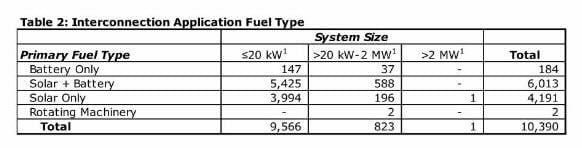
The most popular interconnection option, the “Super Fast Track”, had a median processing time of 84 days from application receipt to interconnection agreement execution (report).
__
In Georgia, Georgia Power estimates that closure costs for both ash pond and landfill facilities through 2073 will reach $8.48 billion as reported in its semi-annual report on the closure of its coal combustion units.
“The Company, with input from third-party experts, has developed forecasts for these long-term projects, some of which span approximately 50 years into the future, based on a combination of factors including … regulatory considerations, engineering studies, detailed closure design, constructability reviews, construction progress, water treatment considerations, operational needs, and post-closure requirements.”
Halcyon angle: Georgia Power filed this report as a .docx – previously requiring a download to view. Halcyon now renders .docx files in the platform. See it in action.
__
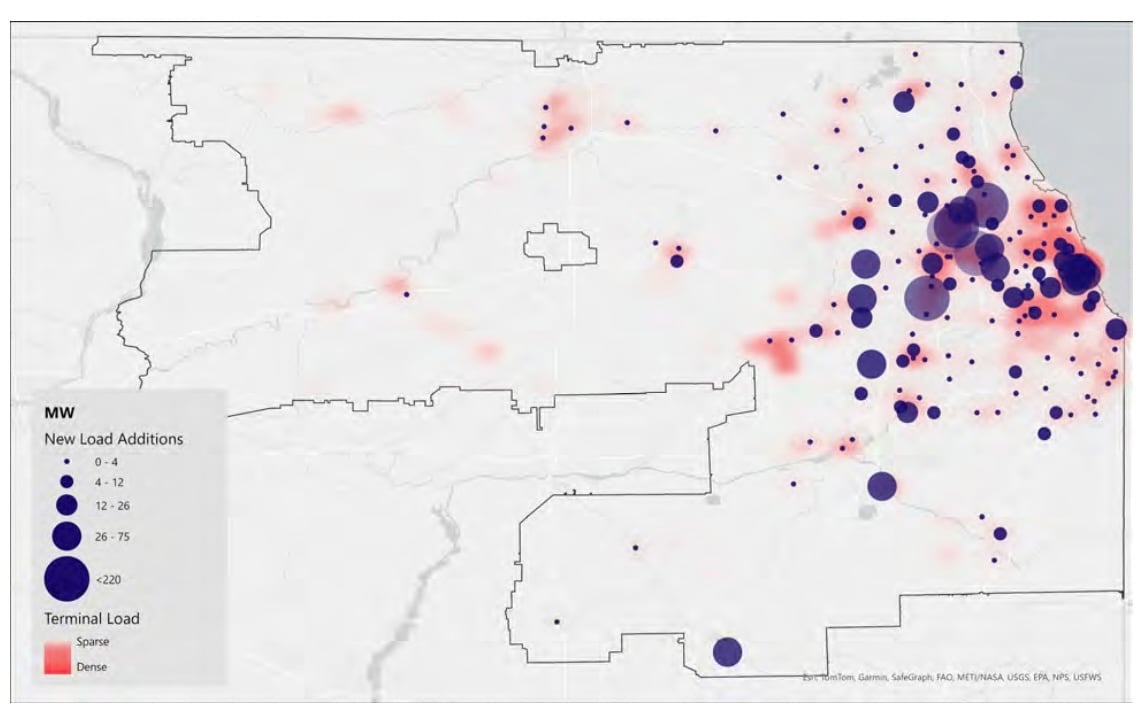
In Illinois, ComEd’s revised Integrated Grid Plan attributes data center growth to state-level tax incentives — but notes that data centers don't drive the majority of capacity investments. Growth is concentrated at specific substations, including Lakeview, West Side, Van Buren, New Elk Grove, and Franklin Park (Chapter 4 and docket profile).
“Unlike residential customers, industrial customers have a less variable response to temperature changes and are more consistent consumers of power … while data centers are driving load growth in a few specific geographic areas, they are not driving the need for the majority of the capacity investments outlined in this chapter. Investments that support load connection from individual customers are funded through New Business and discussed in Chapter 7.”
The most significant portion of the customer growth in ComEd’s service territory is from commercial and industrial (C&I) customers and EV charging stations.
Halcyon angle: Halcyon’s coverage of substations across the country is growing. This week, we released a new version of the New Substation Development Tracker covering ERCOT. This new version adds 93 projects for a total of 293 spanning ERCOT, Northern Grid, West Connect, and CAISO. Learn more here.
__
Halcyon Team Query of the Week
-
The Public Service Company of Colorado (Xcel Energy) is seeking to revise its Gas Demand-Side Management Cost Adjustment (DSMCA-G) tariff, proposing a net decrease in annual revenue that would decrease residential and commercial rates.
- New York State Electric and Gas (NYSEG) highlighted record-setting energy savings in its annual energy efficiency report.
New Docket of the Week
-
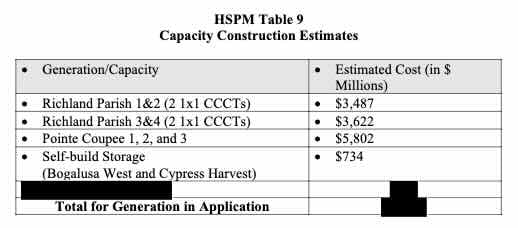
In Louisiana, Entergy Louisiana (ELL) applied for Certification of Generation and Transmission Resources from the Public Service Commission to support Meta’s “Project Evest” (docket profile). The numbers speak for themselves:
- Seven 754 MW combined cycle combustion turbines (four in Richland Parish near Meta’s Laidley data center and 3 in Point Coupee Parish in southeastern Louisiana)
- Three separate battery storage facilities (including two 200 MW facilities co-located with utility-scale solar projects planned and under construction by ELL)
- 2.5 GW of renewable resources through a “Sustainability Agreement.”
- A new 500/230 kV substation, nine new 230 kV switching stations, 20-30 miles of 230 kV transmission line, a new 500 kV switching station, 500 kV transmission lines, including a 153-mile-long 500 kV transmission line.
Public Comment Excerpt(s) of the Week
- In Texas, state representative Vincent Perez submitted a letter to the Public Utility Commission with concerns regarding El Paso Electric's (EPE) application for a 366 MW natural gas generation facility intended to serve a single large data center (docket profile). Perez expressed concerns about the pivot away from renewables to gas, cross-subsidization, and the risks of stranded costs if the data center reduces consumption or shuts down early.
“The Commission has clear authority under PURA §37.056 to grant certificates with conditions to preserve the public interest in cases such as this. The Commission should ensure the existing non-subsidization guarantee becomes an enforceable action of any certificate issued moving forward, to provide a direct enforcement mechanism if a certificate is approved. Further, the Commission should require EPE to obtain a binding take-or-pay agreement from the proposed user that is sufficient to recover the facility’s full costs over its useful life, including liquidated damage provisions to cover any potential stranded costs in the event service is ceased. Texas ratepayers should not be asked to absorb the financial risk of an investment made to serve a single large customer.”
Most clicked item from last week’s WHiE
- PJM Independent Market Monitor presentation on their 2025 State of the Market report
- Summarize Eastman's concerns about SWEPCO's BTMG treatment and Eastman's recommendations.