
What's Happening in Energy highlights the most interesting findings from public utility commission filings.
.png?width=50&name=34C0AE28-DE08-4066-A0A0-4EE54E5C1C9D_1_201_a%20(1).png)
What's Happening in Energy highlights the most interesting findings from public utility commission filings.
Hey there, it's Nat –
This week’s WHiE covers:
- A new RFP for 200 MW of power by 2032, and a legal debate on the statutory interpretation of “rate case” in the Mountain West;
- Impacts to market prices, updates on the ADER pilot program (where participants are aggregating distributed assets into a dispatchable resource), and more public comments on the proposed 765 kV line in ERCOT;
- A formalized proposal for the Zero-Generator Interconnection Agreement (ZGIA) framework for co-located large loads in MISO;
- Detailed plans for “Runners” to secure meals for first responders during an electric emergency in New England;
- And much more!
Read at your leisure and choose your own adventure — skim the surface, or go down the rabbit hole with linked filings and Halcyon's suggested queries.
What's Happening in Energy — Feb 27
Powered by Halcyon
____
In MISO, discussions continue on Zero-Injection Generator Interconnection Agreements (ZGIAs) – covered here last month (note: we still have not figured out if it’s pronounced “Ziggy-Ahh” or “Zzzz-Ghia”). In this framework, large loads could co-locate with generators to reduce required network upgrades (and costs) through the interconnection process – the catch (per their name), is that these generators could not inject power into the grid (presentation from the meeting).
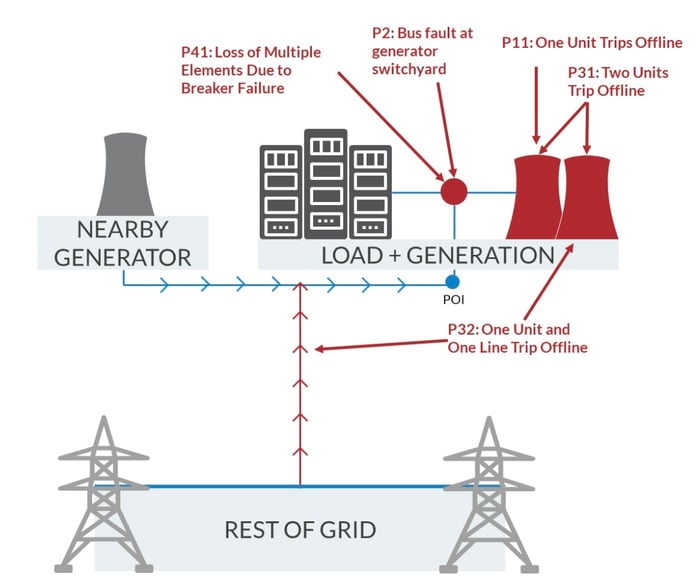
In this meeting, MISO laid out a proposal to formalize the ZGIA framework. For the most part, MISO will maintain and pull from existing MISO frameworks, but it will model the co-located generator as a “Non-Transmission Alternative” that would go through the MISO Transmission Expansion Plan (MTEP). As such, MISO would require a contractual “off-take” agreement between the load and the co-located generator, and it would perform an analysis of contingencies “that produce the most severe system impacts”. Here’s that contingency analysis in graphical form.
Halcyon angle: MISO is requesting feedback on the ZGIA proposal with a deadline of Friday, March 13, 2026. Configure this alert to track future developments – click “Copy Alert” at the bottom left. It’s set to email every Monday of relevant MISO filings, but you can adjust the day or frequency using the Edit Alert feature.
____
In New York, Central Hudson Gas & Electric submitted its Electric Emergency Plan outlining its policies and procedures for responding to extreme weather events. A quick skim shows that the utility has thought things through to the last detail–even establishing a “Meals Unit” equipped with “Crew Guides” and “Runners” to organize meals for the field crews. These are the plans for lunch:
“Lunch should be obtained from area restaurants/delicatessens. Meals are then delivered to work locations, or to a central location, e.g., district headquarters, substations, or staging area. Crew Guides or Runners can then pick up the meals at the central location where necessary.”
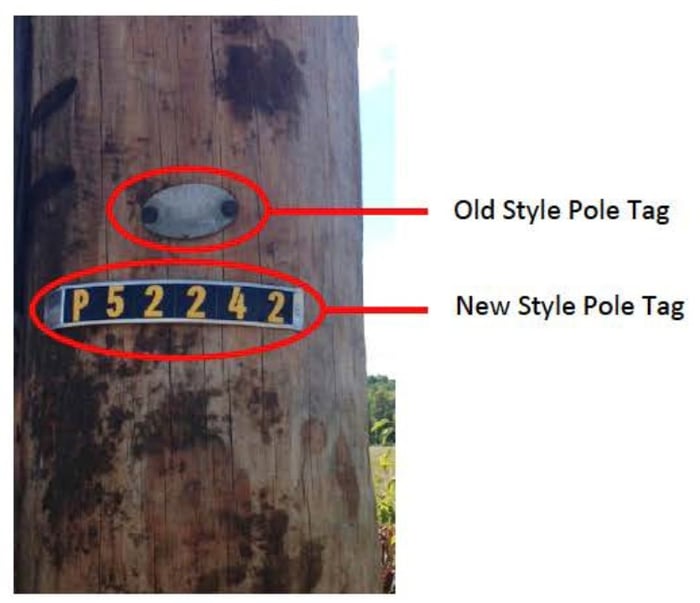
Another fascinating nugget shows that not all grid modernization efforts are high-tech. Behold, Central Hudson’s new “pole tags” – we don’t know how old the old tags are…but they’re old. (full plan – meal plans on page 31 and pole tags on page 202).
____
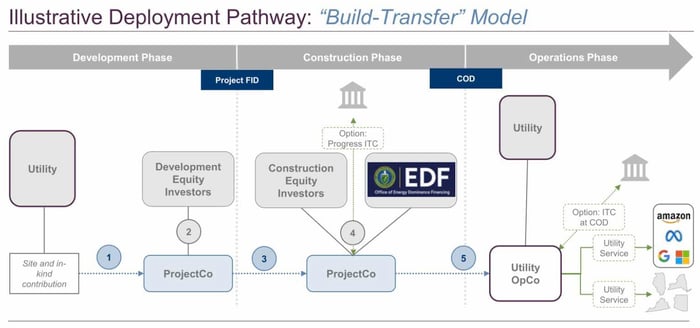
The Arizona Corporation Commission held a workshop on “Advancing Nuclear Power Generation in Arizona”. Guggenheim Partners provided an overview on new partnerships to advance “early-of-a-kind” (EOAK) nuclear projects. These partnerships allocate risk between utilities, OEMs, EPCs, institutional investors, and large loads.
According to Guggenheim, the most likely arrangement for rate-regulated utilities would be a “build-transfer” model where the utility takes ownership of the project after development and construction. . Offtakers at the end could include ratepayers or large load customers (presentation and docket profile).
____
The PJM Reliability Backstop Procurement Workshop continues to generate valuable insights, with PJM presenting background on Interconnection, Incorporating Data Center Loads in PJM’s Long Term Load Forecast, and RPM Cost Allocations. New proposals for accelerating capacity additions keep coming – this week, Google and MN8 with BYONG commentary (click here for the definition and who is in support), plus presentations from NRDC, SMECO, Stack and others. We asked Halcyon to summarize some of these new proposals.
Halcyon angle: There is never a dull moment these days when it comes to PJM resource adequacy. Stay on top of all the filings with Halcyon’s curated weekly email alerts on PJM resource adequacy generally focusing on commentary at state commissions and PJM or monitor the PJM Reliability Backstop Procurement Auction topic specifically.
____
In California, development of the 1,150 MW Prairie Song Reliability utility-scale BESS Project in Los Angeles County is progressing. The California Energy Commission (CEC) issued a Determination of Complete Application in late January, alongside information requests – notably, a request for "additional analysis of potential worst-case impacts in the event of a potential battery energy storage system (BESS) thermal runaway/fire event.” This will inform CEC Staff’s project assessment in response to the public comments raising fire risk concerns (plume analysis and docket profile).
Halcyon angle: Did you know that Halcyon generates Executive Summaries of all filings in its system? In this case, the Executive Summary makes it easy for us to quickly see the key results of the study. This is a reminder that as much as we would love our readers to become experts at search + query, sometimes you don’t need to set up a workspace or customize a new query to find what you’re looking for.
____
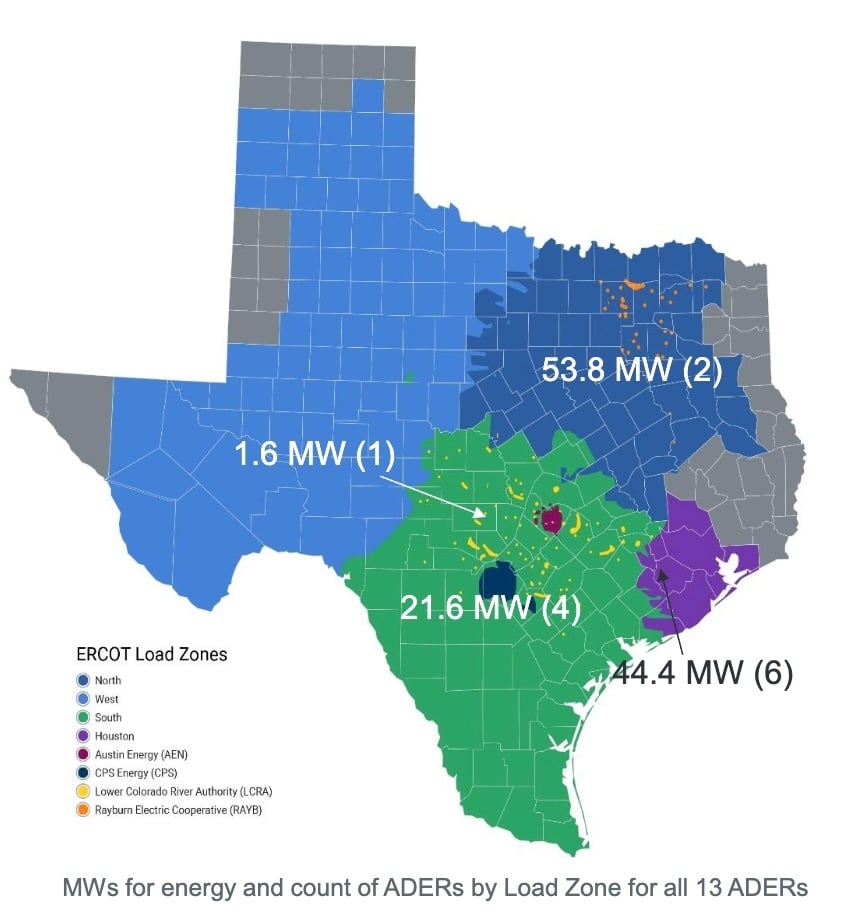
In ERCOT, stakeholders proposed modifying the Aggregated Distributed Energy Resource (ADER) pilot program by raising the capacity allowed by participants from 200 MW in energy or ancillary services (AS) to 500 MW (a 150% increase). The proposal would also increase the share that any individual Qualified Scheduling Entities (QSEs) can provide in the program from 20% to 90% (a 350% increase) of available capacity. The cap for AS remains at 100 MW.
Since the initial 80 MW limit on energy and 40 MW limit on AS from Phases 1 and 2 in 2023 and 2024, there are now 107.7 MW from participants providing energy, 35.4 MW in non-spin, and 49.9 MW in ERCOT Contingency Reserve Service (ECRS) in Phase 3 of the program. Check out the map showing the location of the qualified and potential ADERs providing energy in the program (pilot program update).
____
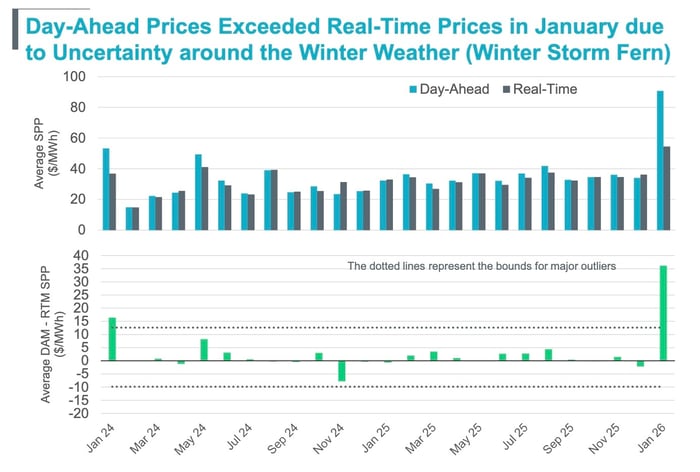
Also in ERCOT, a monthly operations report shows that uncertainty surrounding Winter Storm Fern drove the largest day-ahead market prices to real-time price spread in two years. The difference reached slightly over $35/MWh, which is roughly three times the the outlier threshold defined by ERCOT (~$12/MWh). (ERCOT January 2026 Monthly Operations Report).
____
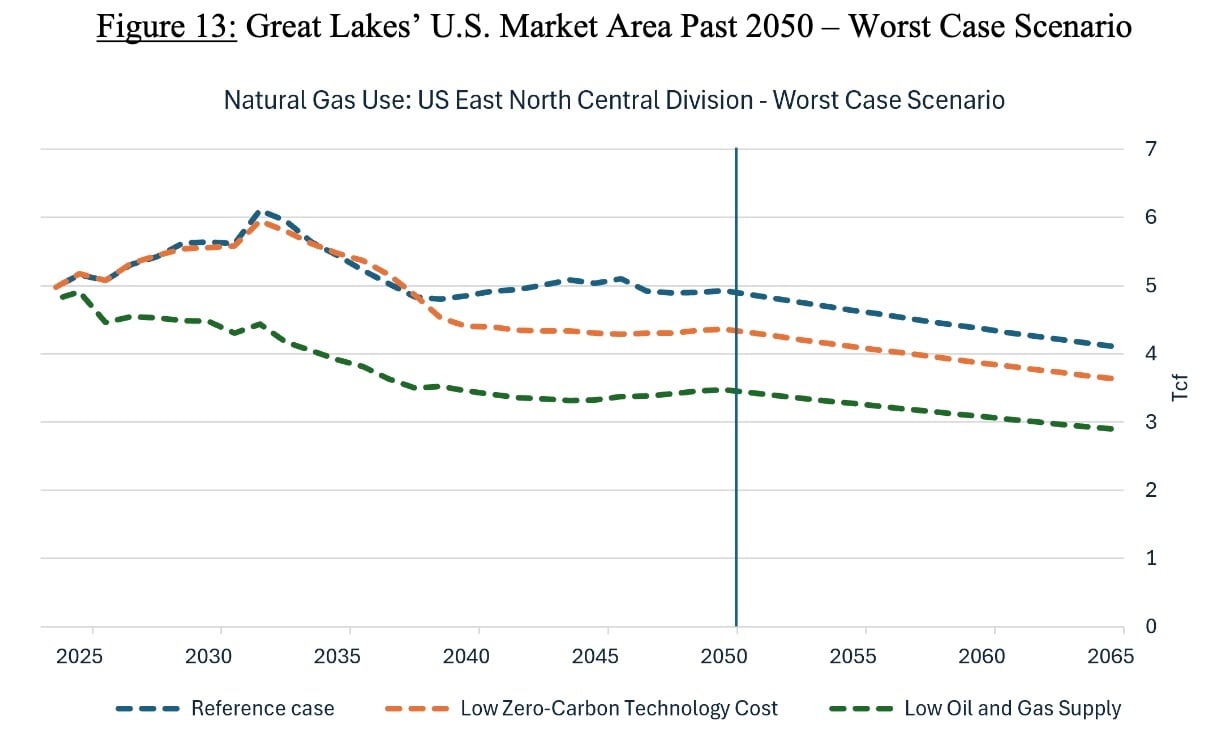
In FERC, Great Lakes Transmission filed numerous supporting documents in response to data requests from Trial Staff in its rate case. In one document, the Company justified its request to set a Remaining Useful Life for its system of 40 years by arguing that gas demand will remain robust until 2065 under both its reference and “worst case scenario”. In its US East North Central Division (Minnesota, Wisconsin, and Michigan), Great Lakes predicts gas demand would, at a minimum, be roughly 3 Tcf in the year 2065.
Halcyon angle: Some of our readers loved digging into last week’s query on Formula-Based Ratemaking, we thought we would indulge you further. Great Lakes proposed changing its rate design from a “zone-of-delivery method to a distance-sensitive zones-traversed method”. We asked Halcyon to explain the distinction, provide an example of how the change might impact a pipeline customer, and summarize any points of opposition raised by intervenors. Check out the response.
____
In North Carolina, the North Carolina Electric Membership Corporation (NCEMC) argues that Duke Energy Progress improperly allocated 100% of the $57.1 million in "proactive solar upgrade" costs to transmission customers via the load-ratio share formula, rather than to the solar generators directly. NCEMC requests the Commission declare this allocation unjust and establish a replacement rate allocating 50% of costs to generators (docket, filing).
__
In Utah, Rocky Mountain Power (RMP) is proposing a Utah Fire Fund (UFF) collected through an associated surcharge to manage costs and liability risks associated with wildfires. If you are a fan of legal debates regarding the interpretation of statutory language, this one is for you…
RMP and the Utah Large Customer Group are debating if the term “rate case” as written in Utah Code Section 54-24-301(3)(a) allows the utility to establish the UFF outside of a general rate case. We asked Halcyon to summarize the perspectives in the latest filings from February 20th (check out the Halcyon response and docket profile).
__
Halcyon Team Query of the Week
-
Picking up discussions up above on batteries and fire risk, in Massachusetts, testimony regarding the Hillman Energy Center. Checkout this query on testimony topics fire risk mitigation.
- In CAISO, the Day-Ahead Market Enhancements (DAME) Configurable Parameters Implementation Working Group session 8 presented the go-live plan with key dates and parameter tuning (also check out the interesting visualizations in the citations too).
- In Hawaii, understand Hawaiian Electric Company, Inc.’s deviations on the model Power Purchase Agreement (causes, magnitude of impact, and how to address these deviations) with Mahi Solar.
Public Comment Excerpt(s) of the Week
- In Texas, more comments are flowing in proposed routes for the Howard-Solstice 765 kV line and the Route Link 3. Last week's public comment excerpts covered opposition to Oncor's line through Dinosaur Valley State Park. This time the opposition is to the Howard-Solstice line that would traverse Medina County. In one comment, a resident expressed concerns about the impacts of the line on their ranch, which serves veterans through "outdoor recreation, hunting, fishing, sport shooting and fellowship." Amongst the therapeutic options available on the ranch is a "high-fence containment system" for exotic game. To quote:
- The high-fence system is the operational backbone of this entire property. It serves the dual critical purpose of containing exotic game species and protecting livestock from coyote predation, which is severe in this area. Transmission line easement requirements are fundamentally incompatible with this system. The proposed 200-foot right-of-way would bisect the property with 140- to 160-foot industrial lattice structures, destroying the secure containment necessary for exotic game management, eliminating the shooting range, and rendering nearly all operations impossible. Once the fence integrity is breached, no amount of accommodation, mitigation, or compensation can fully restore these operations.
New Docket of the Week
- In Idaho, Idaho Power Company (IPC) submitted its 2032 All-Source RFP to the Public Utilities Commission for approval. Check out the new docket, application, and full testimony with supporting bid documents. IPC based its RFP on the results of its 2025 IRP. It is seeking to procure 200 MW of capacity by 2031 and 2032 from two types of bids: Resource-Based Proposals and Market Purchase Proposals. IPC will also allow bids from a team of IPC staff and retained consultants for Self-Build resources, subject "to the same requirements, evaluation methodology, and other standards specified in this RFP for a bid from a third-party Bidder."
Halcyon angle: First, we asked Halcyon to explain the different requirements for a Resource-Based Proposal and a Market Purchase Proposal. We got a detailed response that described eligibility criteria, technical specifications, evaluation metrics, and delivery timelines. Then, after learning that there are three eligible agreements under the Resource-Based Proposal route, we asked Halcyon to dive into the different requirements for the three agreement types from the perspective of a solar and storage developer.