
What's Happening in Energy highlights the most interesting findings from public utility commission filings.
.png?width=50&name=34C0AE28-DE08-4066-A0A0-4EE54E5C1C9D_1_201_a%20(1).png)
What's Happening in Energy highlights the most interesting findings from public utility commission filings.
Hey there, it's Nat. Published early (early early) in anticipation of the Fourth. Happy reading.
This week’s WHiE covers:
- Two new NYDIG crypto mining-size data centers in Texas and Montana
- A new energy and water use survey for large loads to fill out in Texas,
- Capital expenditure forecasts for a major electric utility in the Midwest,
- Data center forecast assumptions underpinning the major statewide load forecast in California,
And much more.
What's Happening in Energy — July 1
Powered by Halcyon
____
RICE for BTM Data Centers // NYDIG LLC // Texas
New York Digital Infrastructure (more familiarly, NYDIG DFM LLC) filed its initial Permit by Rule (PBR) registration application air permit for the 22 megawatt “Jake Facility” in Midland. According to the report, “The purpose of the equipment is to take purchased gas from commercially available pipeline quality natural gas to use as fuel to power small data centers." That’s also summed up in this diagram from the report.
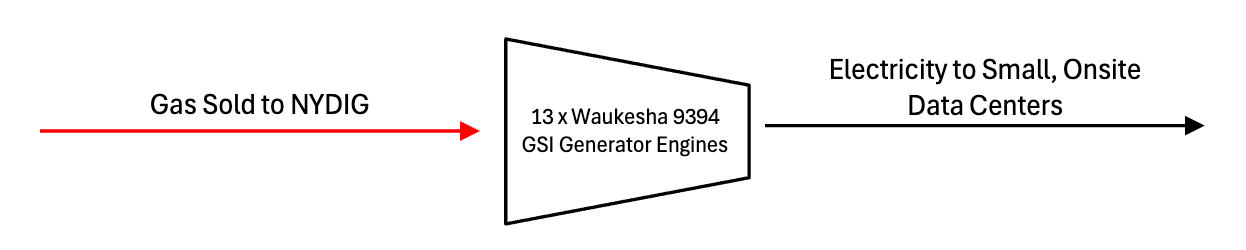
Each of the 13 Waukesha 9394GSI S5 Generator Engines has a maximum rating of roughly 1.7 MW. Also, for context, NYDIG acquired Crusoe’s “Digital Flare Mitigation” assets last year, which capture gas that would have otherwise been flared from oil and gas operations.
There's another NYDIG asset in play in Montana - see the bottom of this note.
____
Energy and Water Use Survey for Large Loads // Public Utility Commission of Texas (PUCT)
The PUCT, in collaboration with the Texas Water Development Board, initiated a proceeding to collect energy and water use data from “Data Centers and Virtual Currency Mining Facilities”. Here are a few of the data points the Commission is seeking to collect in the survey:
- Question 3: Facility State Regional Water Planning Area
- Question 21: Provide the facility' s 2025 actual water intake in gallons.
- Question 22: What percentage of the total water volume provided in question 21 is specifically used for behind-the-meter power generation? (metered or estimated)
- Question 23: What percentage of the total water volume provided under question 21 is directly attributable to IT operations (cooling equipment, blowdown, and other process water supporting IT operations) at the facility? (metered or estimated)
____
ZGIA // FERC Order to Show Cause // MISO
A presentation before MISO’s Large Load Working Group confirms that the system operator may lean on its ZGIA framework in response to the FERC’s Order to Show Cause. Part of the FERC’s Order requires the ISO/RTOs to justify or modify their frameworks to expedite interconnection for generators that are “electrically proximate” to large loads. MISO believes that ZGIA checks those boxes.
“While we are still evaluating the order, the working hypothesis is that we will propose the ZGIA as developed in response to the 206 Order”
____
Utility Capex // Evergy // Kansas
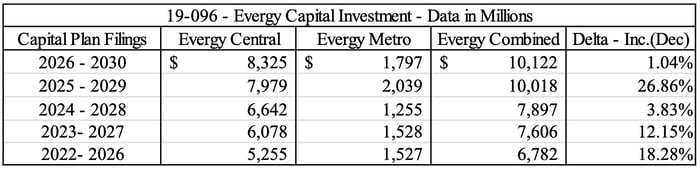
The Kansas Corporation Commission Staff says that Evergy’s capex plan is compliant with the state’s reporting framework. The following statement says it in one shot:
“In total, Evergy’s capital investments over the five-year planning period increased by $3.3 billion or 49.2% from $6.78 billion in its 2022 Capital Plan to $10.1 billion in its 2026 Capital Plan.”
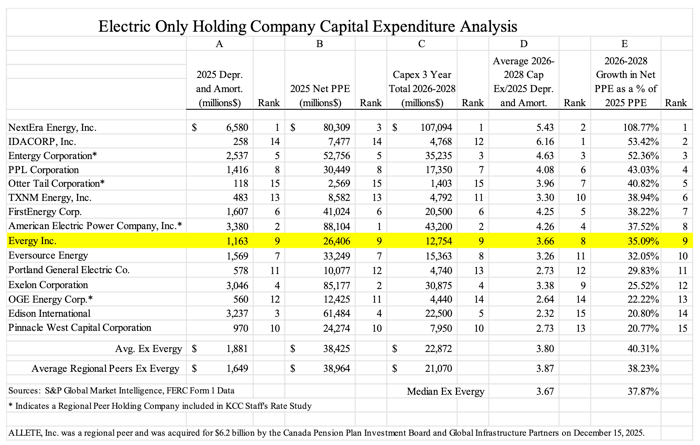
Staff performed an analysis of peer holding companies to benchmark Evergy. From 2026-2028, Evergy Inc. will grow its “Net PPE” (Net Property, Plant, and Equipment) by 35.09% relative to its 2025 Net PPE. That’s still only the 9th highest among peers.
____
ROE // South Coast Gas Company // Louisiana
The South Coast Gas Company (SCGC) in Louisiana filed for an extension of its Rate Stabilization Plan. This plan allows the utility to adjust its rates to recover a return on equity (ROE) of 10%. If earned ROE falls below 9.5%, it can increase its rates, and if earned ROE rises above 10.5%, it must decrease its rates. Staff testimony included a table of the historical earned ROEs and the associated rate adjustments. Earned ROE fluctuated from -13.441% in 2024 to 35.614% in 2025.
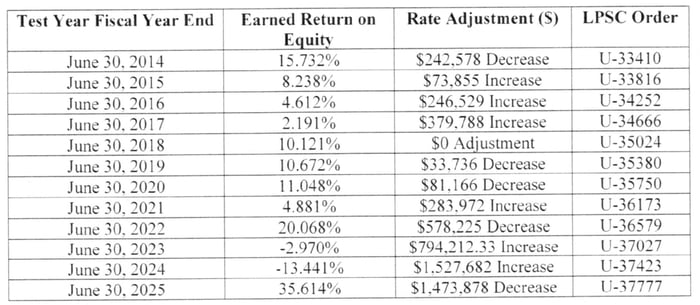
Testimony also included this interesting nugget on a behind-the-meter gas generator boom in the area:
“Additionally. Staff has learned that SC GC has had a significant boom in the number of its residential customers that have sought out and have installed a whole home generator. Conversations have indicated that approximately 30% of the residential customers SCGC serves have a whole home generator installed. This has caused an additional capacity concern for SCGC because its existing infrastructure is unable to support the use of these generators because when they kick on they deplete the system of all of its existing gas supply and the lines are too small to allow them to regenerate the capacity needed for them to run.”
____
Data Center Forecast Assumptions // California Energy Commission IEPR
The California Energy Commission laid out the assumptions behind the data center forecast they used in their 2025 Integrated Energy Policy Report (IEPR). They classified data centers into 3 groups–Group 1 to Group 3–from less speculative to more speculative. The chart below shows the percentage of data centers included for each group into the two main forecasts: the planning forecast and local reliability scenario. Read Halcyon’s explanation of the difference between the two scenarios.
-Jun-30-2026-09-56-11-8304-PM.png?width=1726&height=794&name=unnamed%20(1)-Jun-30-2026-09-56-11-8304-PM.png)
____
Interconnection Costs // Large Demand Customers // ComEd
ComEd responded to a request from the Illinois Commerce Commission for data on the utility’s cluster studies of Large Demand Project Applicants and Customers (LDPACs). Here are the details for Cluster 1:
- A total of 9,195 MW was included in the Cluster Study. As of June 2026, the capacity of Cluster 1 customers moving forward to energization is 5,776 MW.
- ComEd received $12.5 million in deposits for application and initial engineering, plus $33.2 million for long-lead materials.
- To date, ComEd has returned $2 million in deposits to Cluster 1 customers.
- The TSAs in Cluster 1 total $1,752.5 million.
The earliest in-service date is 2028. Click here to read the full list for all 4 clusters.
____
New Dockets of the Week
-
The Alabama Public Service Commission opened a docket with an intriguing title. We’ll be tracking this one: “ESTABLISHING A GENERIC PROCEEDING TO ESTABLISH A PROCESS FOR CONSIDERATION OF CONTRACTS FOR ELECTRIC SERVICE BETWEEN ALABAMA POWER AND LARGE LOAD DATA CENTER CUSTOMERS”
Public Comment Excerpt(s) of the Week
-
In Montana, an environmental assessment of NYDIG DFM LLC’s proposed facility of “small data centers” in Richland County included multiple public comments. This facility would host 8 gas engines totaling 14.9 MW. One commenter expressed concerns about the ambiguity with the word “small”.
“What is a “small data center”? What does it do? What does it look like? What is the definition of 'small'? How do we comment on something that the document fails to clearly identify? Why isn’t there at least a photo to show the public what they look like? All information that DEQ used to assess the impacts should be attached to the assessment. The use of ambiguous and relative terms is used constantly throughout the document. Words like small, minor, and insignificant. For an impact assessment, these words are useless unless there is a definition attached. What is considered insignificant to someone at a desk in Helena may be very significant to someone living 400 ft from the site.”
Most clicked item from last week’s WHiE