
What's Happening in Energy highlights the most interesting findings from public utility commission filings.
.png?width=50&name=34C0AE28-DE08-4066-A0A0-4EE54E5C1C9D_1_201_a%20(1).png)
What's Happening in Energy highlights the most interesting findings from public utility commission filings.
Hey there, it's Nat.
This week:
- Planning reserve margins and debates over how to meet them in SPP,
- Testimony and historical exhibits comparing today’s large load challenges with CWIP and nuclear cost overruns from the 1980s in the Midwest,
- Comments from the soda ash industry on non-public utility generators in the Mountain West,
- And much more.
Let’s get into it.
What's Happening in Energy — July 17
Powered by Halcyon
____
Informational Report on Resource Adequacy // FERC Show Cause // ISO-NE
ISO New England filed a draft informational report outlining two main proposals it plans to put forward in response to the FERC Show Cause Order:
-
Bring Your Own New Generation: “As part of its compliance with the June 18 Order, ISO-NE intends to pursue rules similar to the Southwest Power Pool’s conditional high impact large load service (“CHILLS”) rules, which would allow transmission customers serving large loads to receive energy until sufficient designated resources and network upgrades are in place, subject to flexibility requirements and/or curtailment and interruption.”
-
Excluding Large Loads from the Installed Capacity Requirement in the Capacity Market: “Subject to discussion and review with stakeholders, ISO-NE anticipates including a statement in its filing to comply with the June 18 Order that will put Eligible Customers on notice that the capacity market will exclude new large loads.”
Read the full report here, and follow the FERC 206 Investigation docket for ISO-NE.
____
Settlement Agreement // Rate Case // PacifiCorp
PacifiCorp Utah subsidiary Rocky Mountain Power (RMP) filed a settlement agreement for its rate case. The proposed revenue requirement increase is $93 million. That’s composed of $34 million from “capital structure - equity,” $15.4 million from ROE, $34 million from liability insurance, and $9.6 million from wildland fire mitigation. The agreement states that RMP plans to invest $2 billion in Utah infrastructure through the end of 2028. However, “RMP’s Investment does not include and will not be offset by any investment to service a large load customer…” Dig into the full agreement here.
____
Planning Reserve Margin Requirements // Implementation // SPP
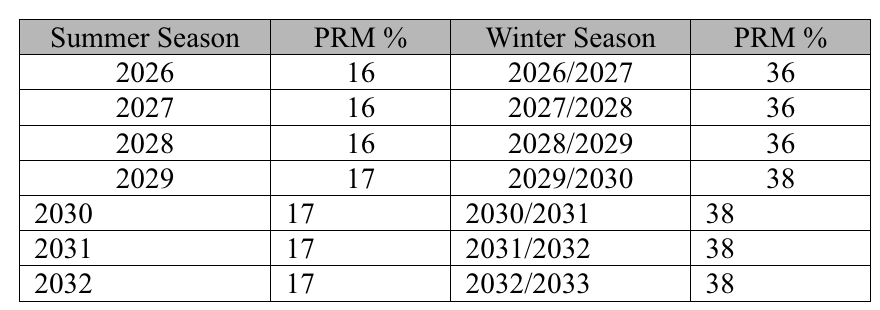
SPP’s Board already approved the updated Planning Reserve Margin (PRM) requirements for 2030 and 2032. Now they are actually implementing them by updating their planning guide through RR784. The PRM for the winter season in 2032/2033 is 38%!
____
Battery PPAs // Procedural Street Fights // Southwestern Power Service
Speaking of SPP’s Planning Reserve Margin (PRM), Xcel subsidiary Southwestern Public Service (SPS) wants to sign six PPAs for 570 MW worth of battery energy storage — spread across its service territory in Southeast New Mexico, the Texas Panhandle, and a sliver of Oklahoma — to meet that PRM.
-Jul-16-2026-07-49-36-2020-PM.png?width=692&height=355&name=unnamed%20(1)-Jul-16-2026-07-49-36-2020-PM.png)
The docket, which was filed at the Public Utility Commission of Texas (PUCT) back in December 2025, has become a street fight. This week, multiple stakeholders, including Texas Industrial Energy Customers (TIEC), the Alliance of Xcel Municipalities (AXM), and the Texas Office of Public Utility Counsel (OPUC), responded to requests for information from SPS. TIEC asked why SPS couldn’t have scoped a gas turbine instead, and suggested a “hold-harmless” clause that insulates customers against a negative cost-benefit. AXM also suggested a gas turbine, but argued that data center growth forecasts are overblown. Meanwhile, the OPUC noted that SPS’s load forecasts don’t account for self-supplied power, and suggested a >50MW large load tariff that incentivizes loads to bring their own power.
____
Stipulation for New Gas Capacity // Southwestern Electric Power Company
Parties filed a settlement agreement in a proceeding covering Southwestern Electric Power Company’s (SWEPCO) application for a Certificate of Convenience and Necessity (CCN) to build a new 450 simple cycle gas plant called the Hallsville Project, and a coal-to-gas conversion of the existing Welsh Unit 1 (525 MW) and Unit 3 (528 MW) coal plants. The estimated total cost of the projects is $723 million. If approved, the settlement agreement contains a provision that would require SWEPCO to pay the Commission for the costs of hiring a third-party to conduct a prudence review of the Hallsville project if the actual costs exceed the estimate by more than 10%. Dig into the settlement here.
____
Historical Exhibits // Nuclear Plant Disallowances in the 1980s // Missouri
Geoff Marke from the Office of Public Counsel in Missouri, while testifying on utilities incurring potentially stranded costs to serve data centers, put a 2025 state law allowing Construction Works in Progress (CWIP) accounting for gas plants in its historical context. CWIP, which allows utilities to recover their cost of capital before a project is placed into service, was originally banned in Missouri during the era of nuclear cost overruns in the 1970s and 1980s. Marke’s testimony cited the Public Service Commission’s disallowance of Union Electric’s (today called Ameren Missouri) expenditures for the Callaway nuclear plant in its 1985 rate case. The company had requested a $639,000,000 increase, and only got $149,449,000 of that in the first year because the Commission excluded $384 million from its rate base. Check out the historical exhibit here.
-Jul-16-2026-07-52-25-5128-PM.png?width=1782&height=450&name=unnamed%20(2)-Jul-16-2026-07-52-25-5128-PM.png)
Marke’s main concern is that customers may bear the risks of capital expenditures to serve data centers if large load tariffs do not directly allocate costs to large load customers:
“I oppose approving CWIP unless customers taking service under the LLPS tariff explicitly agree that they will bear all associated costs. Making existing captive Missouri ratepayers foot the bill for an overpriced, unneeded (but for the data centers) natural gas plant contradicts state utility law, the President’s stated intent, and the hyperscale customers' own pledges. To the extent the Commission approves CWIP, I recommend the Commission order Evergy Metro to allocate all CWIP-related costs to the LLPS tariff customers as the appropriate cost-causers.”
____
Expedited Market Design Enhancements // Stakeholder Voting Results // SPP
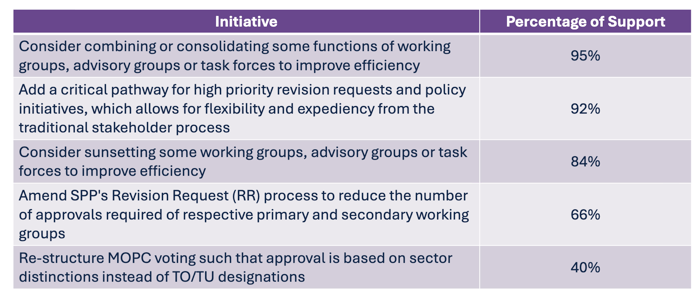
Also in SPP, it isn’t just interconnection queues that ISO/RTOs want to expedite. In a survey, a majority of SPP stakeholders indicated that they would support initiatives to accelerate “high priority” revision requests through a critical pathway. The voting bloc included 22 stakeholders: 12 members of the Corporate Governance Committee (CGC), eight (8) working group chairs, and two (2) members of the Markets and Operations Committee (MOPC).
____
New Dockets of the Week
-
Clover Leaf Development filed a petition for the approval of Phase II of a microgrid it is developing to serve tenants in 128 units (full docket). The microgrid would consist of 625 kW of PV and 350 kW of BESS. All tenants will receive electrified space heating and cooling through air-source heat pumps. And Clover Leaf will roll the costs of this electricity into its leases.
“The Company also respectfully requests a ruling from the Commission that it is not, and need not register, as a competitive electricity service provider (“CEP”) because it is not selling, or reselling electricity. Rather, Clover Leaf is offering its lease arrangements under which electricity included as a lease term.”
Public Comment Excerpt(s) of the Week
-
The trona (i.e. soda ash) industry in Wyoming weighed in on the Commission’s proposal to designate certain suppliers as “non-public utility” generators. The industry supports this proposal: “While statute provides for self-generation and trona companies utilize it at varying levels for their operations, trona companies are experts in the business of making soda ash. They are not experts in electric generation, nor do they want to be and prefer to hire out that expertise. Rising electricity costs, lack of available capacity and declining reliability have left the trona industry with no choice but to advocate for non-public utility generation to safeguard their operations.”
The industry also noted that most of the future investment from Rocky Mountain Power is in Utah (see item on RMP’s settlement agreement above).
“Areas of Wyoming are already less competitive than neighboring states due to capacity constraints. The recent Utah settlement agreement will likely exacerbate this challenge, as Rocky Mountain Power has agreed to invest $2 billion in Utah-specific infrastructure upgrades, which means less investment elsewhere in their system. Only one utility in Wyoming has responded to market demand by viewing non-utility generation as a partnership opportunity rather than a threat. Unfortunately for the trona industry, that utility does not serve them.”
Most clicked item from last week’s WHiE