
.png?width=50&name=34C0AE28-DE08-4066-A0A0-4EE54E5C1C9D_1_201_a%20(1).png)
What's Happening in Energy highlights the most interesting findings from public utility commission filings.
This week:
- Official complaints filed against a utility and an RTO in the Mid-Atlantic and at FERC,
- Data center requests in...Maine?,
- New Cost of New Entry (CONE) values for gas plants in ERCOT,
We also launched a new podcast, Nameplate, where I interview utility CEOs. I’d very much appreciate it if you gave it a listen.
Subscribe to get these insights delivered straight to your inbox:
What's Happening in Energy — Oct 9
Powered by Halcyon
____
Complaint Against PPL // Office of Consumer Advocate // Pennsylvania
The Pennsylvania Office of Consumer Advocate (OCA) filed a complaint against PPL Electric, alleging that its Rate LP-6 does not adequately protect customers from the costs and reliability risks of interconnecting large loads. It’s 425 pages long, but worth a read — or at least a skim using Halcyon. One table that caught our eye came from an OCA witness who compiled all of the “customer service” supplemental projects utilities have submitted to PJM since 2024. According to the witness, these projects offer the earliest view into data center load because data centers are one of the few customer types that would request service at the transmission level.
Here’s the table for projects submitted so far in 2026.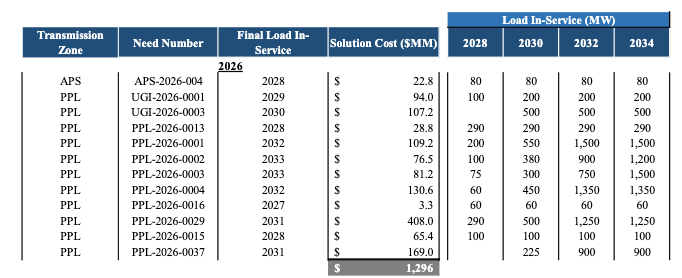 ____
____
Proactive Planning // ConEdison // NewYork
Investor-owned utilities in New York submitted project proposals under a proactive planning methodology designed to identify upgrades needed to support electrification and state climate policy goals. Stateside, Cycle 1 projects totaled $638 million. In NYC, ConEd proposed a mix of secondary system upgrades, transformer upsizes, and hiring to meet winter load growth across six "Accelerated Electrification Zones (AEZs)” in its distribution network. These projects would total $90 million over 2027 and 2028, ahead of the utility’s next rate case.
-Oct-08-2026-04-39-52-4223-PM.png?width=843&height=417&name=unnamed%20(1)-Oct-08-2026-04-39-52-4223-PM.png)
____
Proposed Denial of a Request to Terminate EE Portfolio // SDG&E // CPUC
An Administrative Law Judge (ALJ) recommended that the California Public Utilities Commission deny San Diego Gas & Electric’s (SDG&E) request to terminate its regional energy efficiency portfolio. SDG&E argued that its programs were no longer cost-effective, but the ALJ countered that cutting opportunities to improve energy efficiency would be unwise at a time when energy affordability is top of mind. Read Halcyon’s summary of the Commission’s responses to the terms of the Settlement Agreement between SDG&E and Cal Advocates.
____
Preliminary Recommended Transmission Projects // SPP // Consolidated Planning
While preliminary, SPP’s draft 2026 Integrated Transmission Planning (ITP) & Consolidated Planning Process (CPP) report offers a valuable look at where the RTO plans to recommend projects in the 10-year horizon through Notifications to Construct (NTCs). Many of these projects are new 765 kV builds connecting the central and southern portions of the network.
-Oct-08-2026-04-40-27-7663-PM.png?width=1078&height=606&name=unnamed%20(2)-Oct-08-2026-04-40-27-7663-PM.png)
SPP’s new Consolidated Planning Process brings together generation and transmission planning, and prioritizes projects that satisfy multiple modeling assumptions. This draft report excerpt highlights the benefits of this approach:
"Early, draft analysis shows that roughly two-thirds of this year' NTC-recommended projects address two or more distinct categories of need at once, spanning combinations of reliability, economic, generation expansion, transfer capability, and stability drivers. SPP built its recommendation process to find and prioritize exactly these projects, because a solution that pays off under several different futures is a better use of customer dollars than one that only pays off under a single assumption that may or may not hold.”
____
Data Centers in Maine? // Unitil
Data centers…in Maine! Gas utility Unitil responded to questions from the Maine Public Utilities Commission about how it would serve large data center customers. The utility noted that developers have inquired about building data centers in three communities: Sanford, Scarborough, and Lewiston. However, none of these have progressed beyond the preliminary stage. Lewiston rejected its project, and the other two communities have imposed data center moratoriums. Even if development progressed, Unitil noted that it may be difficult to provide year-round supply, and it would expect customers to secure their own supply.
____
Centralia Coal on Standby // TransAlta // DOE // FERC
FERC rejected TransAlta’s proposed method for recovering the costs of keeping Centralia — its aging 730-megawatt coal plant in Washington — temporarily online under the DOE’s Section 202(c) orders. (The orders keep coal plants available because of resource adequacy concerns.) The Commission argued that TransAlta should allocate costs to load-serving entities in the WECC Northwest assessment area instead of its current proposal to allocate costs more broadly. According to FERC, WECC Northwest better aligns with the resource adequacy concerns in NERC’s 2025–2026 Winter Reliability Assessment cited in the DOE’s orders.
____
The Next Phase for Aggregated DERs in ERCOT // ADER Phase 4
ERCOT’s Wholesale Market Subcommittee is considering governing document changes to advance the next phase of the Aggregated Distributed Energy Resources (ADER) pilot. Phase 4 would allow aggregated batteries on the distribution grid to be dispatched at the nodal rather than the zonal level.
ERCOT calls this new resource an “Aggregated Distributed Energy Storage Resource” or ADESR. The change will give ERCOT more visibility into the state-of-charge and injection/withdrawal capability of aggregated battery resources, allowing them to relieve local transmission congestion. ADESRs would not be eligible to provide ancillary services, but they can supply energy up to the pilot’s 500 MW cap (293 MW of ADERs are currently subscribed to provide energy).
The governing document changes will be posted to the Demand Side Working Group page on October 12th, then move through Wholesale Market Subcommittee endorsement on November 4th, Technical Advisory Committee endorsement on November 17th, and a Board vote on December 7th.
Halcyon angle: Halcyon now has ERCOT stakeholder groups organized in the platform. Click into one of the links above and set an alert on a specific group at your preferred cadence so you never miss a meeting material.
____
A Large Load Tariff for the “First State” // Delaware
The Delaware Public Service Commission proposed regulations to implement House Bill 233, which passed over the summer. HB 233 requires utilities to file large load tariffs and Electric Service Agreements (ESAs) that ensure full incremental cost recovery from large loads. Under the Commission’s proposed regulations, ESA must cover at least 15 years including a load ramp period, and set a minimum billing demand of 90%.
“Large energy users” have a somewhat complex definition with multiple load thresholds: A monthly maximum demand of 75 MW or greater with an 85% load factor, a monthly maximum instantaneous demand of 100 MW or greater, or a monthly maximum demand of 30 MW or greater with NAICS code 518210 (i.e. data centers). The proposal also requires utilities to file load shed protocols so that large loads curtail before emergency conditions arise.
____
131-MW Combustion Turbine // NorthWestern Energy // South Dakota
NorthWestern Energy applied for an Energy Conversion Facility Permit to construct a 131-megawatt simple-cycle gas plant (Aberdeen 3) near Aberdeen, South Dakota. The plant would join the existing Aberdeen Generating Station to create the “Hub City Energy Park.” Most noteworthy: NorthWestern is pushing the project forward despite a weakening case for need.
The resource deficiency NorthWestern initially identified to justify the project has shrunk significantly because of evolving resource accreditation methodologies. The utility’s explanation: “Given the time required to develop, permit, procure, interconnect, and construct generation, NorthWestern advanced the Project based on the planning information available at that time.” Here’s a table of NorthWestern’s summer and winter capacity position since 2024.
-Oct-08-2026-04-41-22-7497-PM.png?width=788&height=214&name=unnamed%20(3)-Oct-08-2026-04-41-22-7497-PM.png)
____
2026 CONE Estimate // Brattle // Sargent & Lundy // ERCOT
Brattle and Sargent & Lundy presented the results of their Cost of New Entry (CONE) study for ERCOT to the Supply Adequacy Working Group. The overnight capital cost for a 444-MW combustion turbine in Harris County came in at $1,853/kW, roughly double the 2024 estimate. Adding capital carrying costs during construction, O&M, and a “capital charging rate” (the portion of total costs an investor would seek to recover in the first year), the final “Level-real CONE” for 2026 comes out to $290/kW-year.
This value assumes revenues increase at the rate of inflation. The chart below compares it to the value that investors would require if revenues stayed flat over the life of the asset, and to the “reservation price”: the value investors require if they assume current high prices will return to a long-run equilibrium after five years. -Oct-08-2026-04-42-08-7427-PM.png?width=704&height=609&name=unnamed%20(4)-Oct-08-2026-04-42-08-7427-PM.png)
____
New Docket of the Week
-
Complaint Against PJM // Winter Storm Fern Postmortem // Mon Power // FERC
Here’s your regular reminder, courtesy of WHiE, that Winter Storm Fern was one of the most expensive power market events in US history. FirstEnergy’s West Virginia subsidiary Monongahela Power Company (Mon Power) filed a complaint at FERC alleging that PJM unjustly pre-scheduled gas-fired resources ahead of Winter Storm Fern, putting ratepayers in its retail service territory on the hook for $145 million.
Mon Power argues that PJM could have dispatched the utility’s coal resources further above their minimum output levels, relieving downstream congestion near its load zone caused by running more expensive gas-fired resources. It also contends that PJM did not need to schedule the gas plants in advance because they were already contractually obligated to perform through the capacity market. Mon Power is requesting expedited treatment to compel discovery of materials from PJM like unit-level market simulation and settlement data to support its complaint. Track the docket here.
Excerpt(s) of the Week
- Reliability Must be Just and Reasonable // Mon Power // PJM // FERC
Here’s an excerpt from the Mon Power complaint against PJM. We thought it offered an interesting take on balancing reliability and costs — the core tension underlying most debates in the world of utility commissions.
“PJM’s response to Winter Storm Fern should not be immune from scrutiny merely because PJM invokes “reliability” to justify it. While PJM may be entitled to exercise discretion leading up to and during an emergency, that discretion must remain within the filed tariff and must be exercised in a just, reasonable, non-discriminatory manner that is consistent with cost-causation principles. The existing record provides strong reason to question whether PJM exceeded or misapplied its narrow tariff authority, discriminated against non-gas resources such as coal, and produced unjust, unreasonable, unduly discriminatory, or preferential outcomes that are inconsistent with cost-causation principles.”
Most clicked from last week’s WHiE