
.png?width=50&name=34C0AE28-DE08-4066-A0A0-4EE54E5C1C9D_1_201_a%20(1).png)
Regular readers know that Halcyon does not shy away from the energy sector alphabet soup. We’ve got another one for you: FERC’s proposed ANOPR in docket RM26-4-000, Interconnection of Large Loads to the Interstate Transmission System. For those not so deeply in the soup: that’s the Federal Energy Regulatory Commission’s proposed Advance Notice of Proposed Rulemaking, meant to speed up and otherwise ease the interconnection of significant new sources of electricity demand in the US grid - mostly, but not exclusively, data centers. At the moment, 175 unique organizations have filed notices or comments in the docket. More will be coming, as reply comments will be filed through December 5. Parsing the comments already received is an unstructured data problem of the sort that Halcyon regularly tackles for customers. We have identified six core topic areas across proceedings and analyzed each commenter’s position on each topic. Here is a preview of two areas. The first concerns the 20...

To help address an “unprecedented” surge in power demand from AI, data centers, and industrial electrification, in October 2025, the Federal Energy Regulatory Commission (FERC) opened Docket RM26-4-000 regarding the interconnection of large loads to the interstate transmission system. (Halcyon covered the Advanced Notice of Proposed Rulemaking (ANOPR) for this proceeding in December.)
The Department of Energy (DOE) gave FERC a deadline of April 30, 2026, to issue a final rule on large-load interconnection. We’ll get into the details of this proceeding’s objectives below, but the big news: FERC punted on this deadline. On April 16, the Commission issued what it called an “Order Regarding Intent to Act,” announcing it would take action by the end of June instead.
To be clear: this is probably the right call. A rule that affects trillions of dollars of infrastructure investment, has never been previously federally regulated, and has been hotly contested by nearly every major stakeholder group should take longer than six months. FERC saying it needs until June to get it right illustrates the breadth of complexity and the depth of what’s at stake.
What FERC’s June Order Will — and Won’t — Do
As we wrote in December, FERC Docket RM26-4-000 is meant to “speed up and otherwise ease the interconnection of significant new sources of electricity demand in the US grid - mostly, but not exclusively, data centers.”
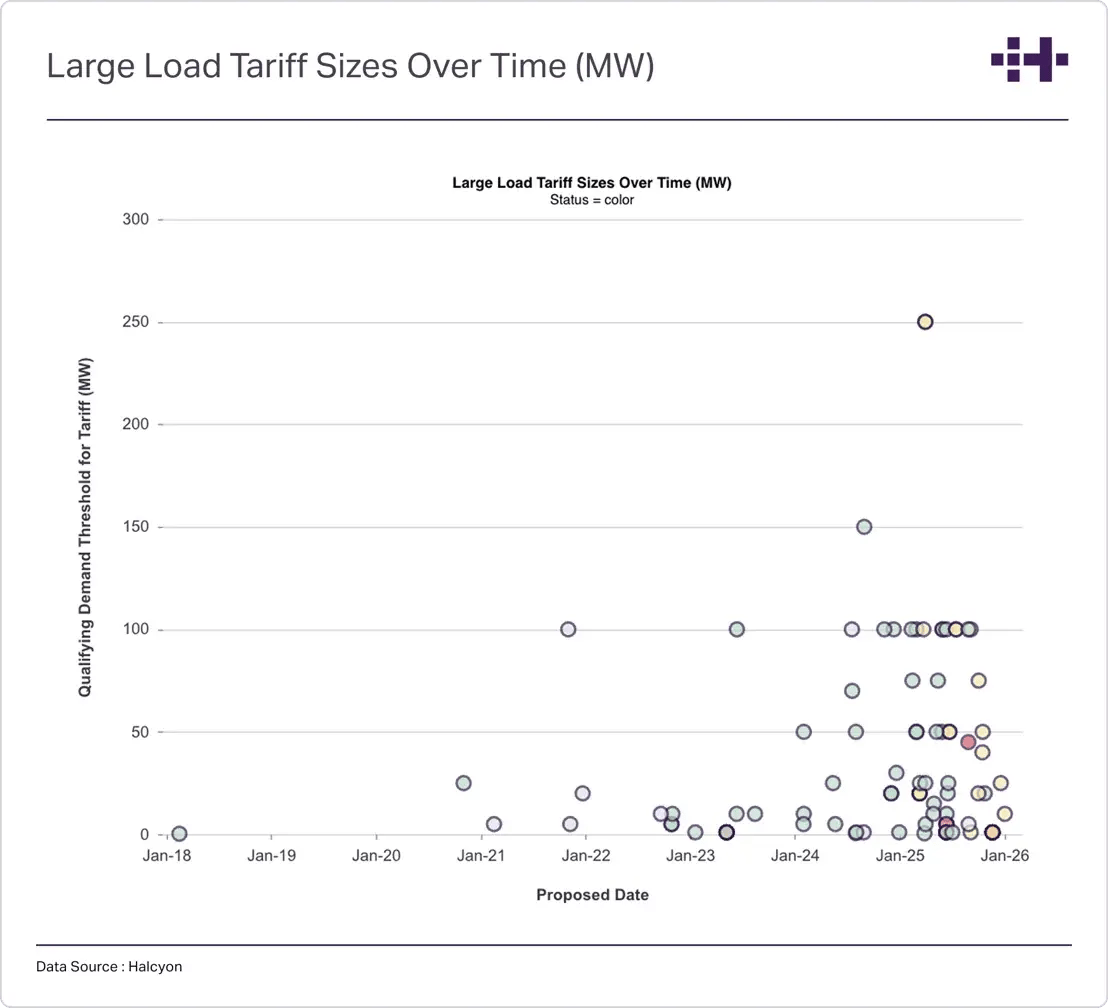
FERC’s June action will almost certainly assert federal jurisdiction over the direct interconnection of large loads to the interstate transmission system. It will define what a “large load” is by establishing a minimum size threshold, resolving a legal question that has confounded utility planning since at least 2024.
It will also establish standardized procedures analogous to the Large Generator Interconnection Procedures that govern generator interconnection today: study deposits, readiness requirements, and withdrawal penalties. The December 2025 PJM co-location order gives you a preview of the direction — FERC found PJM’s tariff “unjust and unreasonable” for failing to address co-located load arrangements and ordered four new transmission service options. Expect similar frameworks to propagate nationally.
Cost allocation is one of the most contested questions. The DOE proposed that large loads pay the full cost of network upgrades, with possible crediting over time, which Google and OpenAI broadly accepted. Most utilities and state commissions pushed back hard. NARUC filed formal comments warning that federalizing the queue “interferes with state authority to protect residential ratepayers from the cost of the AI race.” This sentence tells us where the fault lines are.
What FERC cannot do, and what its June order will explicitly not attempt, is resolve the state-level questions: distribution-level interconnection; retail tariff structures; cost allocation below the transmission threshold. These answers live at the state PUC jurisdiction level, and they are where the actual project-level risk lives for the vast majority of data center developments.
What Halcyon Is Seeing in State Filings Right Now
This is where it gets interesting, and where the filing record tells a more nuanced story than the federal headlines suggest.
-
Missouri — Ameren’s rate case filings document a shift from zero expected data center load in 2023 to 2.27 gigawatts of committed large-load projects today, a swing that has completely reoriented its capacity planning. The revised Preferred Resource Plan targets up to 2 GW of new demand by 2032. The large-load tariff proceeding is where the cost allocation fight actually happened — approved unanimously by the PSC on November 24, 2025 under Missouri SB 4.
Missouri PSC Docket No. ET-2025-0184 (large-load tariff) | Docket No. ER-2026-0088 (IRP) -
Pennsylvania — PPL disclosed in Q2 2025 investor materials that active data center requests in advanced stages had grown to 14 GW, with a 60 GW total interconnection queue and load that could grow from 800 MW in 2026 to 14.4 GW by 2034. The PA PUC’s en banc hearing in April 2025 and its Tentative Order on a model large-load tariff issued November 6 is one of the most sophisticated state-level proceedings in the country right now —worth tracking regardless of where your projects are.
PA PUC Docket No. M-2025-3054271 (en banc / model tariff) | Tentative Order Nov. 6, 2025 -
Nevada — Callisto Enterprises LLC — Google’s data center vehicle — is seeking an energy supply agreement with NV Energy backed by Fervo Energy’s Corsac geothermal project. The twist buried in the filing: the utility is revising its pricing model, but its details will remain confidential for at least five years. That opacity is itself a signal. Sophisticated hyperscalers are negotiating bespoke energy arrangements that the public record will not illuminate.
Nevada PUC Docket No. 24-05022 (Callisto/NV Energy energy supply agreement) -
Georgia — The IRP proceeding surfaces something that should give investors pause: Georgia Power sought certification for 9,885 MW of new generation; PSC staff argued the need was much less. The PSC ultimately approved a range of 6,000–8,500 MW minimum/maximum, then authorized the full 9,885 MW via stipulation in December 2025 — contingent on Georgia Power backstopping stranded cost risk. The gap between utility projections and the settlement floor isn’t a rounding error. It’s a cost allocation dispute that will resurface at the next rate case in 2028.
Georgia PSC Docket No. 56002 (2025 IRP, approved Jul. 15, 2025) | Docket Nos. 56298 & 56310 (capacity certification, Final Order Dec. 19, 2025) | Docket No. 44280 (large-load cost allocation rules) -
Kentucky — East Kentucky Power Cooperative proposed a dedicated Rate DCP — Data Center Power tariff for loads 15 MW and above (with a 60% load factor requirement). The most consequential clause: loads exceeding 250 MW must submit a dedicated power supply plan with their own generation resources. That’s a statement about co-location necessity, not just tariff design, and it was approved by the Kentucky PSC on October 30, 2025, before FERC’s federal framework existed. Every special contract with a data center requires PSC approval.
Kentucky PSC Case No. 2025-00140 | PSC Order Oct. 30, 2025
The Five Questions FERC’s June Order Leaves to the States
If you’re a data center developer, an infrastructure investor, or a utility trying to figure out what the next 90 days require of you, here’s what the June order won’t answer:
- Who pays for distribution upgrades? Most data centers connect at the distribution level, not directly to transmission. Distribution upgrade cost allocation is entirely a state PUC call.
- Does your state’s large-load tariff protect the utility from stranded cost risk if your project doesn’t perform? Minimum bill requirements, exit fees, and minimum load factors vary dramatically by state and are being set right now in active proceedings.
- How long will utility interconnection studies actually take? The federal framework streamlines transmission studies. Utility distribution studies, often the real bottleneck, are governed by state rules.
- Will your state commission approve cost recovery for grid upgrades in the utility’s next rate case? A commission hostile to data center cost allocation can stop future recovery and redesign rates so that data centers pay more. That risk is visible in the filing record if you know where to look.
- How does your state treat co-location under retail tariff rules? The FERC PJM order addressed wholesale co-location. State commissions have been asserting independent authority over the retail dimension — and they’re not waiting for June.
What to Do Between Now and June
Don’t wait for the federal rule to begin state-level engagement. The distribution interconnection process and large-load tariff proceedings at your relevant state PUC are on their own timeline — and in many states, they’re further along than the federal process.
Use Halcyon’s Large Load Tariff Tracker to see where your target states stand on tariff design, cost allocation, and minimum bill structures across all 50 states. Set an alert on FERC's Docket No. RM26-4-000 and on the relevant state PUC dockets for your markets, so you’re not reading about the June order in a press release, you’re reading the order itself when it’s posted.
The filing record is public. Most people aren’t reading it. That asymmetry is the opportunity.
About the Author
Sharon Reishus is a Halcyon Advisor, a former Chair of the Maine Public Utilities Commission, and a founding architect of RGGI — America’s first mandatory carbon cap-and-trade program. She serves as Board Chair of Unity Environmental University and Vice Chair of Community Health Options. The analysis in this post draws on Halcyon’s regulatory filing corpus across all 50 state PUCs and FERC.
Subscribe for more content like this; reach out with questions: sayhi@halcyon.io; follow us on LinkedIn and Twitter