
What's Happening in Energy highlights the most interesting findings from public utility commission filings.
.png?width=50&name=34C0AE28-DE08-4066-A0A0-4EE54E5C1C9D_1_201_a%20(1).png)
What's Happening in Energy highlights the most interesting findings from public utility commission filings.
Hey there, it's Nat –
Remember, you can view the documents linked herein, but you must authenticate with a code sent to your email address (and sometimes in spam).
This week’s What’s Happening in Energy covers:
- Capital structure in the Mountain West,
- Residential bill impacts and a pipeline at risk for landslides in the Pacific Northwest,
- Capacity expansion and large load studies in Texas,
- Louisiana’s long-awaited energy efficiency program launch,
- Retail supply rule changes and interconnection costs in the Mid-Atlantic, diagrams of high water marks in the Southwest and more
Read at your leisure, or choose your own adventure on Halcyon’s platform by clicking and refining the linked queries below. Here are a few Halcyon queries of the week to start you off:
- In Massachusetts, Eversource is seeking approval for the Dalton-Hinsdale Capital Investment Project through the provisional system planning program. Learn about the requests for information (RFI), disagreements, and constraints related to hosting capacity.
- In Maine, there’s an investigation of time-of-use (TOU) rates for delivery and standard-offer service for investor-owned transmission & distribution utilities, summarize feedback on the strawman proposal.
Subscribe below to get these insights delivered straight to your inbox:
What's Happening in Energy — Jan 16
Powered by Halcyon
____
In Idaho, the Public Utilities Commission Staff commented on PacifiCorp’s (Rocky Mountain Power) request to reduce its parent company's equity capital structure to below the adopted 44% minimum threshold. The utility cited "material pressures" from wildfire liabilities, transmission investments, and renewable generation as justification.
Staff countered these points arguing that the wildfire liabilities mostly stemmed from Oregon, the special purpose vehicle set up to finance the transmission investment avoids the need for debt or equity “at the utility level”, and that Idaho has no “mandate to require renewable generation”. If, however, the Commission grants PacifiCorp’s request, Staff recommended the following:
.png?width=1420&height=238&name=ID_PacifiCorp_Staff_rec%20(1).png)
____
Still PacifiCorp but into Oregon, the utility shared a pie chart visualizing the costs underlying a typical retail bill for a residential user that consumes 900 kilowatt-hour (kWh) per month. Distribution makes up the biggest slice of the pie at 38.56%. Generation Power Costs and Generation “Other” make up a big chunk of the rest (combined for roughly 39.01%).
.png?width=1638&height=1058&name=OR_PacifiCorp_Retail_Bill_Piechart%20(1).png)
____
In Delaware, the commission is submitting amended rules for the competitive retail electric supply market. A key change is the strike of the definition of “"Aggregator" means any person or entity who contracts with an electric supplier or PJM (or its successor) to provide energy services, which facilitate battery storage systems for grid integrated electric vehicles and related technologies.” By excluding Aggregators, this change would maintain a clear distinction between retail sales activities (Brokers/Agents) and grid-balancing services (Aggregators), preventing the technical management of EV storage systems from being conflated with standard retail marketing.
.png?width=700&height=259&name=DE_Reg3001%20(1).png)
Interested in a summary of the changes since the previous amending rule order last June?
____
In Texas, the ERCOT Batch Study Process presents initial stakeholder feedback emphasizing the need for a batch-based approach; that process uncertainty creates risk for developers with existing large load interconnection (LLI) requests; the importance of how existing and advanced LLI requests are treated; and greater transparency, consistency, and alignment with the transmission planning process. (see bold right below).
.png?width=2118&height=1232&name=TX_ERCOT_Batch%20(1).png)
Check out the stakeholder feedback interview list (slides 3-5) – it's a who’s who of energy in Texas.
____
In Louisiana, the Public Service Commission adopted final rules to implement the Louisiana Energy Efficiency Program (LEEP), ending a 16-year (!) saga.
- August 2009: The Commission opened the docket to engage parties to deliberate on a statewide energy efficiency program.
- January 2013: Commission adopted “Quick Start”, as a temporary Phase I while stakeholders worked on a permanent Phase II solution. However, according to the Commission, “As is evident by the abundant record in this Docket, the establishment of Phase II rules proved difficult given the diverging opinions amongst stakeholders, Staff, and the Commission.”
- April 2024: Staff proposed Phase II EE rules with a third-party administrator (TPA).
- April 2025: the Commission rejected the rules at a Business & Executive (B&E) session “At the … B&E meeting, the Commission voted to cease working towards a statewide energy efficiency program, including directing Staff to provide written termination of the Commission’s retention of the TPA and EM&V Contractor, but voted to maintain the energy efficiency quick start programs through the end of calendar year 2025.”
Instead, the Commission moved to establish LEEP, which incorporated elements of the Quick Start program with some modifications. Read the full General Order below.
____
In Texas, Southwestern Public Service (Xcel) filed testimony supporting its application of Certificate of Convenience and Necessity (CCN) for seven generation and storage projects totaling 3,849 Megawatts (MW). The chart below shows the types and expected commercial operation dates for the projects. A quick Halcyon query on the docket indicates that the “Surplus” label is meaningful: the wind, solar, and BESS projects are labeled as “Surplus” because they will utilize surplus interconnection capacity on the grid.
.png?width=700&height=471&name=TX_SPS_Build-Own_CCN_Projects%20(1).png)
SPS will file another CCN application later this year for Build-Transfer and PPA projects. All the projects make up the “Final Recommended Portfolio”, seen below broken down by Bid ID, developer, and cost.
.png?width=1378&height=1290&name=TX_SPS_Final_Preferred_Portfolio%20(1).png)
Despite this ambitious portfolio, the utility admits that it will not be resource adequate prior to Winter 2028/2029. To address the shortfall, “SPS will be working with customers to adjust the timing of new connections and in some instances adjusting load ramps of existing loads and seeking short-term capacity purchases.”
____
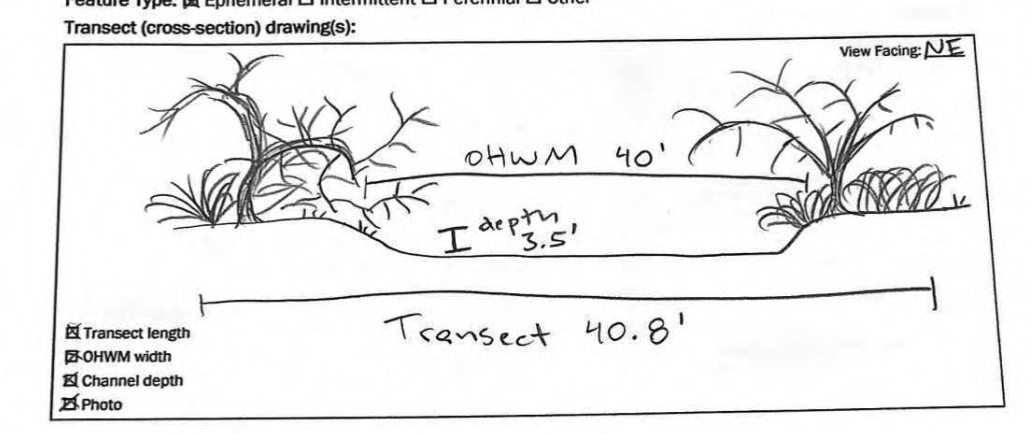
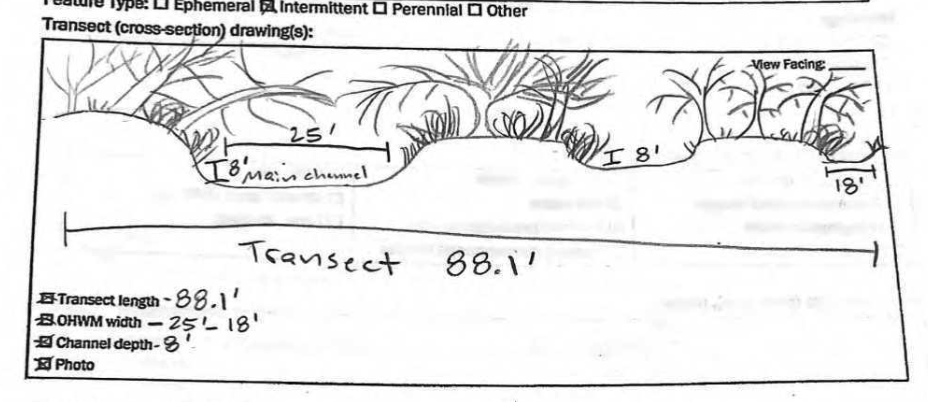
In Arizona, applicants submitted environmental documents for a Certificate of Environmental Compatibility (CEC) for the Vulcan Interconnection Project – a 4.3-mile, 500 kilovolt (kV) gen-tie line connecting an 800 MW solar and battery facility to the grid. Because we at Halcyon love examining the technical details that reveal the painstaking fieldwork behind every utility project. These sketches from the 500+ page filing caught our attention—they map the Ordinary High Water Mark (OHWM) at multiple survey points along the proposed gen-tie line route.
The first one shows an OHWM 40 inches high.
The next one has slightly more intricate terrain befit for the Arizona desert.
If you love looking through all the cool graphics in environmental documents, check out more below.
____
In Virginia, Dominion submitted three executed Generation Interconnection agreements (GIA) to FERC with interconnection charges entailing $2.4B and 2,489 MW. Want to know more? Check out this query or view the site plan below for a hint.
-Jan-16-2026-03-28-14-6720-AM.png?width=426&height=629&name=unnamed%20(1)-Jan-16-2026-03-28-14-6720-AM.png)
__
In Oregon, gas utility NW Natural proposes to purchase the Coos County Pipeline from the county for $1 in exchange for assuming responsibility for the pipeline’s safety and maintenance (projected at $10 million for landslide prevention). The utility would cancel Schedule 160—a $0.02 per therm surcharge on sales customers in Coos County—and terminate its existing Transportation Services Agreement.
The pipeline has a history of physical risks, including landslides that triggered a level 3 emergency response (indicating a regional emergency is anticipated or occurring). Outstanding questions include whether the Commission has authority to approve the asset sale, as it can authorize utility sales but may lack jurisdiction over property purchases.
Check out this query: What are the options and corresponding trade-offs for this pipeline?
__
In Indiana, Indiana Michigan and Power Agency (IMPA) filed a semi-annual report on its 260 MW combustion turbine project in Anderson. IMPA has contracted with Siemens for a turbine with a heat rate of 8,530 BTU/kWh and seasonal MISO capacity accreditation ranging from 196 MW (spring) to 208 MW (fall). The project budget, which is bond financed, has increased from $337.9 million in the August 2024 initial application to $464.4 million in the January 2026 report.
“... recent budget estimate changes were new costs required by refinement of the design, increases in the cost of the gas pipeline and other major equipment costs (including the CT, generator step-up transformer and high voltage breakers), and increased financing cost and contingency estimates… IMPA may be required to seek additional borrowing authority from the Commission; however, IMPA is hopeful that cost estimates for contingency and escalation will not be needed…”
__
Halcyon Team Queries of the Week:
- In Minnesota, a look into the carbon‑free standard (CFS) implementation, including whether and how life‑cycle analysis (LCA) is used for compliance, criteria/standards for partial eligibility, and which technologies/resources are fully or partially eligible. Understand how various stakeholders want to define "carbon-free" in Minnesota’s Carbon-Free Standard.
- In Oregon, interested in knowing what PacifiCorp's 2026–2028 Transportation Electrification Plan means for those doing fleet charging?
New Docket of the Week:
- Well, technically two FERC dockets of the week, In Illinois, Commonwealth Edison (ComEd) filing two Transmission Security Agreements both with Mobile-Sierra treatment. The first is PowerHouse Hillwood Holding, LLC for a data center (Docket profile) and the second is Grundy County Power NR I, LLC (Docket profile).