
What's Happening in Energy highlights the most interesting findings from public utility commission filings.
.png?width=50&name=34C0AE28-DE08-4066-A0A0-4EE54E5C1C9D_1_201_a%20(1).png)
What's Happening in Energy highlights the most interesting findings from public utility commission filings.
Hey there, it's Nat –
Remember, you can view the documents linked herein, but you must authenticate with a code sent to your email address (and sometimes in spam).
We also launched Agentic Alerts this week, a major improvement to our existing Alerts offering. In addition to surfacing new documents you care about, we now surface relevant information from within those documents. Try it out now (authentication required), and read the blog from Bruce.
This week's WHiE covers:
- Capital costs uncovered in CPCN and IRP filings for gas and nuclear in the Southeast,
- Presentations and testimonies related to large load tariffs, interconnection requests, and load transparency across the Midwest and the Rockies,
- Resource adequacy reforms, market design changes, and multi-year ratemaking in the West,
- Public comments in support of a gas-to-coal conversion in the Southwest,
- And so much more
Subscribe below to get these insights delivered straight to your inbox:
What's Happening in Energy — Jan 30
Powered by Halcyon
____
In PJM, a presentation submitted for the February 3rd meeting of the Transmission Expansion Advisory Committee (TEAC) outlines the upgrade costs necessary to interconnect large loads served by AES Ohio (formerly Dayton Power & Light). One customer request is for a load ramping up to 1,400 megawatts by May 2033. The project would interconnect near the Eldean substation in Piqua, Ohio.
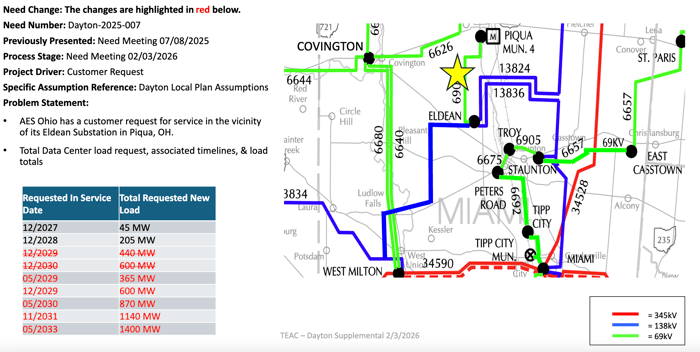
Other projects range from 300 to 1,300MW with in-service dates from 2029 to 2032. The presentation also includes cost estimates for line and substation upgrades. One cost estimate for a substation called "Patina" to support an 800 MW load request comes out to $168 million.
For a full view on substation development across the country, join the waitlist for Halcyon's Substation Development Tracker!
- Presentation before the TEAC
____
In Virginia, transcripts from the 11th day of hearings about Virginia Electric and Power Company's (Dominion) application to build transmission are in (2,535 pages total across all hearing days!). Interested in where there is disagreement during the 11th day, a summary across all 11 hearing days, mentions of billions of dollars? Or perhaps you want to ask your own specific questions? That's easy: just open link > click Edit > open your workspace, click Query > and ask away.
____
In Arkansas, the Arkansas Electric Cooperative Corporation's (AECC) is proposing to construct two combined cycle gas plants, Independence Gas Plant Units 3-6, that would total 1,499 MW. The estimated capital cost is $1,744 per kW, and AECC would own a 75% stake. Testimony filed on behalf of Public Service Commission Staff made multiple requests: First, justify the construction of capacity clearly in excess of future need; and Second, justify the decision not to convert existing on-site coal generation to gas. A redacted–but still informative– summary of project costs appears in the table below.
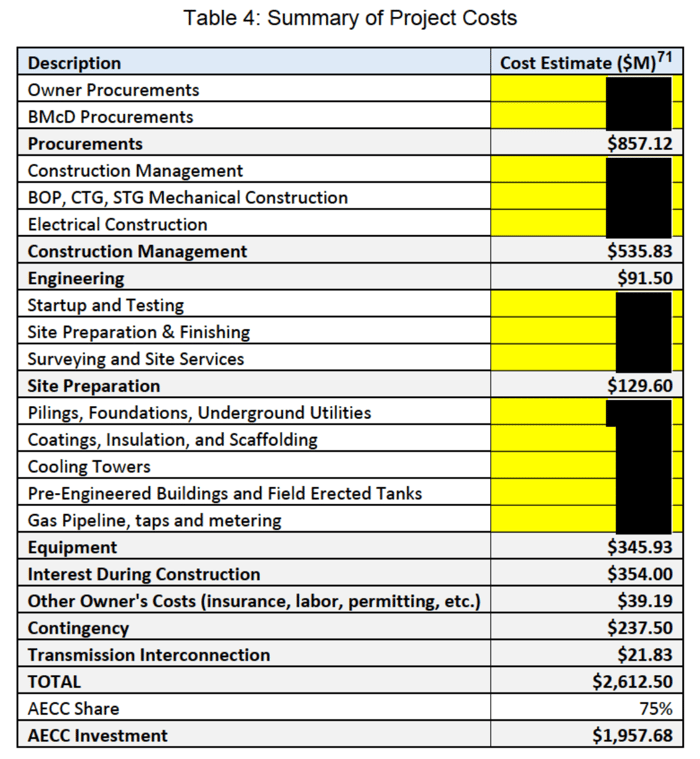
Halcyon angle: In addition to explaining the arguments laid out in CPCN applications, Halcyon can provide more detail on the broader context of a proceeding by explaining the perspectives of different parties. In this proceeding, we see that the Commission Staff substantially weighed in on the application through multiple testimonies, so we queried the full docket to understand their position more deeply.
Want the full US picture of gas plant capital costs? Check out Halcyon's Gas Power Plant Tracker.
____
In Oregon, a performance-based regulation (PBR) and multi-year rate plan (MRP) workshop was held this week with the Current Energy Group and the Regulatory Assistance Project as part of the rulemaking docket to establish a MRP framework. Are you debating PBR? This week's workshop included some questions for input and a pre-read (including a summary of PBR in different states – available here). And in case you missed it and are curious about the 1st workshop, check out the December workshop with Great Plains Institute, Current Energy Group, and the Rocky Mountain Institute.
____
In Louisiana, Entergy Louisiana (ELL) filed its integrated resource plan (IRP) assumptions with some notable nuclear performance (both at 10,000 Btu/kWh) and cost:
- 2 Large Light Water Reactors (LWRs) with an installed capital cost of $18,490/kW
- 3X4 Small Modular Reactor (SMR) with an installed capital cost of $14,965/kW
-Jan-29-2026-08-23-35-9913-PM.png?width=951&height=349&name=unnamed%20(1)-Jan-29-2026-08-23-35-9913-PM.png)
For the full entergy cost and performance table see slide #21.
And peak load increases by 41% between now and 2030.
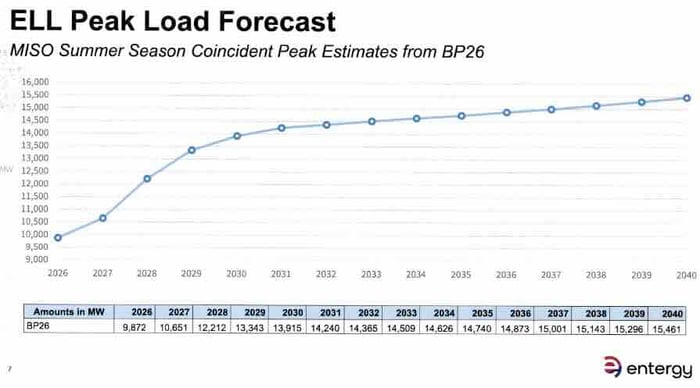
Check out other great visuals including the 20-year resource need and tax credit assumptions. The first stakeholder meeting is February 24th.
____
In Montana, the Montana Farmer's Union (MFU) filed a Motion with the Public Service Commission to compel NorthWestern Energy to produce Letters of Intent (LOI) that the utility referenced in its merger application but withheld from discovery. According to MFU, Northwestern has entered into "at least three Letters of Intent with data centers", and the Commission must balance the utility's request to protect the confidentiality of the LOIs with the "public's right to know."
"These LOIs are the best evidence of the scale of the load NorthWestern intends to serve and the terms under which they are negotiating. NorthWestern cannot tell investors these projects justify the merger while denying they exist to this Commission. MFU requests an order compelling NorthWestern Energy to provide full and complete responses to discovery requests regarding the impacts of large load growth and to produce its LOIs with potential large-load customers, including data centers."
____
In Wisconsin, in the "very large customer (VLC) and bespoke resource tariffs" proceeding with Wisconsin Electric Power Company's (WEPCO), Sierra Club filed Direct Testimony. The testimony cited an attachment with a partially redacted table (below) showing WEPCO's $19.5 billion five-year electric capex plan. Note "Bespoke Capex" (underlined in red) refers to customized, project-specific capital expenditure, which is redacted. However, from the Sierra Club referenced 2025 investor presentation (slide 16), about 14% of 2030E asset base is VLC/bespoke which didn't even exist as a category in 2024A and is happening specifically in WI.
-Jan-29-2026-08-30-42-3088-PM.png?width=1238&height=252&name=unnamed%20(2)-Jan-29-2026-08-30-42-3088-PM.png)
In the testimony, Sierra Club stated "WEPCO's investor presentations show that the Company preparing to now spend $19.3 billion on electric generation over the next five years," (from 2025 presentation slide 14) "an increase of nearly $10 billion since the 2024-2028 five-year plan" (from 2024 presentation slide 13), "and a plan largely driven by these two data centers." Assuming meaning those two listed in the table above – the text was redacted.
Meanwhile, many requests and responses for information have flown in read a summary here – including Microsoft's objections.
____
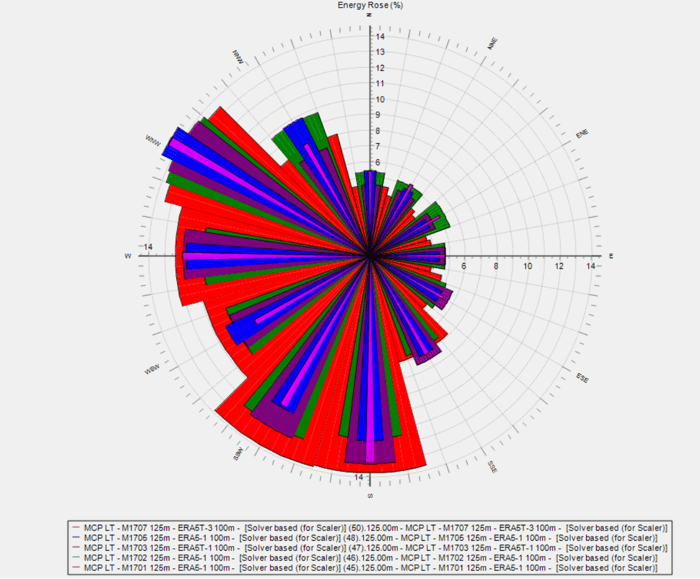
Continuing in Wisconsin, Columbia Project, LLC. (Columbia Wind) filed the public version of its application for a Certificate of Public Convenience and Necessity (CPCN) from the Public Service Commission to construct a 277 MW wind farm consisting of 57 turbines across 59 locations. The application included a "Wind Rose" diagram showing the annual "frequency that the wind is observed to blow from a given compass point" for the sites across the Project Area. The prevailing wind direction is S-SSW, although smaller variations occur across project sites.
Halcyon angle: CPCN applications are long, so we asked Halcyon to break this one down into its most important elements: justification for site selection and need. The response helpfully referenced specific parts of the application such as pages 15-16.
____
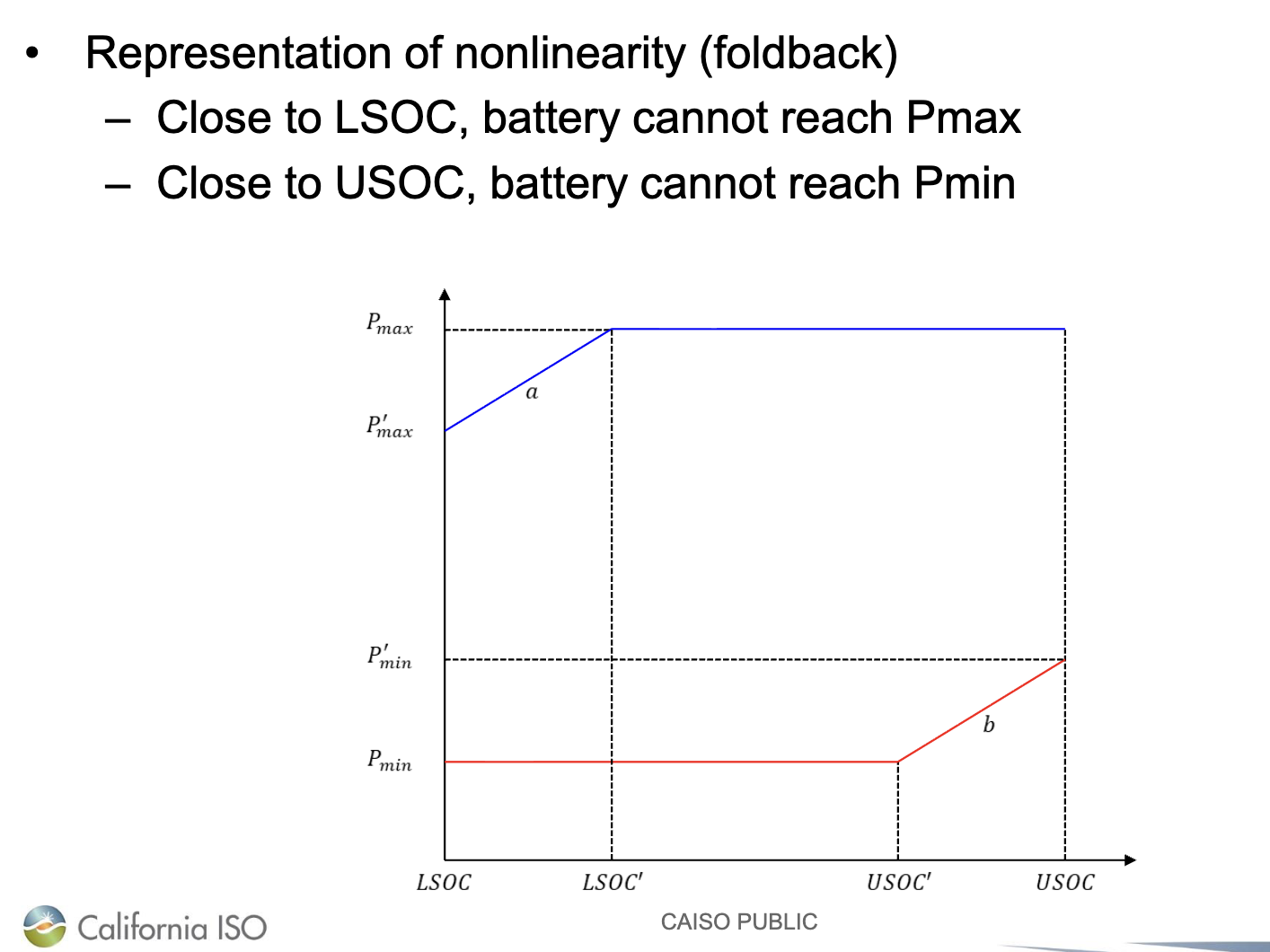
In CAISO, stakeholders discussed multiple proposals regarding the modeling of energy storage resources in the market. One of the proposals from REV Renewables would update State-of-Charge (SOC) modeling to account for "foldback"–the phenomenon where the maximum and minimum power output of a battery changes as the SOC nears the upper and lower limits. Why does this matter? Accounting for this nonlinear behavior will allow the ISO to model the behavior of storage resources more accurately through the "rate of change on state-of-charge rather than ramp rates in terms of MW value." Check out the helpful graphic on slide 40 in the presentation from the stakeholder meeting showing the break points near the upper (USOC') and lower (LSOC') SOC at which the maximum and minimum power outputs would change.
Halcyon angle: ISO/RTO stakeholder proceedings often involve multiple years of presentations, technical workshops, and task force meetings. For an issue like modeling "foldback" in CAISO, we can use Halcyon to analyze the procedural history of the CAISO Storage Design and Modeling Initiative to summarize the discussions on this topic.
We filtered to CAISO, constrained the search to the keywords "storage," "design," "modeling," and "initiative," and queried the resulting documents to summarize "the arguments regarding foldback in the CAISO Storage Design and Modeling Initiative." The answer–found here–synthesizes information from stakeholder comments going back to early 2025.
__
One last one (also) in California, the Resource Adequacy (RA) rulemaking docket is receiving Track 1 proposals. Track 1 addresses high-priority RA issues to ensure load-serving entities (LSEs) and central procurement entities secure sufficient resources. Exciting topics include flexible capacity, accreditation methodology for long-duration storage, and transactive energy within the slice-of-day (SOD) framework—where LSEs must secure capacity to meet customer demand for all 24 hours on the month's highest-demand day.
Review submissions from the California Public Utility Commission Energy Division proposal, Vistra, SCE, CAISO and others. It's dense material – you can read a summary here. Also if you want to track this docket moving forward, set up your own Halcyon Agentic Alert (launched this week!) to know when a new filing comes in and learn what it's about.
To receive alerts about CA RA yourself (we are going to make this easier):
- Click here;
- Then click "Refine Query";
- Select a workspace (or create a new one);
- Click "Query" (the prompt we used will auto-populate);
- Click "Run";
- Click "Create Alert" in the top right corner;
- Finally, set your Alert name and frequency
- Docket profile
__
Halcyon Team Queries of the Week:
- In Southwest Power Pool (SPP), a scoping document was released to evaluate the ability of the SPP Balancing Authority to reliably plan for energy assistance from neighboring regions. Want to understand more about how SPP thinks about help from neighbors?
- In Minnesota, Public Utilities Commission Staff briefing papers covered Northern States Power's (Xcel Energy) approval of power purchase agreements (PPA) for firm dispatchable resources and Xcel's 2024-2040 integrated resource plan (IRP). Questions include should the Commission approve the listed resources, should Xcel shareholders bear future costs to offset carbon emissions for a particular PPA? View the summary of issues and Staff recommendations.
Public Comment Excerpt of the Week
- In Arizona, residents from Apache County filed public comments with the Corporation Commission in favor of the proposed conversion of Tucson Electric Power's Springerville Generation Station from coal to gas. Here is a notable excerpt from one:
"To the Arizona Corporation Commission, My name is Josh Haelbig, and I am a fifth-generation Arizona native raised in the White Mountains. My family has called this region home for more than a century, and I am proud to continue that legacy. I am writing to express my strong support for the gas conversion of the Springerville Generating Station. For me, this project is far more than a technical upgrade or an energy policy decision. It represents the ability for families like mine to continue living, working, and contributing to the communities we love. The conversion from coal to natural gas not only strengthens Arizona's energy reliability, but it also sustains the livelihoods of the people who have built their lives around these facilities. It allows me to feed my family and remain in the place that shaped me."
Check out more comments from Apache County residents in the filing.
Most Heavily Redacted Filing of the Week
- In Missouri, Public Service Commission Staff filed a Rebuttal recommending conditional approval of a Certificate of Convenience and Necessity (CCN) for Ameren Missouri to build a 250 MW solar project, Reform Solar, and associated 345 kV interconnection facilities. The filing argued that the project will help Ameren reach its generation targets under the state's Renewable Energy Standard through Renewable Energy Credits (RECs). However, the capital costs associated with the facility, according to Staff, exceed industry standards and deviate significantly from Ameren's 2023 IRP. By how much, exactly? That's redacted. Same with the estimated RECs. And what about the cost of the proposed Odyssey Switching Station? That's redacted as well.
Nevertheless, despite the heavy redaction, the filing is chock full of narrative details supporting Staff's position on the CCN. Check it out below.