
What's Happening in Energy highlights the most interesting findings from public utility commission filings.
.png?width=50&name=34C0AE28-DE08-4066-A0A0-4EE54E5C1C9D_1_201_a%20(1).png)
What's Happening in Energy highlights the most interesting findings from public utility commission filings.
Hey there, it's Nat.
This week:
- Interconnection agreements, construction permits, and pipeline permits for growing gas capacity to serve data centers across the Midwest and South,
- An intriguing comparison between competitive solicitation timelines and car repairs in the complaint against FERC Order 1000 solicitation requirements at FERC,
- Public comments from rural co-op members against a new framework to designate generators as non-public utilities in the Mountain West,
And much more.
We are building more-sophisticated tools for customers every day. As we do so, Halcyon is moving to a gated access model to better understand and support our customers. What's Happening in Energy will continue to arrive in your inbox every week, free for all subscribers. To view any linked document, docket, or query result in full — or to sign up for alerts — start your free trial or talk to sales to learn more about our solutions.
Let’s get into it.
What's Happening in Energy — July 10
Powered by Halcyon
____
RICE Units in Rapid City // Wärtsilä // Black Hills Energy // South Dakota
Black Hills Energy filed its Interconnection Agreement for six reciprocating internal combustion engines (RICE) in Rapid City, SD. The units are restricted to a maximum output of 115 MW. The commercial operations date is January 1, 2029. And no, this installation is not for a data center; it is for reliability purposes.
____
Data Centers // Wurldwide LLC // Meta // El Paso Electric
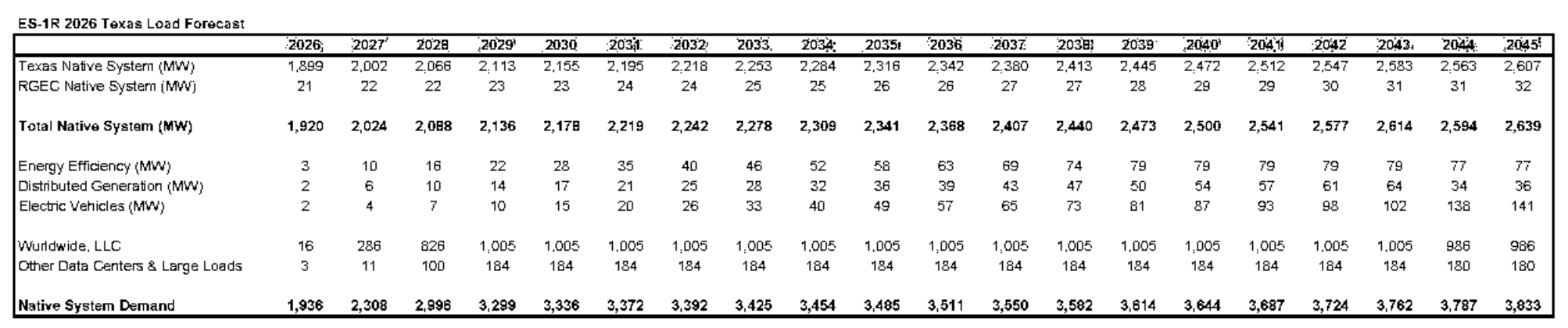
El Paso Electric shared a load ramp forecast of Meta’s Wurldwide one gigawatt data center and other large loads it will serve in Texas. The growth curve is steep: the total data center load forecast starts at 19 MW in 2026—roughly 0.01% of system demand—and reaches 1,189 MW by 2030–almost 36% of the utility’s total demand in TX.
____
Data Centers // Oracle // New Mexico // Gas Pipeline
Transwestern Pipeline requested authorization to build an 18-mile 24-inch pipeline to serve the gas power plant energizing OpenAI and Oracle’s Project Jupiter data center complex in Doña Ana County, New Mexico. The Sierra Club and others pushed back against Transwestern’s request for expedited action on multiple grounds. Among them, that the power plant for Project Jupiter still has not received its approval from the New Mexico Environmental Department, which has received 6,200 comments to review on the plant’s revised application.
____
Pumped Storage + Gas Hybrid // FERC License
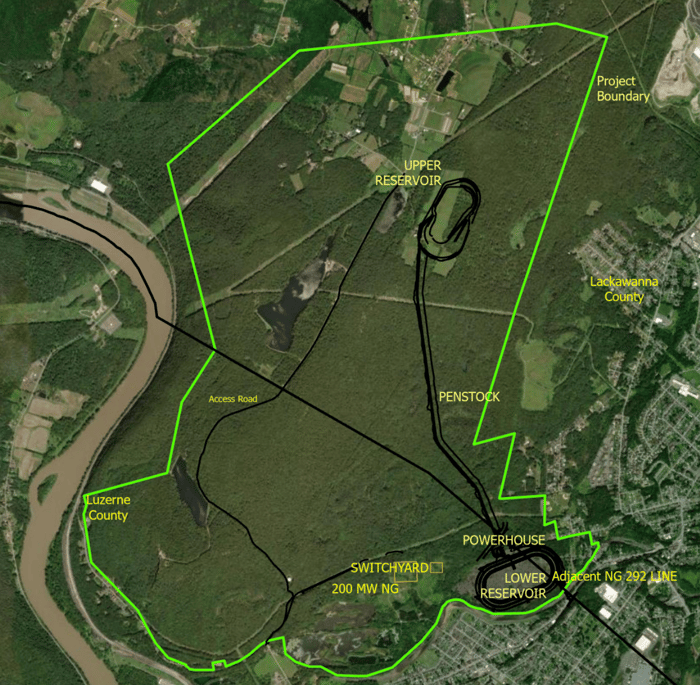
It’s been a minute since we’ve seen a new pumped hydro application. Renewable Energy Aggregators filed a “Pre-Application Document” for a FERC license to construct the Old Forge Pumped Storage Project—a new 184 MW pumped storage facility with 200 MW of behind-the-meter gas. The pumped storage would discharge for ten hours, and charge for 13.5 hours from the behind-the-meter gas plant.
There’s mention of a behind-the-meter load that would take power from the gas plant when it’s not pumping water…but no details on what that load would do. Check out the rendering of the proposed project with its upper and lower reservoirs, a gas plant, penstock, and adjacent pipelines.
____
Fuel Cells in PJM // Annual Report // Bloom
Diamond State Generation Partners (DSGP) submitted an annual report on the Bloom Energy“qualified fuel cell projects” it operates in PJM: 24.9 MW at the Red Lion site and 2.6 MW at the Brookside site. Here are the average revenues it made in the market from June 2025 through May 2026.
-
Monthly energy payment averaged $977.158 /month
-
Capacity payment averaged $206,423 /month
-
Reactive Services payment averaged $3,750 /month
-
Miscellaneous payments averaged $1,609 /month
The fuel cells averaged roughly 24.2 MW of output with an 87.5% capacity factor. After accounting for PJM revenues and $8.5 million in gas costs, DSGP will recover $29.3 million from ratepayers in a contract with Delmarva Power and Light.
____
NextEra BESS // Public Input Presentation // South Dakota
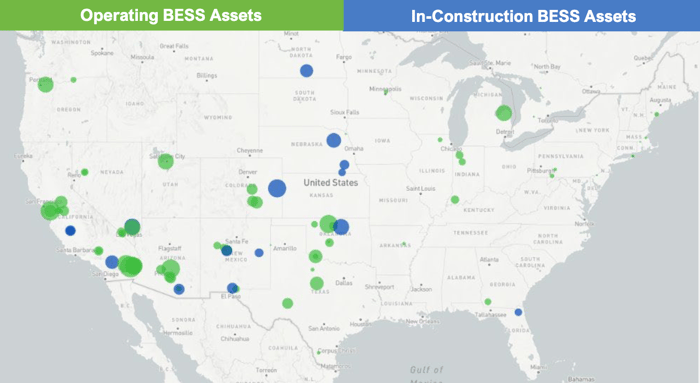
NextEra presented an overview of its 120 MW/480 MWh Crowned Ridge Energy Storage project in South Dakota. The overview includes a map of NextEra’s battery energy storage systems (BESS) operating and in-construction across the US. Most of the assets are concentrated in the west.
Halcyon angle: We’re tracking this project—and about 800 others-–in our BESS Tracker. Learn more here.
____
Gas Procurement Strategy // Appalachian Power Company // West Virginia
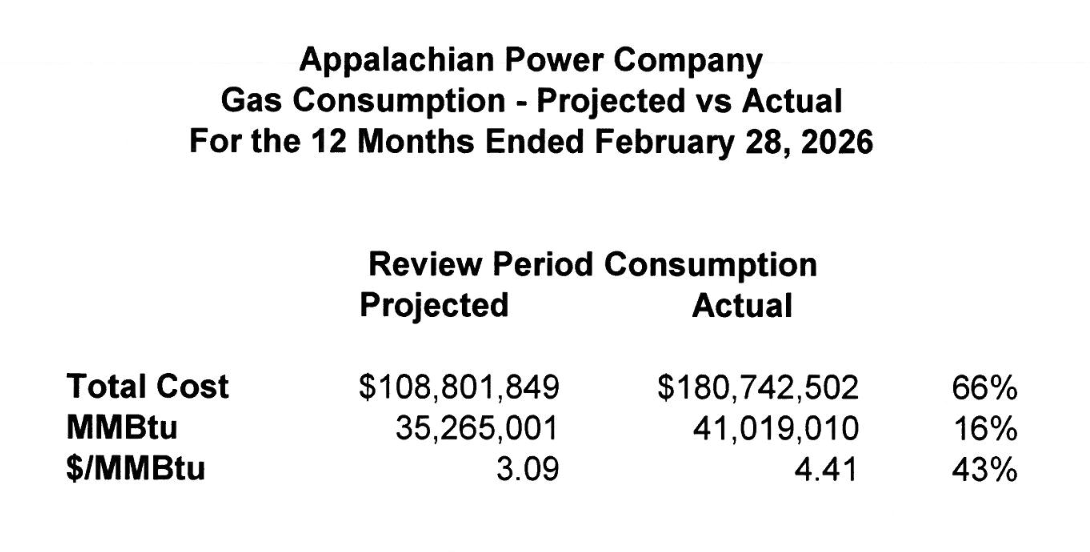
Looking for a thorough but concise overview of the U.S. natural gas commodity, transportation, and storage market over the past year? AEP’s Director of Natural Gas Procurement delivered exactly that in testimony supporting AEP subsidiary Appalachian Power Company’s updated Expanded Net Energy Cost rates: pages 312-320. According to AEP, storage withdrawals during the last week of January 2026 (Winter Storm Fern) came out to an all-time record of 360 billion cubic feet (Bcf). The testimony also included a table of Appalachian Power Company’s projected versus actual gas purchases during the reporting period ending in February. Actual costs were 66% higher than projected.
____
Data Center Load Forecast // California Energy Commission
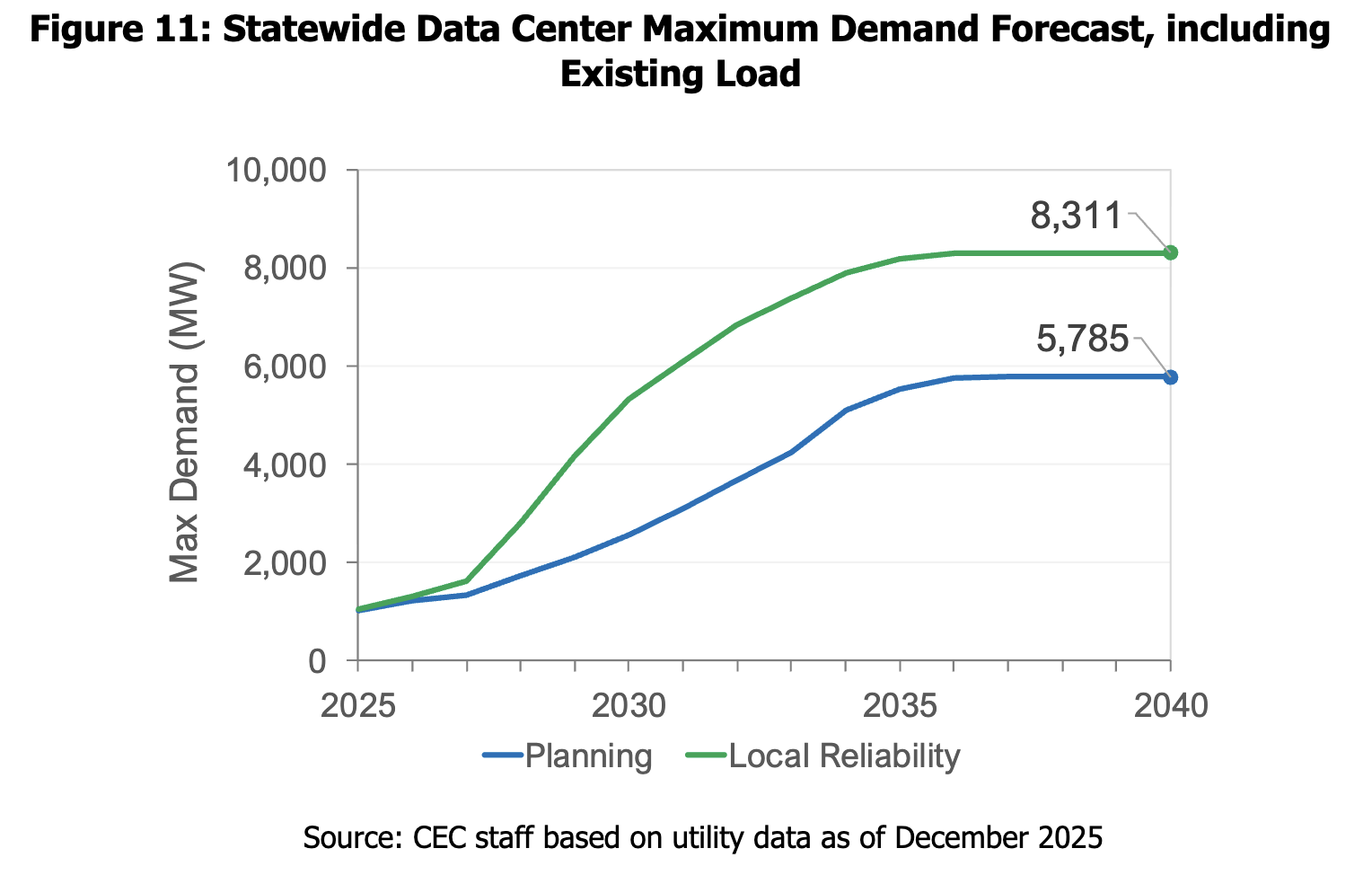
Readers of last week’s WHiE may remember the table we shared of California Energy Commission assumptions behind their “planning” and “local reliability” scenarios in their forecasts of data center load in California. Now here’s the actual chart. The Local Reliability Scenario forecasts roughly 2.5 gigawatts of data center demand in 2040 (8.3GW) than its baseline Planning scenario.
____
CHILLS OATT // Revision // Southwest Power Pool
SPP filed revisions to its Open Access Transmission Tariff (OATT) in response to the FERC’s approval of its Conditional High Impact Large Load Service (CHILLS) and High Impact Large Load Service (HILLS) on June 5. Revisions include adding language around when SPP would provide the form for a CHILLS agreement to a customer, a “Subregional” charge, and operational requirements for behind-the-meter generation. If approved, the language would become effective July 1, 2026 (FERC docket profile).
____
Utility Coalition Complaint against MISO and SPP // FERC Order 1000
The Grid Acceleration Coalition—a group of utilities in MISO and SPP—filed testimony responding to protests against its complaint to the FERC about Order 1000’s competitive bidding rules. Proponents argue that competitively procured projects do not delay transmission development because all completed projects have met their in-service dates. To rebut this claim, one testifier went all analogical: a trip to the car mechanic.
“Consider, for example, if you were in need of a car repair and the mechanic told you that it would take two weeks—one week to run an auction to purchase the part (which could be “sole sourced” immediately) and another week to do the job—and further, that the mechanic executed on that schedule, taking one week for the auction and another week to do the job. If the question is whether the auction process caused delay in getting the car fixed, my answer would be “yes, the auction caused one week of delay.” Certain parties are suggesting that the answer should be “no, because the mechanic got the job done in two weeks, as initially estimated.” While that may be the right answer to a question, it is not the right answer to the relevant question.”
Another rebuttal testimony from ITC Midwest clarified the numbers behind the delays. The Iowa utility is projecting load growth of 2,000 MW or 65% of peak demand primarily from Google and QTS data center campuses near Cedar Rapids.
Halcyon angle: Halcyon makes it easy to track this important proceeding by constantly monitoring the documents that come in and pushing alerts to your inbox. Set an alert on the docket by clicking “Create alert” in the top right. We recommend a weekly cadence to balance frequency with substance.
____
New Dockets of the Week
-
Microsoft applied for a construction permit from the Indiana Department of Environmental Management for its LPO Campus in La Porta County, Indiana. The project would include 42 3,000 kW and six 500 kW diesel-fired emergency generators from Caterpillar. That’s about 130 MW of emergency diesel backup. Microsoft plans to limit the NOx emissions from the generators to less than 100 tons per year to avoid needing a major source permit. Check out the fuel limits proposed here.
Public Comment Excerpt(s) of the Week
-
In Wyoming, members of rural cooperatives submitted comments opposing the Public Service Commission’s proposal to establish a process to designate “non-public utility generators” that serve, wait for it, “non-residential retail non-utility electricity consumers”. Generators under this designation would not have to undergo the regular CPCN, public comment, and other review processes that public utilities are subject to.
“I am writing to oppose the proposed changes under Chapter 6 Non-Public Utility Generators. I am a consumer-member of my local electric cooperative, and I rely on it for affordable, reliable power. Co-ops were created to ensure communities like mine have fair access to electricity through a locally owned, not-for-profit model. This proposal would allow a small number of large power users to buy electricity outside the co-op system, while the rest of us remain responsible for maintaining the grid. That is not a fair option for everyone. It shifts costs onto Wyoming families, ranchers, and small businesses. Co-ops are built on a simple principle: everyone shares the costs, and everyone benefits. This proposal puts that balance at risk. Consumer-members across Wyoming spoke out and stopped this proposal in 2024. I urge the Commission to listen to those voices again. Please reject this proposal and protect Wyoming's electric cooperatives.”
Query of the Week
Most clicked item from last week’s WHiE