
What's Happening in Energy highlights the most interesting findings from public utility commission filings.
.png?width=50&name=34C0AE28-DE08-4066-A0A0-4EE54E5C1C9D_1_201_a%20(1).png)
What's Happening in Energy highlights the most interesting findings from public utility commission filings.
Howdy there, it's Nat –
This week’s WHiE covers:
- A Securities and Exchange Commission (SEC) 8-K describing the proposed joint venture between an American small modular nuclear reactor (SMR) company and an Argentinian state-owned company,
- The long-awaited proposal for the Reliability Backstop Procurement in PJM,
- The suspension of a large load tariff proceeding in the Mid-Atlantic,
- A fraught exchange between community members and a state agency over air permit approvals for diesel generators at a data center campus in the Midwest,
- And ever so much more!
Take it at your own pace – skim for the highlights, or go deeper through the linked filings and Halcyon’s suggested queries. Here are two Halcyon queries to get you started:
- In Delaware, a suspended procedural schedule for Delmarva Power and Light’s proposed large load tariff to allow additional discovery and potential revisions (read summary of concerns raised by stakeholders advocating for the suspension).
- At the FERC, more comments in the Interconnection of Large Load Advance Notice of Proposed Rulemaking (ANOPR) proceeding. Here is a summary from Harvard Electricity Law Initiative, NARUC, ITC Holdings Corp., and SPP Transmission Owner Group comments.
What's Happening in Energy — Apr 17
Powered by Halcyon
____
PJM presented its Reliability Backstop Procurement (RBP) proposal, structured in two phases. First, a six-month Bilateral Contracting phase commencing in September 2026 where counterparties can enter into bilateral contracts, with PJM and Charles River Associates acting as matchmakers. Second, a centralized auction in March 2027 run by PJM where the RTO would work with utilities to set a target amount of capacity to procure.
PJM issued a Request for Information from demand and supply side resources interested in participating in the RBP. The information would help match supply and demand along the dimensions visualized below: Location, Timing, Quantity, Operational Profile, Commercial Terms & Pricing, and Development / Credit.
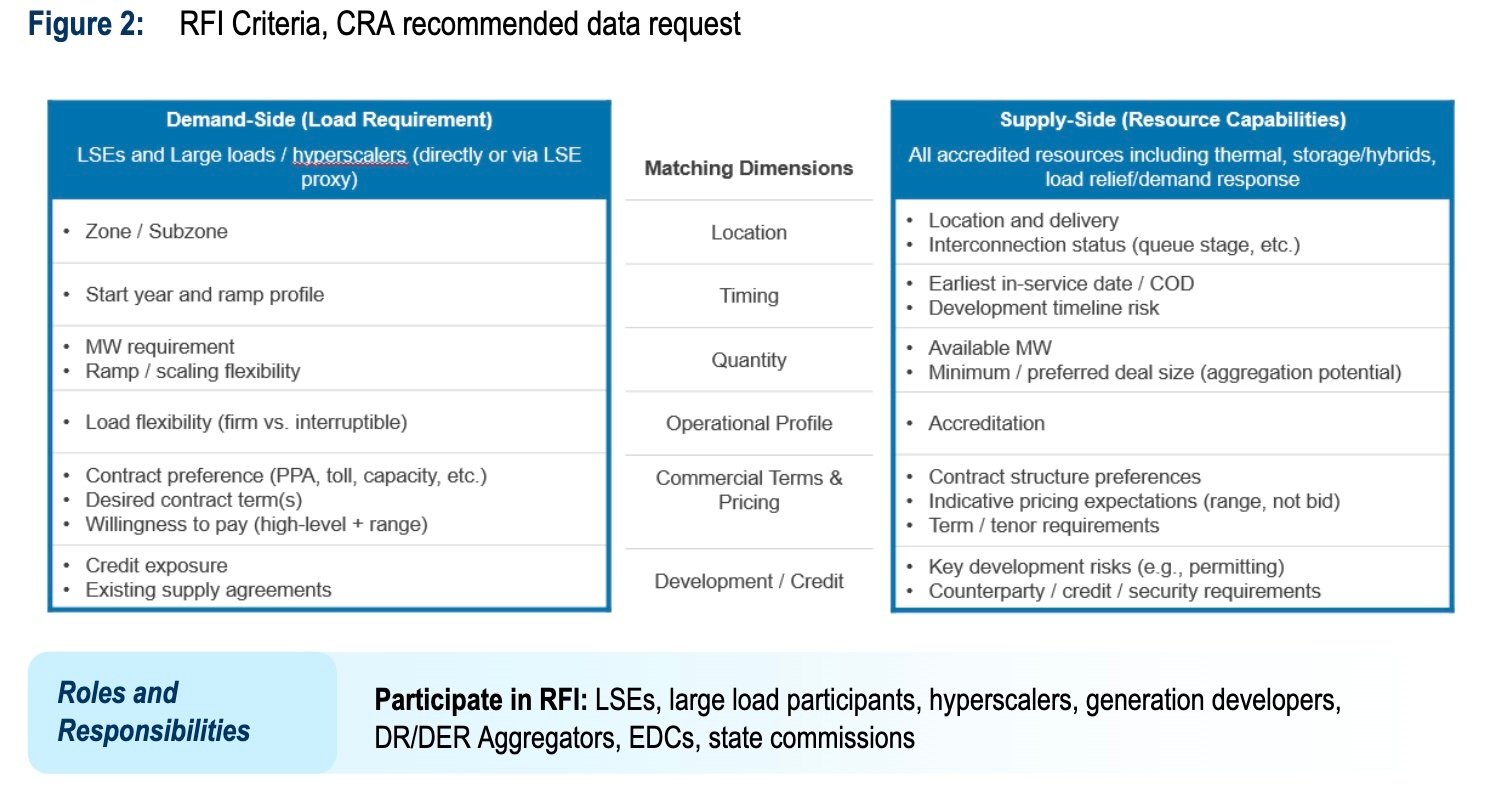 We filtered to PJM’s two presentations on its proposed design of the RBP and asked Halcyon for a summary. Check out the response.
____
In Arkansas, Entergy is seeking a Certificate of Convenience and Necessity (CCN) for two 115-kV lines to interconnect a 150 MW data center expected to come online in September 2027 (docket profile). The developer, Avaio, is paying for the lines upfront through a Contribution in Advance of Construction (CIAC) and will receive service under the Commission-approved Schedule 8, Large Power Service (LPS) tariff. The project will not require Entergy to build incremental generation. In addition to the CCN, Entergy is seeking Commission approval of its highly confidential agreement with Avaio (request). When asked whether the agreement's terms would apply to future Avaio contracts, Entergy noted (testimony):
“... with respect to any potential expansions will be subject to a separate review and approval. Thus, the current Agreement recognizes that each transaction is different, and the need and scope of additional or different terms for any future transaction will be based on the risks and facts associated with the specific transaction.”
____
In New Jersey, residential customer enrollments with Competitive Service Providers (CSPs) have been in decline. This is according to the Division of Rate Counsel’s comments to the Board of Public Utilities regarding readoption of its Energy Competition Rules. The comments include this chart where enrollments peaked in 2013.
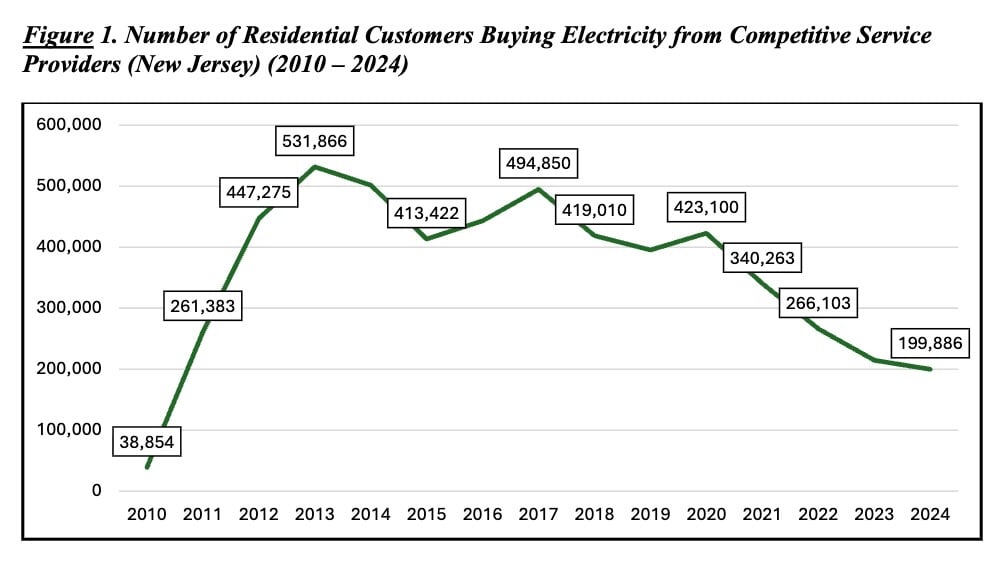
The Division explains that this dropoff likely stems from the increase in retail prices from CSPs relative to default service providers. In 2010, CSPs average price was almost 1 cent higher per kilowatt-hour (15.49 cents vs. 16.48 cents) as compared to default service providers. In 2024, the CSPs average price was 5 cents per kWh higher (24.10 cents vs. to 19.10 cents) than default service providers.
We asked Halcyon to explain the Board’s proposed amendments to the rules. Check out the response.
____
In Texas, more filings came through in the proceeding regarding Freestone Power Generation’s (FPG, owned by Calpine, subsidiary of Constellation) net-metering arrangement with C1 Freestone (owned by data center developer CyrusOne). In this arrangement, C1 will interconnect up to 760 MW behind FPG’s existing Point of Interconnection on the grid for its 1,099 MW gas plant. We covered testimony from C1 last month. This past week, FPG submitted its concerns from the generator’s perspective (filed testimony):
“Further, I do not agree with ERCOT' s conditions that impute responsibility onto Freestone for actions that are solely within C1' s control. For example, the ERCOT conditions indicate that "Freestone and C1 must ensure that C1' s load fully curtails its consumption in the manner directed by ERCOT" or that "Freestone and C1 must ensure that each breaker that connects C1 to the Freestone generating facility is opened and that C1's load is fully disconnected from the ERCOT System no later than the end of that 30-minute or 10-minute curtailment period" (emphasis added).”
The exhibits included a table of the expected load ramping schedule for C1. Past 320 MW, the interconnection is contingent upon a system upgrade — the Southern DFW Transmission Line Upgrade — to avoid thermal overloads. The schedule indicates that this upgrade will become available by the start of 2029.

____
Also in Texas, Public Utility Commission Staff comments on ERCOT’s upcoming Batch Zero study of large load interconnection requests address the distinction between “base loads” and “study loads” – the criteria determining which large load projects will be restudied and which will have their interconnection requests honored because of a previous study. Staff argued that base loads need not be restudied in Batch Zero because they have already had their interconnection studies deemed valid by ERCOT.
For the study loads — i.e. large loads that do not have an interconnection study that ERCOT deems valid–Staff recommends that ERCOT restudy these projects in Batch Zero. However, Staff acknowledges that “while there is general consensus … that Batch Zero must aim to filter the queue of phantom loads and protect ratepayers in a manner that supports business development and to ensure reliability of the ERCOT grid, there is disagreement about how best to achieve those objectives.”
See the table on page 4 that Staff included with their recommendations on the criteria to distinguish between base and study loads.
____
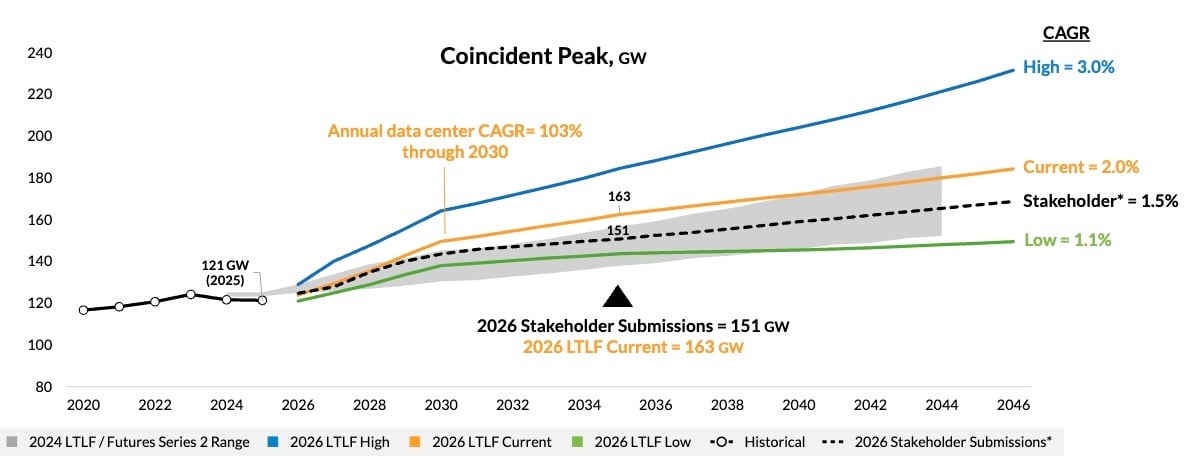
In MISO, the “Current” coincident peak Long-Term Load Forecast for 2026 tracks the “High” scenario from the 2024 forecast (2026 LTLF results). The driver? Data center load growth.
____
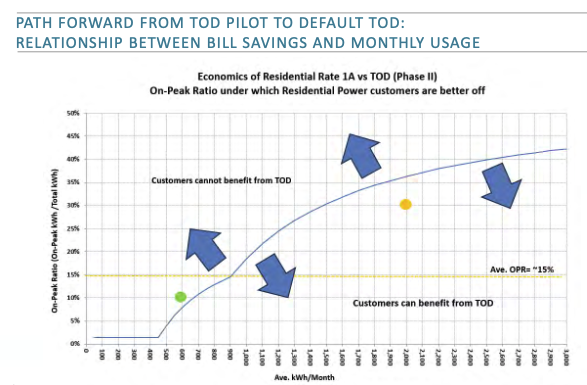
In New Mexico, PNM filed its Second Annual Grid Modernization Review (note the large file size) requesting an updated budget mainly driven by the Advanced Distribution Management System (ADMS) and Advanced Metering Infrastructure (AMI) increases and, requesting, again, (originally denied in Docket No. 25-00049-UT) the classification of Software as a Service costs as capital in years two through six. We asked Halcyon to describe the status and budget changes of PNM’s Grid Modernization. According to the response, the company is planning to move into “full-scale implementation” this year, release its ADMS next year, and complete all of its AMI deployments by 2028.
According to PNM, this grid modernization ground work enables the Roadmap to Default Time-of-Day (TOD) (see page 365). It includes a chart that shows which residential power customers are better off (that is, below the blue line, where the X-axis is “average kWh/month” and Y-axis is “On-Peak Ratio (i.e. On-peak KwH/Total kWh)).
____
Also in New Mexico (and a little bit in Texas!), Southwestern Public Service (SPS, subsidiary of Xcel) is seeking Certificates of Convenience and Necessity for seven self-build generation and storage projects totaling $9.3 billion, 3,849 MW, which include a little bit of everything — wind, solar, gas thermal, and battery energy storage (BESS) (breakdown of the project). The Public Service Commission hearing examiners issued a Recommended Decision on the application.
The document recommends granting the certificates, with a few conditions. We asked Halcyon to explain how the Recommended Decision deviates from the utility’s original request. According to the response, SPS’s estimated cost “is the largest nominal dollar amount request in at least ten years.” Thus, the Recommended Decision “acknowledges arguments from parties that such high costs create risks that may require countervailing risk."
__
At the Securities and Exchange Commission (SEC), Nano Nuclear Energy filed an 8-K form announcing its proposal to jointly develop a natural uranium hexafluoride (UF6) production facility with Dioxitin, a state-owned Argentinian firm. UF6 is a compound used to enrich nuclear fuel. Check out the Halcyon summary of the 8-K.
Halcyon angle: You might notice the new UI on the document and docket summary page. The pane with associated metadata on the left helps situate you in Halcyon’s corpus and navigate seamlessly from document to docket to query.
__
In Indiana, Indiana Michigan Power (I&M, subsidiary of AEP) applied for a Certificate of Public Convenience and Necessity (CPCN) to acquire the Sycamore Riverside Energy Center, a 918 MW dual-fuel facility in Sullivan County, Indiana with an expected commercial operations date of March 31, 2029 (docket profile and petition for CPCN). The project, identified in I&M’s 2024 IRP, will help the utility meet peak loads expected to grow from 2,800 in 2024 to over 7,000 MW by 2032.
We asked Halcyon for an explanation of the acquisition structure: I&M will acquire 100% of the equity in Sycamore Riverside Energy, a subsidiary of Invenergy, in a Purchase and Sale Agreement.
Halcyon angle: Halcyon released the latest version of its Gas Power Plant Tracker. This version adds 40 new gas plants. See here for more information.
__
In Montana, Public Service Commission Staff issued a Memorandum recommending the Commission deny NorthWestern Energy’s Motion to waive requirements to present historical demand data across rate classes in its IRP. NW Energy argued that there is good cause to grant this waiver because it has only recently begun collecting this AMI data for all customers and it lacks “the analytical capability to process large volumes of existing AMI data by customer class.” (Staff Memorandum)
The Staff Memorandum does not mince words: “...NorthWestern has had two and a half years to obtain a program to process the data it would receive from customers. NorthWestern has had ample time to find and implement a program to process the data it would receive. NorthWestern’s recent implementation of its newly built large data platform is not sufficient good cause for why the rule should be waived.”
____
Halcyon Team Query of the Week
-
In Georgia, two air permits were issued from the GA Environmental Protection Division: 1) Southern Company / Georgia Power and 2) Albany Green Energy to support the Procter & Gamble Paper Products facility (learn more).
- In North Carolina, a brazen fraud scheme violating PJM and MISO tariffs and the FERC’s anti-manipulation rule resulted in a FERC ordered a civil penalty of $722 million (learn more).
New Docket of the Week
-
In New Mexico, El Paso Electric (EPE) is seeking a CCN to replace the 200 MW Eddy HVDC Tie that connects the Eastern and Western Interconnections of the US grid (docket profile and application for CCN). The current tie, originally built in 1984, is reaching the end of its life so EPE issued an RFP in 2025 for bids to replace the facility. They ultimately selected GE Vernova’s proposal to construct a replacement HVDC tie with “Voltage Source Converter (“VSC”)-based technology” with “Insulated-Gate Bipolar Transistors in a modular multi-level converter (“MMC”) arrangement”. We asked Halcyon to explain how this replacement will benefit the grid. Check out the response for the list of grid services that the technology is expected to provide. EPE also included an image of the “valve hall” configuration that the facility will have when it goes into service in 2031.

EPE is requesting expedited approval of the CCN so that it can honor the estimated replacement cost of $289 million. According to the utility, if approval is not forthcoming by the end of 2026, then costs will be 11 percent higher. And if approval is not received by June 30, 2027, then EPE will need to renegotiate its contract with GE Vernova. Why such high cost uncertainty? According to EPE, “The increase in cost reflects long-term price uncertainty being experienced by electrical sub-station equipment manufacturers and the demand for equipment driven largely by data center growth. There is currently a large demand for HVDC projects in Europe and Asia and therefore it is difficult for any vendor to guarantee prices past twelve to eighteen months.”
Public Comment Excerpt(s) of the Week
- We came across a fraught exchange in the transcript of a hearing concerning a “Significant Source Modification” of an air permit for a Google data center in Fort Wayne, Indiana. Although the hearing is from November 2025, the excerpt captures the backlash around the data center buildout continuing to grow across the country (excerpt).
Ms. Cohen: “...if you approve this permit without further input, without changes to it, without straight-up denying it, and as someone else mentioned, possibly revoking the first one, then that is proof that this system doesn't work. We've given you so many reasons, and I don't like the way that you're smugly smiling at me right now.
MS. COHEN: And I don't like the fact that you were whispering to each other instead of listening to me. It's not funny. This is serious. This is tantamount to defrauding our community to extract resources, raise our bills, ruin our health, and for what? Whose pockets are getting greased?”
Most clicked item from last week’s WHiE
- Summarize stakeholder comments from Enchanted Rock, Data Center Coalition (DCC), Sierra Club, and the Environmental Defense Fund (EDF), highlighting areas of alignment on the proposed Large Load Demand Management Service, a competitive procurement mechanism for demand reductions from large loads in ERCOT.
- Halcyon summary of concerns regarding the financial health of NYSEG and RG&E in their ongoing rate case.
And if you made it this far…
…here are two slides from my keynote for Transition-AI earlier this week, quantifying just what share of today’s regulatory filings concern data centers and large loads.
-Apr-16-2026-07-17-38-4191-PM.png?width=1820&height=2048&name=unnamed%20(5)-Apr-16-2026-07-17-38-4191-PM.png)