
What's Happening in Energy highlights the most interesting findings from public utility commission filings.
.png?width=50&name=34C0AE28-DE08-4066-A0A0-4EE54E5C1C9D_1_201_a%20(1).png)
What's Happening in Energy highlights the most interesting findings from public utility commission filings.
Hey there, it's Nat –
This week’s WHiE covers:
- ERCOT recommendations for Crusoe’s data center co-location with a wind facility and Chevron’s concerns about the 765 kV lines in Texas,
- An application to construct transmission lines and a substation to support data center load growth in the Mid-Atlantic,
- A proposal to supply an extra 1.3 million dekatherms to an LNG export terminal on the Gulf Coast,
- Mid-century wildfire risk projects in the Upper Midwest,
- And oh so much more!
Read at your leisure and choose your own adventure — skim the surface, or dive deeper with linked filings and Halcyon's suggested queries. Here is a Halcyon query of the week to start you off:
-
In California, read an overview of proposed changes to the Demand Side Grid Support (DSGS) program – including suspension of emergency dispatch and a $21 million allocation toward the market-aware storage virtual powerplant pilot.
What's Happening in Energy — Mar 13
Powered by Halcyon
____
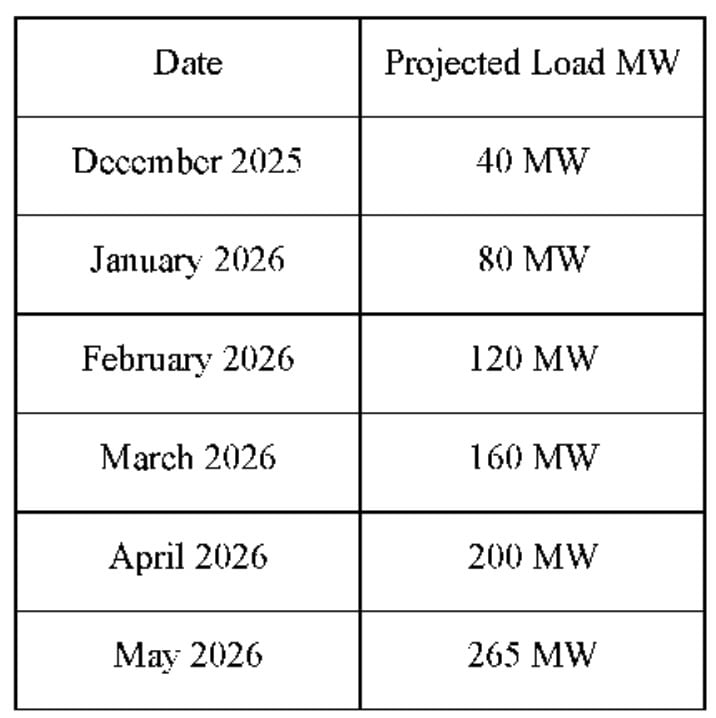
In Texas, ERCOT proposed conditions for the Public Utility Commission of Texas to impose on Crusoe, developer of the 265 megawatt (MW) data center project, Crusoe One. The project will co-locate with Goodnight Wind’s facilities in Armstrong County, Texas (ERCOT filing). Read Halcyon’s summary of the conditions. Crusoe One’s energization schedule submitted to ERCOT targets 265 MW by May 2026 (see table below). Note Crusoe has a separate interconnection request for a second large load, a 260 MW data center, that will also be netted with GOODNIT1.
____
In Maine, Versant Power presented a 10-year bottom-up forecast to support integrated grid planning (presentation). Versant explained the bottom-up approach enables evaluating its needs at the distribution level due to increased DER penetration and end use electrification.
While concluding that 80-90% of its system could accommodate these impacts, Versant noted that the results show that 1) some “substantial assets” would be affected, and 2) across its two service territories, the Bangor Hydro District (BHD) and the Maine Public District (MPD), BHD will experience more impact from electrification growth and MPD more impact from DERs.
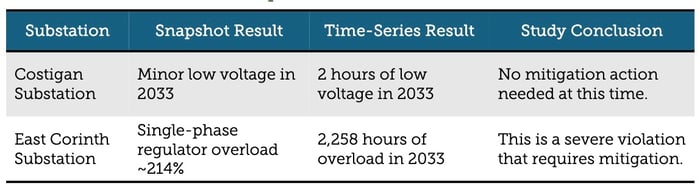
To illustrate the types of insights that this more granular and dynamic “8760” time-series forecasting (what is 8760?) can provide, Versant shared a table with the number of hours that two substations may experience violations in 2033.
Halcyon angle: Halcyon ingested the transcript from this workshop along with this presentation. We asked Halcyon to summarize the perspectives of the different parties. Try jumping into different sections of the transcript with the in-line citations in the response.
____
In Louisiana, NextEra is developing a hybrid PV and BESS facility in Amite, a town in southeastern Louisiana (docket profile), which would share a 100 MW limit at the point of interconnection in a surplus interconnection agreement with MISO. The Dixie Electric Membership Corporation (DEMCO) is entering into an Energy Storage Agreement with the BESS project. We asked Halcyon to tell us more about the contract and DEMCO’s need for the project. Halcyon’s response put the benefits of the BESS project into two buckets: energy and capacity.
-
Energy benefits: DEMCO would discharge the battery to help hedge against high energy costs.
- Capacity benefits: DEMCO would offer the battery into the MISO Planning Reserve Auction to help meet its own capacity obligations as a Load-Serving Entity.
Halcyon angle: Did you know that Halcyon is tracking almost 600 BESS projects planned, in construction, or otherwise in development across the US? And the list gets bigger every month. This past release, over 100 new projects made it into the newest update. Learn more here.
____
In Illinois, Nicor Gas is proposing a $221 million increase in its base rates using a test year of 2027. We opened the full docket and queried it to learn more about the following topics (docket profile). Click into the responses for a tour through how you can use Halcyon to dive into any rate case.
-
How does Nicor Gas justify its proposed rate increases? What are the main investments that Nicor Gas is proposing? Halcyon response.
- How does Nicor Gas justify its proposed rate increases? What are the main investments that Nicor Gas is proposing? Halcyon response.
- How does Nicor Gas justify its proposed rate increases? What are the main investments that Nicor Gas is proposing? Halcyon response.
____
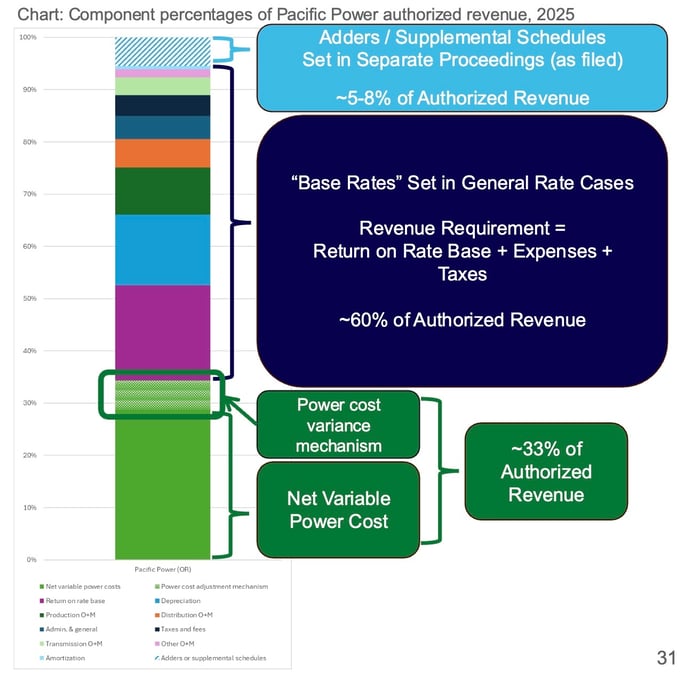
In Oregon, multiyear rate plan workshops continue (docket profile). The most recent session focused on Existing Regulatory Structures, where Pacific Northwest National Laboratory (PNNL) experts presented a breakdown of gas and electric revenue requirement cost components. Interestingly, both sectors have similar cost structures – the base rates, power/fuel costs, and adders constitute roughly 60%, 30%, and 10% of revenue requirements.
PNNL shared a chart of PacifiCorp’s cost breakdown for its electric operations. Here's a higher resolution image and a similar chart for Northwest Natural’s gas rates (full workshop presentation).
According to PNNL, we can expect the following future trajectories for utilities.
-
“Electric utilities expect significant capital investments over the next 3 to 6 years.”
- “Gas utilities are exploring flat or reduced load over 20 to 30 years in part due to state policies.”
____
In New York, Rochester Gas & Electric (RG&E) and New York State Electric & Gas (NYSEG) jointly responded to an information request from New York Solar Energy Industries Association on the companies’ DER interconnection policies, adoption forecasts, and hosting capacities. In response to a question about how circuits handle voltage issues related to DER penetration, the utilities made an important distinction:
“DERs are also different than retail customers in the fact that they can fluctuate quite rapidly. Most residential, commercial, and industrial customers have controlled loads that do not rapidly fluctuate. Therefore, their gradual power draws up and down are not extreme enough and allow utility voltage regulating equipment (capacitors, regulators, etc.) to operate in a reasonable time.” (NYSEG/RG&E response)
Halcyon angle: There are four dockets before the New York Public Service Commission on RG&E/NYSEG’s electric and gas rate cases–one for each utility and operational segment. To track all the dockets together, we created an Agentic Alert. First, we clicked Alerts using the “hamburger” dropdown in the top right of the platform. Then, we filtered to the New York Public Service Commission and the four dockets (25-E-0375, 25-G-0378, 25-E-0379, 25-G-0380). Finally, we titled the alert, set the frequency to “Every Weekday”, and added a query for Halcyon to summarize the latest filings for each docket. Check out the result here. Click Copy Alert in the bottom left to receive this alert!
____
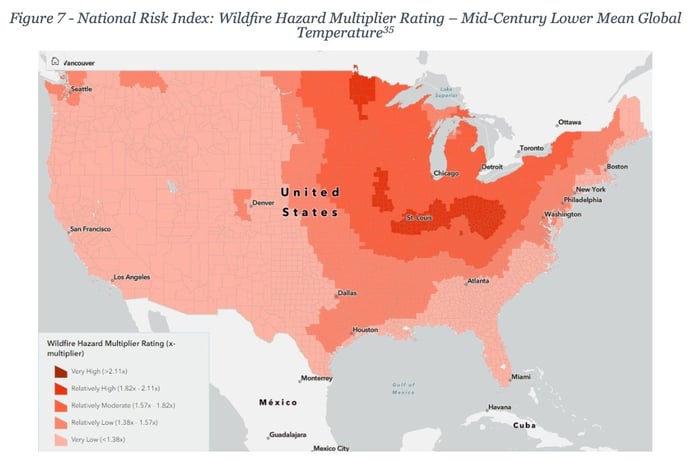
In North Dakota, a Wildfire Mitigation Plan from Otter Tail Power Company includes FEMA’s “National Risk Index: Future Risk Prototype”. This prototype projects that — under the most conservative scenario — the wildfire risk rating in its service area is expected to increase by a factor of between 1.57x and 2.11x by mid-century. In the mid-century projections, FEMA expects the wildfire risk to increase the most in the central, midwestern, and eastern parts of the country. To see FEMA’s late-century projections see page 22 of the plan. (docket profile, wildfire mitigation plan)
____
In Louisiana, Entergy Louisiana’s (ELL) requested termination of the River Bend nuclear Deregulated Asset Plan (a construct to handle investments deemed imprudent — for more detail). The request would move the portion of the nuclear station from deregulated status back into the regulated rate base. This week, three commenters weighed in (read a summary of 212 pages of comments). As context, in 1987, the Commission disallowed $677 million of capital investments after determining that they were imprudent. ELL claims that, because the losses subsequently borne by shareholders from 2005-2024 (roughly $794 million) far exceed the initial damages from the Commission’s disallowances, “continuing to disallow a portion of capital additions and operating expenses that are necessary to keep River Bend operating for the benefit of ELL’s customers is not reasonable” (docket profile).
__
In Virginia, NextEra Energy Transmission Virginia (NEET VA) applied to build part of the Virginia portion of the Mid-Atlantic Reliability Link (MARL) project (docket profile and CPCN application). NEET VA proposes to build 500 kV transmission lines (estimated cost: $19 million) and the 500/138 kV Woodside Substation (estimated cost: $286 million). The entire MARL project is intended to address load growth in the Pennsylvania, West Virginia, Maryland, and Virginia portions of PJM. PJM states this growth, if unaddressed, could cause “thermal overloads of existing high voltage transmission lines and potential voltage collapse, leading to electric system failure and blackouts throughout the larger PJM Region…as early as 2027.”
“The Project is currently being developed to be in service by December 31, 2031; however, PJM has informed NEET MA that the need for reinforcements to the existing bulk electric system (“BES”) is so substantial that PJM is asking NextEra Energy Transmission, LLC (“NEET”) to accelerate the in service date to December 2029 or earlier.”
Halcyon angle: We came across this CPCN application through the Halcyon curated alert on PJM Resource Adequacy. Sign up for this curated alert here.
__
In New Jersey, Governor Sherrill's Executive Order No. 2 prompted the Staff of the New Jersey Board of Public Utilities to issue a request for information (RFI) on DER integration and grid modernization. Three of the four electric distribution companies (EDC) have responded addressing a range of topics from accelerating interconnection timelines to improving hosting capacity maps. Here is a summary of the EDCs' responses, the challenges identified in complying with the Order, and general comments submitted by stakeholders such as Dimension, WeaveGrid, and others.
__
In New Mexico, Public Service Company of New Mexico (PNM) filed a 677 page draft supplemental request for proposals (RFP) to procure firm generation resources for 2029-2032 (docket) (draft RFP).
Halcyon angle: We asked Halcyon to explain what types of resources PNM is seeking, why PNM wants to procure them, and the requirements for bidders. Here’s the detailed response.
__
Halcyon Team Query of the Week
-
In ISO-NE and NYISO, an updated coordination agreement deletes references to “interconnection revenue metered quantities” metering and now just states “metered quantities “and moves from “such reasonable assistance would not normally require the shedding of firm load” to now “All Balancing Authorities and Transmission Operators in a position to assist should take any available action, excluding load shedding.” Click to understand more about the agreement and details about revenue and load shedding.
- In Hawaii, an 40 MW restated power purchase agreement for an always-available, firm, flexible, renewable dispatchable, dual-fuel biofuel generation. Learn more about the project here.
Public Comment Excerpt(s) of the Week
- In Texas, it isn’t just landowners that are concerned about the impacts of the giant 765 kV transmission lines that make up the Permian Basin Reliability Project.
Now, Chevron is weighing in on Oncor’s proposed routes for the Permian Basin segments of the project with concerns about the impacts of the high voltage lines on the metallic pipelines that carry their oil to market.
“AC transmission facilities can induce hazardous voltages and currents on nearby metallic pipelines, including through inductive coupling, capacitive effects, and fault conditions…These issues are of material concern to Chevron due to its operational reliance on interconnected midstream pipeline infrastructure in the Delaware Basin. Adverse impacts to DBM or other third-party pipeline systems along the proposed transmission route could directly affect the safe and reliable operation of Chevron-connected assets. AC interference-related integrity issues, therefore, present not only safety and environmental risks but also the potential for operational disruptions, increased integrity management and mitigation costs, and regulatory compliance challenges if interference risks are not timely and adequately assessed.”
New Docket of the Week
- At the FERC, Kinder Morgan (doing business as Kinder Morgan Louisiana Pipeline, KMLP) applied for an “abbreviated” application for a Certificate of Public Convenience and Necessity to “create a new, high-capacity path from multiple Texas supply sources into KMLP’s existing certificated system by constructing a short pipeline extension from Jefferson County, Texas into Cameron Parish, Louisiana.” One of the major facilities the project would support is Woodside’s proposed LNG terminal in Calcasieu Parish, LA, to which KMLP would provide an extra 1,300,000 dekatherms per day of gas (docket profile, application, and cost estimates). Total projected costs come in at $112 million.
Halcyon angle: Interested in tracking LNG export projects proposed to or approved by FERC? Sign up for these premade alerts on proposed and approved projects. You’ll get notified whenever a new filing comes through.
In case you missed it, the most clicked item from last week’s WHiE