
What's Happening in Energy highlights the most interesting findings from public utility commission filings.
.png?width=50&name=34C0AE28-DE08-4066-A0A0-4EE54E5C1C9D_1_201_a%20(1).png)
What's Happening in Energy highlights the most interesting findings from public utility commission filings.
Hey there, it's Nat –
This week’s WHiE covers:
- Record-setting market prices from Winter Storm Fern and detailed system reliability reports in New England;
- Cost allocation frameworks and tariff agreements for large loads in MISO and SPP;
- Hard evidence that customers will wear warmer clothes when participating in demand response during cold days in North Carolina;
- A sprawling coalition of cities that have denied a utility’s proposed large load tariff in East Texas;
- And oh so much more!
Read at your leisure and choose your own adventure — skim the surface, or go down the rabbit hole with linked filings and Halcyon's suggested queries. Here are two Halcyon queries of the week to start you off:
-
The Public Service Company of Oklahoma (PSO) responded to data requests for the Corporation Commission pre-approval of 1,300 MW of gas, wind, and battery resources.
- In New York, Con Edison’s latest quarterly report reveals its non-wires solutions (NWS) costs and benefits.
What's Happening in Energy — Mar 6
Powered by Halcyon
____
In Utah, Enbridge Gas seeks approval of a five-year pilot program to drill horizontal gas wells (with Enbridge subsidiary Wexpro). Enbridge justified the program as a way to potentially access resources to hedge against future volatility in the gas markets. Wexpro would drill 8-12 wells through 2030 to prove out the technical potential of the horizontal wells at Wexpro’s existing vertical drilled sites (docket profile).
Halcyon angle: It’s rare to see a gas utility actively drilling. We were curious how Enbridge justified the need for this program, and how it would finance the costs. Halcyon responded with a few interesting details: “Total investment is capped at $150 million…For wells that do not pass a commercial well test (classified as dry holes), costs are shared 50/50 between Wexpro and customers, with customer contributions capped at 9% of the total annual program capital…Wexpro earns a utility rate of return for wells that meet commercial thresholds.”
____
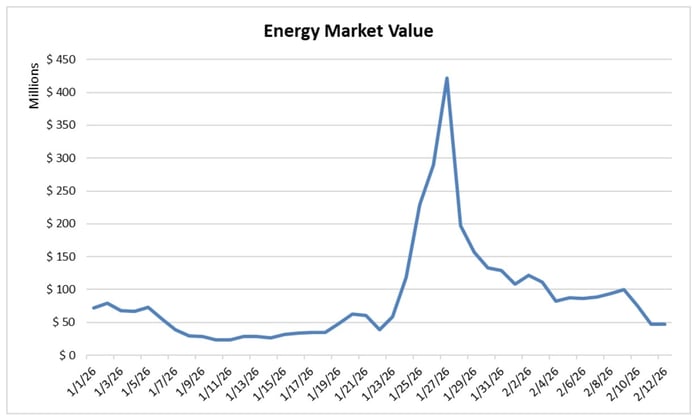
Following our coverage of Winter Storm Fern's record-setting market price impacts first in ERCOT, then PJM, WHiE now turns to ISO-NE — where the storm's effects were equally historic. The “Energy Market Value” — the total value of the day-ahead and real-time prices across zones — in January 2026 was the highest since the launch of the market in 2003. Additionally, January 27 was the highest daily Energy Market Value in the history of the market (ISO-NE presentation)!
____
We continue to follow the execution of agreements between Wisconsin Electric Power (WE Energies) and its large load customers: Vantage Data Centers and Microsoft. Over twenty filings outlining the agreements came through on March 2nd and March 3rd. Instead of sifting through all the filings, we asked Halcyon to describe them (response here). Though heavily redacted, the agreements reveal that Vantage will receive 25% of a "Full Benefits Resource" — an energy source offering with advantages beyond just electricity generation, often economic, environmental, health, and grid-reliability benefits — and that Microsoft is entering under a time-of-use rate plan (docket profile).
____
In North Carolina, a settlement agreement concerning the proposed merger of Duke Energy Carolinas and Duke Energy Progress estimates that the cost to retail customers in North Carolina will reach $286 million (settlement agreement). To offset this cost, the agreement states that the merger will reduce costs for $242 million by allowing for the removal of a battery energy storage project from Duke’s Recommended Portfolio and Near Term Action Plan. Duke plans to cover the remaining $44 million through “(1) reduced reliability purchases, (2) reduced operating reserves, (3) reduced online contingency reserves, and (4) fuel savings.”
And if Duke does not achieve these benefits:
If the newly consolidated Duke Energy Carolinas does not achieve these benefits 14 years after Legal Day 1 on January 1, 2027, the shareholders will cover the remaining balance, unless “the shortfall in achieving the Targeted Measurable NC Benefits is due to unforeseen circumstances outside of the direct control of the Combined 1U Utility, such as material economic, legal, or regulatory changes, the Combined 1U Utility shall be permitted to present information to the Commission regarding the overall benefits of the Combination, and if the Commission finds that the Combination has been in the public interest, no shareholder contribution may be required.” (docket profile)
____
In SPP, the upcoming Consolidated Planning Process Task Force Meeting (CPPTF) on March 10th will discuss three options for allocating transmission costs driven by large loads. It labels the three options as 1) Upfront, 2) Adder, and 3) Hybrid. Check out the graphic towards the beginning of the presentation prepared in advance of the discussion.
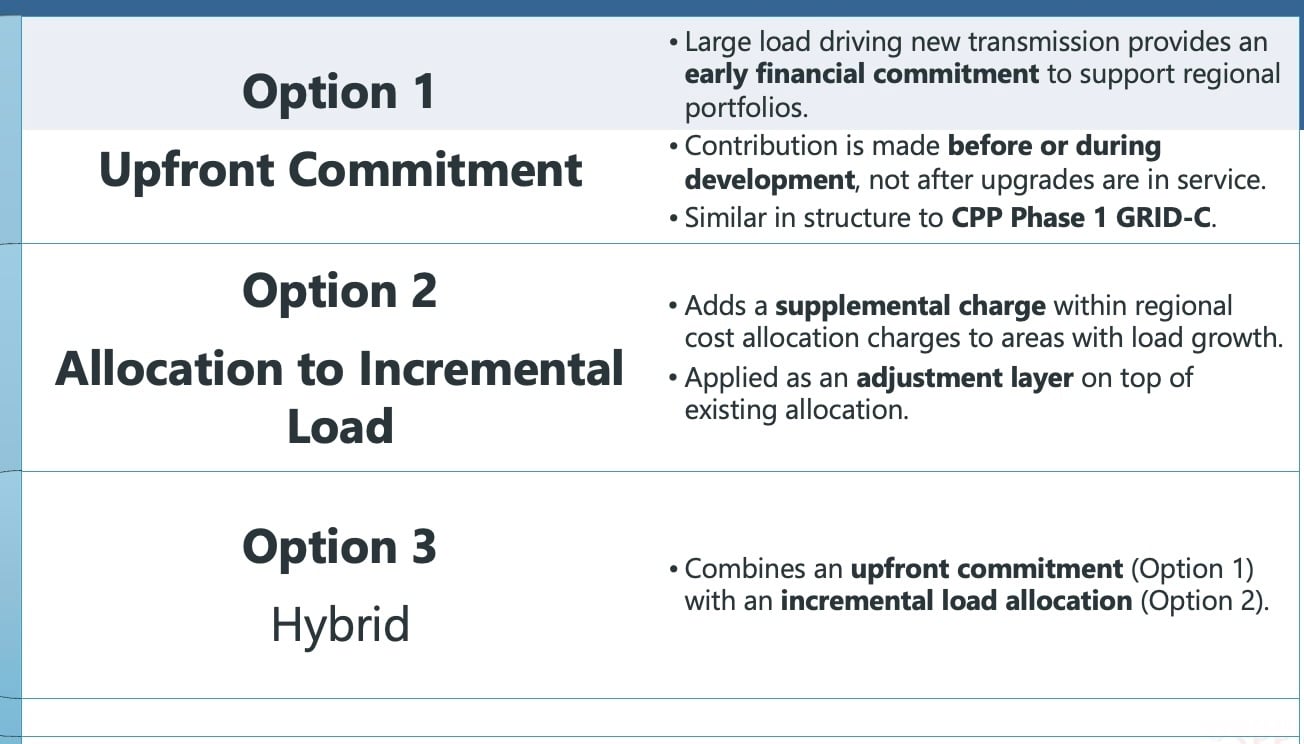
Dig into the presentation for all the gory details.
Halcyon angle: The presentation is packed full of excellent details and examples. But you might find it helpful to have a summary on hand that structures the information according to your preferences, so that you can refer back to the summary right before the meeting. We asked Halcyon to explain the options, describe the upsides and downsides of each option, and provide a concrete example for each option. Check out the structured response.
____
In FERC, a coalition of Independent Power Producers (IPPs, or the “MISO Generators”) filed a complaint in December 2025 regarding the adjustment MISO is proposing to make to the results of the 2025/2026 Planning Reserve Auction. The total impact of the adjustments is $280 million — with the brunt falling on overpaid IPPs. Last summer, MISO discovered that a “third-party software coding error” had been incorrectly calculating the Loss of Load Expectation (LOLE) using “all-hours” instead of “peak hours.” Although this error goes back to 2017, MISO is proposing to make “appropriate adjustments” only for the prior year under Section 12A of its tariff with the FERC. Last week, MISO filed its response to the IPPs.
MISO’s response explores the boundaries of procedural rhetoric. It is (wait for it) a “Motion for Leave to Answer and Answer to the Motion for Leave to Answer and Answer.”
Check out Halcyon’s response to a query to explain MISO’s legal arguments in the filing.
Halcyon angle: Two FERC dockets cover IPP complaints against MISO's handling of this issue: (EL26-35 and EL26-26). To track them, click the “Alert” icon (between “Query” and “Share”) at the top of the docket profile. This replaces the previous “Follow Docket” feature – you’ll receive a weekday email alert whenever new filings are added.
____
In Washington, Puget Sound Energy (PSE) filed its request for a multi-year rate increase with the Utilities and Transportation Commission (filing). In Rate Year 1, 2027, PSE is requesting to increase both electric and gas rates roughly 15% — that’s a $690 million and $191 million increase for PSE’s electric and gas operations, respectively (dockets for electric and gas).
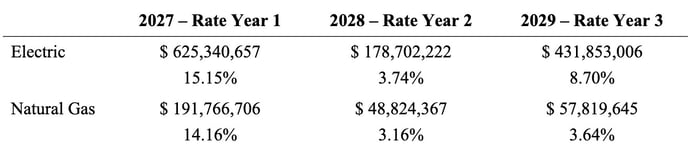
Halcyon angle: Did you know that Halcyon’s Rate Case Tracker includes a year-by-year breakdown of the proposed and authorized revenue requirements for IOUs across the country with multiyear rate increases? Learn more about the monthly data subscription here.
____
In MISO, Wisconsin Power and Light (WPL) filed a revised (and a less-redacted) version of the April 2025 application with the Public Service Commission (PSC) establishing Individual Contract Rate (ICR) service with a 220 MW large load customer. Although still heavily redacted, the revision now reveals that the ICR will set a fixed demand charge beginning June 1, 2028, with fixed increases over the contract's duration. The newly unredacted material also shows these charges will “reflect anticipated increases in capacity costs” stemming from MISO's implementation of Direct Loss of Load capacity accreditation in 2028/2029. (revised application, PSC Staff requests with unredacted passages: 1, 2, 3).
WPL expressed concerns about PSC Staff’s approach to requesting the disclosures in a letter to the Administrative Law Judge:
“WPL maintains that Commission staff’s approach for revisiting previously approved requests for confidential handling of these application materials at the technical hearing was untimely, highly irregular, and, in our view, inconsistent with the procedures and standards established under Wisconsin law and the Commission’s own regulations. Nonetheless, after conferring with our customer and in the spirit of transparency and administrative efficiency, WPL has elected to release a significant volume of information that would otherwise qualify for confidential handling under the law.” (WPL letter)
__
In Massachusetts, Eversource Energy submitted its 2025 Annual Service Quality Report. Before digging into the 111 pages of SAIDI, SAIFI, and CAIDI charts, we asked Halcyon to summarize the submission, with a focus on how Eversource’s system performed in 2025 compared to prior years, the main causes of grid faults, and what voltage levels were the most impacted.
Halcyon angle: If you haven’t noticed yet, we updated the look and feel of the in-line citations in our system. For a report like this, Halcyon saves you significant time by taking users directly to the source page for every response. Try refining the query (click “Refine Query” in the bottom left of the query response page) further with your own questions about Eversource’s report.
__
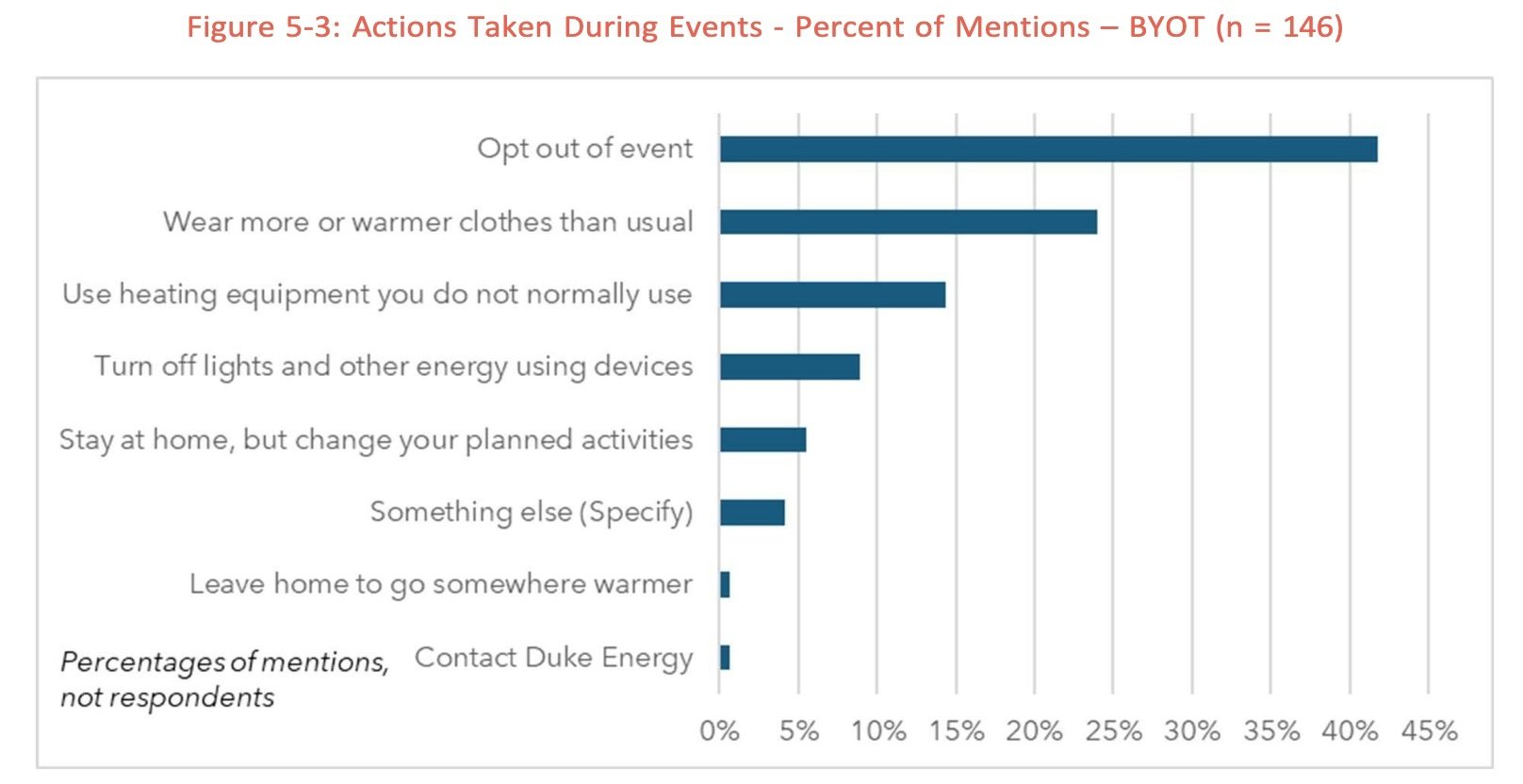
And back to North Carolina, Duke Energy Carolinas submitted its 2023-2024 Power Manager program as part of its Demand-Side Management and Energy Efficiency Cost recovery rider testimony. The program provides bill credits to residential customers who participate in a “Bring-Your-Own Thermostat” (BYOT) or a “Heat Strips Direct Load Control” (DLC) program (new to the term? heat strip defined). BYOT allows Duke to remotely adjust thermostat set points during “events”: peak hot or cold days. One chart shows the actions that surveyed BYOT participants took in response to these events. Although 42% of respondents opted out of participation, 24% of respondents wore “more or warmer clothes than usual” (Resource Innovations report).
__
Halcyon Team Query of the Week
-
In Texas, 21 cities passed ordinances and resolutions denying Southwestern Electric Power Company’s (SWEPCO) large load tariff for electric service (ES-LL contract for loads > 75 MW).
- A $1.5B deactivation project in Washington, DC – running ~$775 million over budget – exemplifies the broader trend of rising transmission costs. Query the Synapse study to identify the root causes and proposed responses to the rising costs of transmission.
- In California, PacifiCorp is seeking CPUC authorization to recover ~$340.5M recorded in its Wildfire Expense Memorandum Account (WEMA). Read how WEMA works, impact of cost recovery on PacifiCorp’s financial health, and how securitization of approved cost could lower bills for customers.
Public Comment Excerpt(s) of the Week
- In Colorado, the Vehicle-Grid Integration Council (VGIC) submitted comments to the Public Service Commission on Ford’s request for a Declaratory Order that certain home-backup charging systems not be classified as “interconnection resources”. VGIC argues that because these devices disconnect from the grid before discharging (i.e. “break before make”), they do not need an interconnection agreement (full comment).
“Classifying such verified, isolated systems as “interconnection resources” would impose administrative burdens without providing any grid safety benefit. As transportation electrification is expected to continue growing in Colorado, the unnecessary paperwork and administrative burden…must be considered. Without technical merit to justify these soft costs and/or application fees, they would serve only to create barriers to customer adoption with no incremental grid safety benefit.”
New Docket of the Week
- Check out the new FERC docket for PJM’s proposed Expedited Interconnection Track (EIT). To receive alert filings for the docket, click the “Alert” icon (between “Query” and “Share”) at the top of the docket profile or sign up for the curated PJM EIT alert to track discussions across FERC, PJM, and PJM states while suppressing motions to intervene.
In case you missed it, the most clicked item from last week’s WHiE