
What's Happening in Energy highlights the most interesting findings from public utility commission filings.
.png?width=50&name=34C0AE28-DE08-4066-A0A0-4EE54E5C1C9D_1_201_a%20(1).png)
What's Happening in Energy highlights the most interesting findings from public utility commission filings.
Hey there, it's Nat –
This week’s WHiE covers:
- Jurisdictional battles, a new Connect and Manage proposal for large loads, and more in the ongoing pressure cooker that is the PJM market,
- Using Halcyon to wrap your head around convoluted data request responses and Multi-Year Grid Plans,
- A request for proposals for 1 gigawatt of mid-duration battery storage in New England,
- A scrumptious cake analogy in a public comment against a rate hike in the Southwest,
- And much more!
Read at your leisure and choose your own adventure — skim the surface, or dive deeper with linked filings and Halcyon's suggested queries. A Halcyon query to start you off:
- In Arizona, Microsoft files exhibits for an upcoming hearing and proposes that customer-provided power and load interconnection queue reform are superior alternatives to Arizona Public Service Company's (APS) proposed formula rate plan.
What's Happening in Energy — May 15
Powered by Halcyon
____
In PJM, the Connect and Manage Senior Task Force presented (wait for it) its “Connect and Manage” plan. Under its proposal, large loads forecast to come online next year would be subject to curtailment if the capacity procured through future capacity auctions is less than the RTO’s reliability requirement (presentation). Here’s the summary slide.
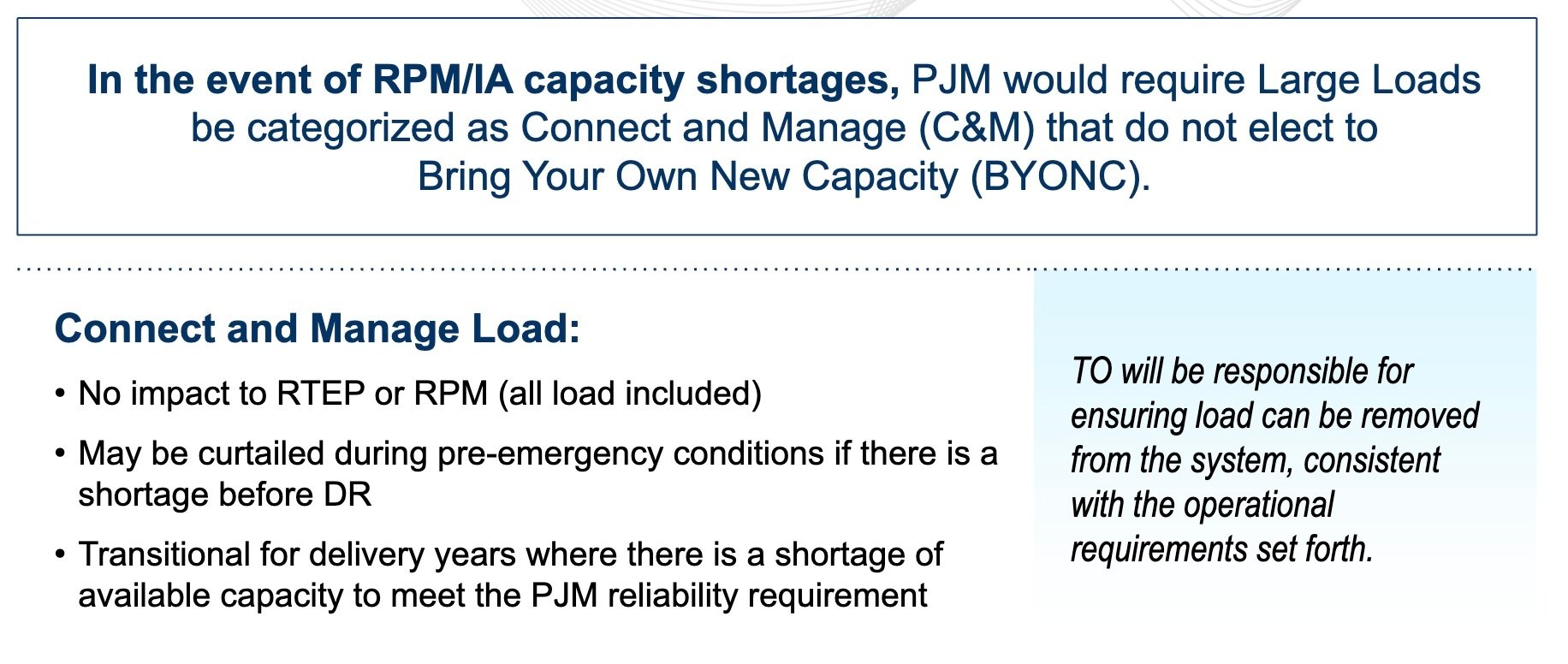
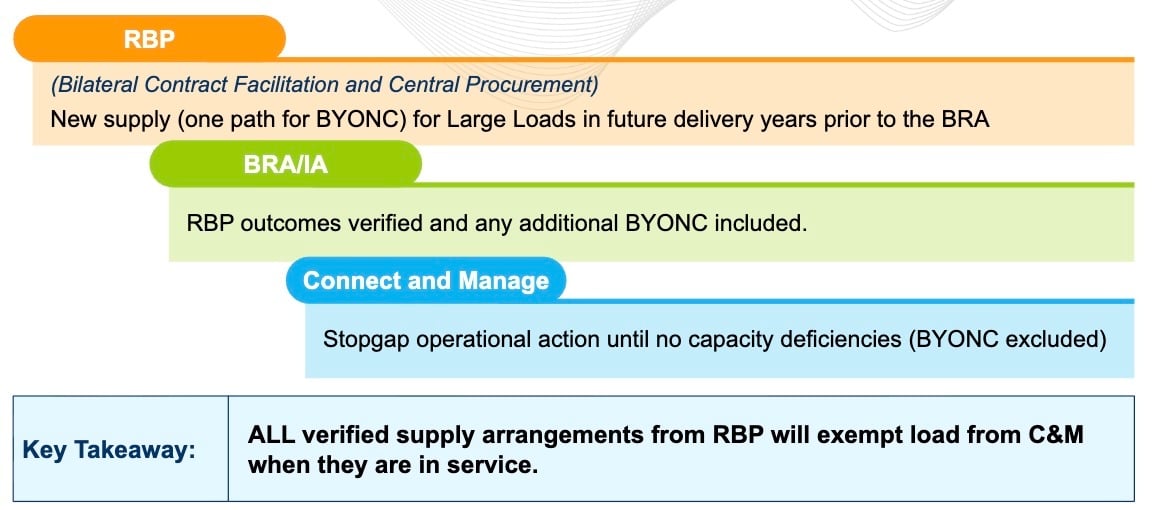
The January 2027 large load forecast will determine the cutoff: large loads not included in the summer 2026 peak contribution will be subject to curtailment. Those loads subject to Connect and Manage can offset how much they are exposed to PJM’s curtailment through “Bring Your Own New Capacity” (BYONC) contracts they enter into through the Reliability Backstop Procurement (RBP) or otherwise. Here’s a graphic to see how the Connect and Manage framework is nested under the RBP and the capacity auctions.
____
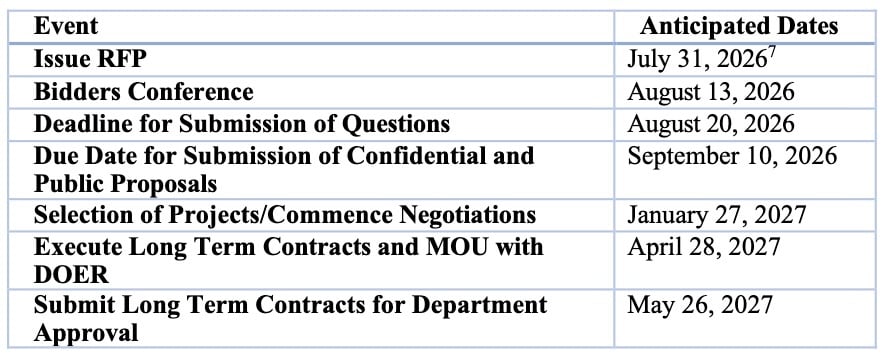
In Massachusetts, the Department of Energy Resources (DOER) submitted a draft RFP to the Department of Public Utilities (DPU) for 1,000 MW of mid-duration energy storage (docket). This is the second tranche of staggered RFPs issued to reach the statewide goal for Unitil, National Grid, and Eversource to procure 5,000 MW by 2030.
In a letter, DOER asked the DPU to confirm if this RFP should allow utilities to enter into contracts for energy service contracts and environmental attributes. We asked Halcyon to explain the difference between these contracts: Contracts for environmental attributes are like Renewable Energy Credits – the utility purchases credits and any proceeds from selling them would reduce customers’ bills. The energy service contracts would involve the utility topping up a developer if their strike price is higher than a reference price – the revenues a battery operator would be expected to earn through arbitrage (buy low-sell high) in ISO-NE.
RFP timeline below:
Set an alert for this docket to be notified when the Department responds.
____
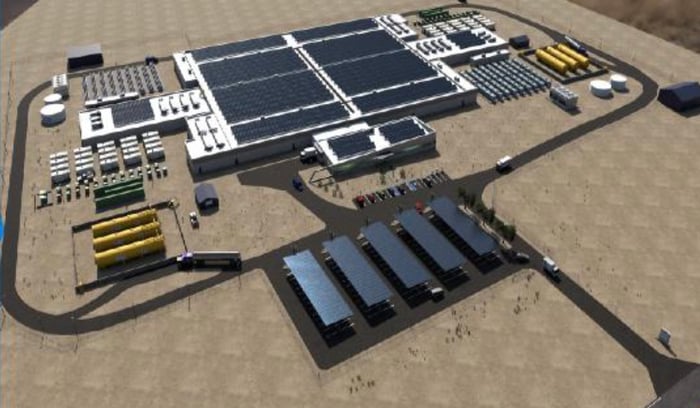
In California, RB Inyokern Data Center LLC submitted an application for a Small Power Plant Exemption (SPPE) from the California Energy Commission (CEC) (full application). This pathway exempts power plants 50 and 100 MW from needing a certificate from CEC. RB’s proposed data center would host 99 MW of backup diesel generators.
“The emergency generating facility, configured with two generator yards of 20 units each providing N+1 redundancy per yard (N+2 campus-wide), serves only on-site critical loads at a maximum 99 MW load consistent with Southern California Edison (SCE) Method of Service Study MOS174…The Project does not interconnect to the California Independent System Operator (CAISO)-controlled grid; interconnection is processed directly through SCE as the interconnecting utility under SCE’s retail tariff.”
If all goes as planned, the facility would become operational in 2031. Check out the sleek rendering from the application.
WHiE readers may have déjà vu from last July, when we covered Microsoft’s request for the same exemption for its 97.3 MW facility in San Jose. As of this week, the exemption is still pending.
____
Also in California, PG&E responded to data requests from the California Public Utility Commission (CPUC) about its 2027 General Rate Case (data request responses). Read the Halcyon angle to learn how we wrapped our head around this 97-page filing.
Halcyon angle: Halcyon’s proverbial fire hose of information inevitably means that you may stumble across a document with zero context of what came before or what key details are important. In this example, we received an alert that PG&E responded to a set of data requests from the CPUC, but we were not following the proceeding closely, so we had no idea what the utility was even responding to. In much the same way that an LLM can home in on granular details buried in many documents, it can also summarize granular details at a high level. We took this approach for this data response. First, we queried: “What major themes did the data requests seek to address about PG&E's rate case?” We then copied and pasted the themes identified in the response (litigation and bankruptcy settlements, post-test year (PTY) ratemaking and escalation, capital expenditures and distribution planning, transportation electrification, workforce planning, and operational efficiencies) into a new query to understand how PG&E responded specifically to questions on these topics.
____
In Pennsylvania, the Office of Consumer Advocate (OCA) filed a petition requesting that the Public Utility Commission review the need for the Mid-Atlantic Reliability Link (MARL) — a 500 kV transmission project identified through PJM’s regional transmission planning process (OCA petition for interlocutory review).
“PJM indicated that a high concentration of new, large, AI data center customer interconnections in other states drove the reliability “need” for MARL, which the OCA intends to investigate further…There is ample legal authority, as cited above, for the Commission to consider the costs and benefits of the MARL Project and whether the Project is consistent with state, regional, and national public policy objectives regarding allocation of costs for the siting and construction of large, AI data centers, notwithstanding PJM’s separate determination that there is a reliability need for the Project.”
The developer, NextEra Energy Transmission MidAtlantic (NEET MA), filed a brief in opposition to the petition earlier this week arguing that PJM’s determination of need for the line preempts the Commission (NEET MA brief). (It turns out that this brief is not the first time the Schrödinger’s Cat analogy has been referenced in the context of regulatory proceedings. In fact, filtering on the keywords "Schrödinger" and "Cat" yields 47 documents! Halcyon explained that this metaphor has been used "to describe perceived paradoxes in regulatory authority, evidentiary status, and administrative finality within the energy industry.")
“At its core, the Petition is asking the Commission to view the issue of “need” related to the proposed high-voltage (“HV”) transmission line and proposed electric transmission service that are the subject of the MARL Project as “Schrödinger’s cat.”...However, unlike the unobserved cat in Schrödinger’s thought experiment, the scope of the Commission’s authority to second-guess PJM’s determination of need is not in question; it is clear, defined, and undisputed that the Commission is preempted from such action.”
This is decidedly NOT a part of the Halcyon corpus or canon, but we do enjoy this illustration of the aforementioned quantum cat:
 (credit: Getty Images)
____
In Iowa, MidAmerican responded to an Order from the Utilities Commission for information on its summer preparedness (response). The utility referenced its experience during Winter Storm Fern when it had difficulty procuring adequate gas supplies for its generators over the weekend when gas markets had less liquidity.
“Given these challenges, MidAmerican encourages the Utilities Commission to urge MISO to adopt a more proactive and conservative approach to unit commitment during extreme cold weather events, especially when such events are expected to occur over a weekend, to support system reliability and fuel market efficiency.”
The utility also noted that MISO’s Expedited Resource Addition Study (ERAS) process has helped it bring new capacity online much faster. It referenced a side-by-side comparison of the reliability impacts of ERAS from NERC’s Long-Term Reliability Assessment on risk levels in MISO, showing lower energy risk now.

____
In ERCOT, the Reliability and Operations Subcommittee recommended PGRR145, the revision request guiding the implementation of “Batch Zero” for approval by the Technical Advisory Committee. Batch Zero would bring sanity to the flurry of large load interconnection requests in ERCOT by clearly defining how loads will be studied based on their project maturity. After Batch Zero, ERCOT will study large load interconnection requests in batches instead of a first come-first served approach. The key sections in the revised Planning Guide, 9.2.1.1 and 9.2.1.2, define the criteria for how large loads will be included in Batch Zero. “Base loads” will have their interconnection studies honored while others will undergo studies in Batch Zero. The document is the culmination of months of comments from market participants. Dive into the revised Planning Guide Section 9 here.
____
At the FERC, transmission cost allocation remains thorny. The Maryland Office of People’s Counsel (OPC) filed a complaint about PJM’s transmission cost allocation methodology for its regional transmission projects (complaint). The complaint argues that the methodology fails to align benefits with costs from the highly geographically concentrated network upgrades from data centers. The OPC is requesting that FERC fast-track the complaint and order PJM to refund Maryland customers. Read Halcyon’s explanation of the OPC’s concerns with the current methodologies and suggested improvements.
____
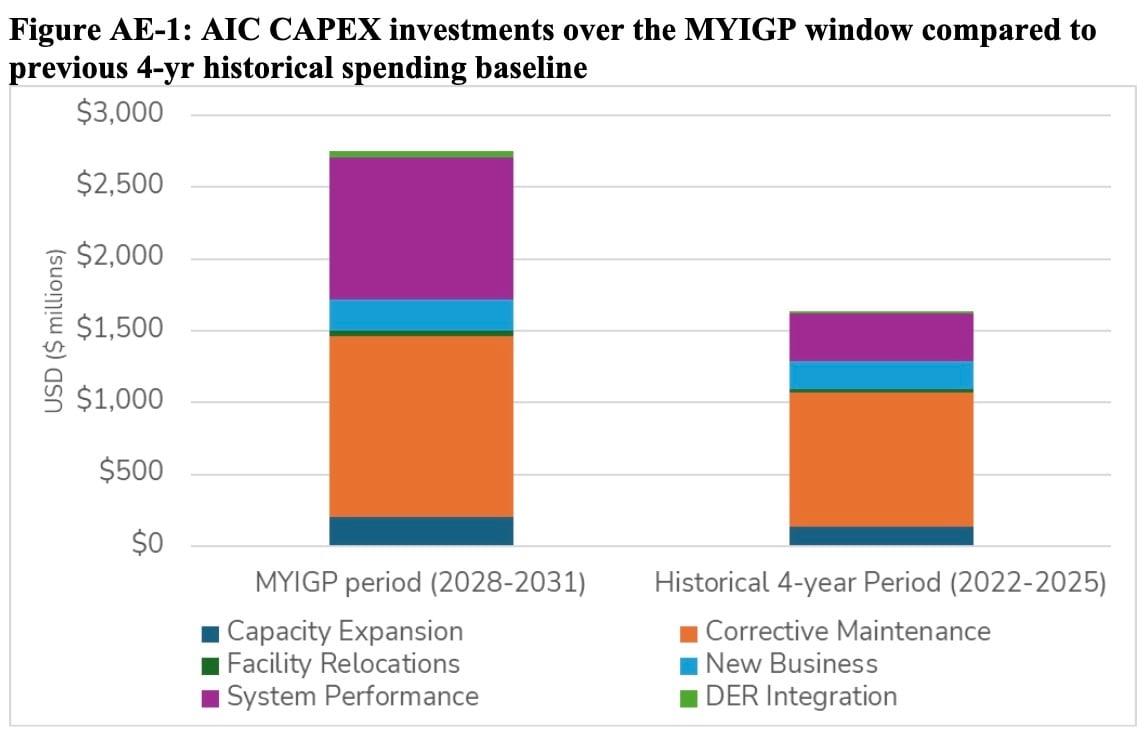
In Missouri, Ameren is requesting approval of its 2028-2031 Multi-Year Grid Plan. Read the Halcyon angle for an example of how to use the platform to research these types of proceedings and home in on key testimony excerpts.
Halcyon angle: Multi-Year Grid Plans, Integrated Resource Plans, Demand-side Management Plans, Grid Modernization Plans, etc. each contain hundreds of filings and dozens of stakeholders. Halcyon makes researching these plans easier. For example, stakeholders submitted testimony on Ameren’s Multi-Year Grid Plan last week.
- We started by querying the docket: “What are the key issues raised by stakeholders regarding Ameren's Multi-Year Grid Plan?” From the response, we learned that the capital expenditures in this plan dwarf spending from the previous plan.
- We then asked, “What are the largest capital expenditures that Ameren is proposing in its Multi-Year Grid Plan?” The response to this question brought us to a telling graphic submitted by the Citizen’s Utility Board (CUB), showing how 90% of the increased spending comes in the “System Performance” category (CUB testimony).
____
In New York, nearly 30 comments were submitted in the proceeding to address interconnection reforms for large loads — from stakeholders including the Joint Utilities, NY Power Authority, Natural Resources Defense Council, NYISO market monitor Potomac Economics, and more. Read a summary of these commenters' responses on how to accurately forecast and verify large load, which include suggestions like coordination, modeling, standardization, disclosure of committed and prospective sites under consideration, and a shift from binary to degrees of confidence for load forecasts.
____
Halcyon Team Query of the Week
- In Oregon, the Public Utility Commission issued an order addressing Portland General Electric's (PGE) marginal cost study and tariff rules for large loads and data centers – read Halcyon’s summary including details on the new large-load queue and a "potentially" expedited interconnection pathway for customers funding up to 100% of generation and transmission costs (where generation or transmission constraints are the cause of the delay).
New Docket of the Week
-
Also at the FERC, the Commission filed a notice that they will hold a technical conference on PJM’s governance and stakeholder processes on Thursday, July 23, 2026 (notice) “with a particular focus on identifying and evaluating actionable reforms to improve PJM’s ability to address system needs in a timely and efficient manner.” We translate that into our favorite phrase: speed to power. Set an alert for this docket to stay on top of when FERC and PJM respond by clicking “Create Alert” in the top right of the docket profile.
Public Comment Excerpt(s) of the Week
- In Arizona, residents are filing comments against APS’s proposed rate increase. One comment stuck out to us for its particularly vivid cake analogy.
“It has been brought to my attention that the 14% raise for APS customers is far out of proportion and gives APS share holders (sic) not only huba delicious cake but a fantastic frosting, while imposing costs to the rest of the population to the point of some having to ration when electricity can even be used. Arizonans will die this summer because of record breaking high temps. Will you be part of the helpful or part of the hurtful as you think on this in your marvelously well air conditioned homes.”
Most clicked item from last week’s WHiE
- SPP Large Load Integration & Operation presentation
- Transcript analysis for Dominion’s large load interconnection proceeding: Identify the main sections / areas of disagreement in this hearing transcript?