

Halcyon just launched its fourth data subscription, the Battery Energy Storage System (BESS) Tracker. We already track gas-fired power generation assets, large load tariffs, and rate case cost of capital proceedings; this subscription deepens and broadens our coverage of US power infrastructure for anyone building, financing, supplying, or underwriting its future. Similar to our other data subscriptions, the BESS Tracker updates monthly, drawing data from every US state public utility or service commission, Federal Energy Regulatory Commission, and ISOs/RTOs, in a corpus of 5.4 million (and counting) documents. As with our other subscriptions, building and updating the tracker means extracting specific, structured data from a wide array of unstructured context. This first version contains over 250 assets with a power capacity greater than 100 megawatts, and includes more than 25 data fields per asset. These fields range from asset ID and relevant docket, to storage capacity and...

In 1980, a man in Geneva started counting oil tankers. Former Rhodesian intelligence agent Conrad Gerber’s firm, Petro-Logistics, maintained a clandestine network of two dozen sources at major oil ports on the Black Sea, the Persian Gulf, and West Africa. For decades, when traders wanted to know how much oil OPEC really shipped, they read his reports.
In 2004, the ships started announcing themselves. The International Maritime Organization began requiring Automatic Identification Systems (AIS) on all ships over 300 gross tons, effectively broadcasting ship location and movement. But it lacked detail: how much, whose, headed where? Big trading shops built that picture in-house, but everyone else had to stitch it together from broker reports, port agents, and customs data — all of which lagged.
Ten years later, an LNG trader was tired of pitches for ship-tracking software. He didn’t care about the ships. He cared about their cargo. A carbon-credit startup saw the opportunity, pivoted to LNG, and became Kpler. It showed what each ship carried, who sold it, and who bought it. Traders stopped stitching that picture together in spreadsheets.
Today, the $850 billion energy buildout is powered by spreadsheets. Filings land every day, but data center developers choosing between utility territories still base massive decisions on stale data.
Not anymore. Today, four of our Data Subscriptions (Gas Power Plant Tracker, Battery Energy Storage Systems Tracker, VPP Explorer and IRP Explorer) have evolved beyond static reports and now live directly in Halcyon’s platform as continuously updated Grids. Grids are living, breathing, structured tables that make Data Subscriptions more recent, more customizable, and a stronger starting point for deeper research with Halcyon.
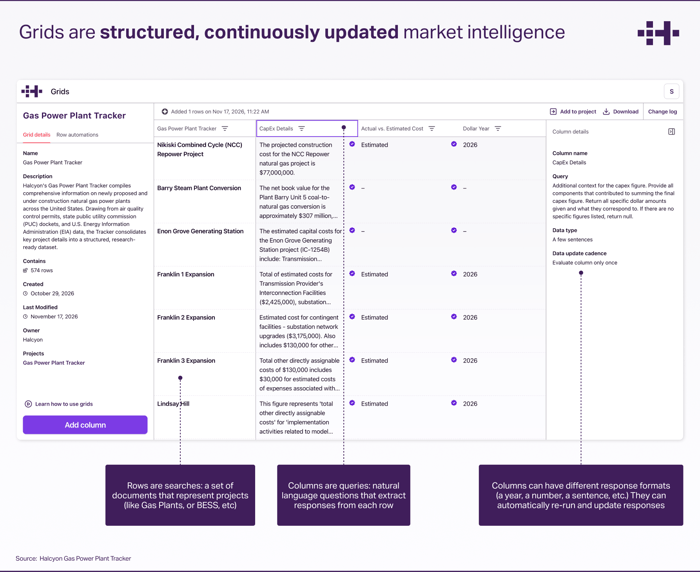
When we first launched Data Subscriptions, we assumed that a monthly spreadsheet verified by energy experts was a meaningful improvement to the quarterly, bi-annual, or ad-hoc reports that represented the status quo. It was an improvement, but it wasn’t enough. Spreadsheets age the day they ship and they represent only the creator’s view of what matters.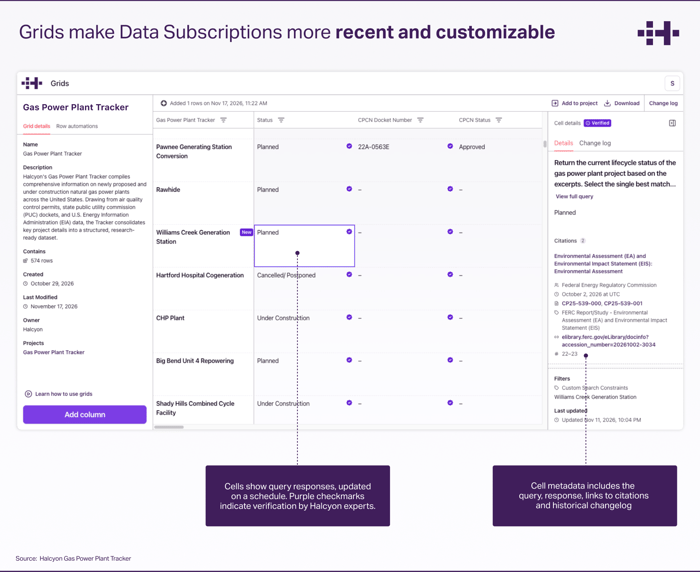
We believe that technology can do better:
Better freshness: A developer can identify a behind-the-meter gas generation project tied to a data center when the filing drops, not a month later
Better customization: That developer can scale intelligence and back out cost projections using their own formulas across 500+ gas projects, in less than an hour
Better history: An investor in one of those gas projects can use cell-level changelogs to see exactly when project’s capacity or timeline shifted
Better research: That investor can leverage the Halcyon-built search constraints that define a gas or battery project as a jumping off point for deeper interrogation and monitoring
Better integration: When coupled with our API, the intelligence can move beyond static spreadsheets and directly into real-time workflows. (We know many of you prefer to work with excel files — don’t worry, you can still take a snapshot of a Grid and download it at any time.)
Those of you suspecting that we built technology to make all this possible are exactly right. Read more from our Sr Staff Eng William Hakim about significant innovations that made this shift possible in Part 2.
Over the next few months we’ll migrate the remaining Data Subscriptions to Grids. We’ll be able to build new Data Subscriptions faster. Soon, we’ll enable customers to make their own Grids, so they can create their own Data Subscriptions. We’re already building powerful custom Data Subscriptions for our customers — just ask your analyst what spreadsheet they’re tired of maintaining by hand. We’ll build it with you.
It took 30 years to get from spy network-based intelligence to technology that helped LNG tankers announce themselves. It was another decade before intelligence about what they were carrying became accessible in a timely manner. The intelligence behind the energy buildout has been public from the jump. Fortunately, energy professionals won’t have to wait another decade before it’s useful.