
INVESTORS + DEVELOPERS
See which utilities plan to add gas, solar, wind, or storage, how many megawatts, and when, so you can size the opportunity before an RFP is issued
316 plans from 200 utilities, filed since 2020
46 states, across investor-owned utilities, CCAs, municipals, and cooperatives
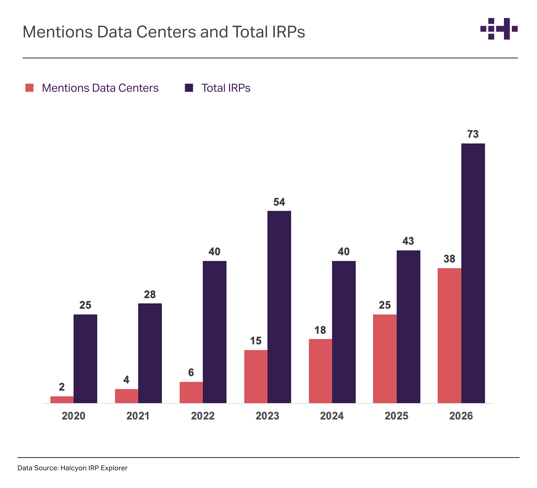
112 plans address data center or large load growth, with 8 curated columns plus your own
See which utilities plan to add gas, solar, wind, or storage, how many megawatts, and when, so you can size the opportunity before an RFP is issued

Benchmark your load forecast, capacity value assumptions, and scenario design against peer plans across every state commission

Find the utilities that are planning for large loads, how much they expect to serve, and how they allocate the cost of serving it

Trace planned coal and gas retirements, resource additions, and peak demand growth that shape supply, prices, and volatility over the planning horizon
Halcyon-curated data are a starting point. The real power of the IRP Explorer is that you can add your own columns, asking tailored questions according to your needs. The dataset is a grid: plans are rows and questions are columns. When you add a column with your own question, Halcyon runs it across every plan in the dataset, and each answer is tied back to the underlying filing. That turns a stack of thousand-page documents into a research tool you can shape to your own work. A few examples of columns you could add:
Each of these would normally take weeks of reading across dozens of dockets. In the IRP Explorer, it only takes a few clicks.
Integrated Resource Plans have been the backbone of utility planning for decades. On a consistently irregular cadence, a utility files a plan with its state commission forecasting how much load it expects to serve, what resources it has, and what it intends to build or retire to meet that load. Some call it an IRP, others a Ten-Year Site Plan, a Multi-Year Grid Plan, or a long-term resource plan. The name changes by state, but the core question does not: how will this utility keep the lights on at a cost that's just and reasonable?
Today, that question is harder to answer. Data centers, manufacturing, and electrification are driving up load forecasts after years of flat demand, while utilities weigh coal and gas retirements, interconnection queues, supply chain constraints, and policy targets. IRPs have become one of the most important signals in the energy market. The problem is that they are long, inconsistent, and scattered: a single IRP can run thousands of pages across a main volume, appendices, and workpapers, filed under dockets that differ by commission.
The IRP Explorer is a tracker of more than 300 IRPs and comparable long-term resource plans filed since 2020. It covers both electric and natural gas utilities, and spans investor-owned utilities, municipals, and cooperatives. Every plan is identified in Halcyon's catalog of state commission filings, and every data point is reviewed by our analysts.
The Explorer comes with eight curated columns that make it easy to navigate and join to third-party datasets such as EIA. Halcyon adds new plans as utilities file them, so coverage keeps growing.
|
Column |
Description |
| Utility Name | The utility that filed the plan. |
| States | The state(s) of the utility's jurisdiction that the plan covers. |
| Start Year | The first year of the planning horizon. |
| End Year | The last year of the planning horizon. |
| EIA Utility Number | The utility's EIA identifier, for joining to EIA-861, EIA-860, and other federal datasets. |
| EIA Ownership Type | Investor-owned, municipal, cooperative, etc. |
| Data Centers | True / False: whether the plan addresses data center or large load growth. |
| Data Centers Description | The plan's mentions of data centers, large loads, and how they impact forecasts, scenario planning, and cost allocation. |
| Your Own Columns | Add a column with any question, and Halcyon answers it across every plan in the dataset, with each answer tied back to the underlying filing. |
Showing seven of 300+ plans. Updated as utilities file new plans.
Halcyon added the data center columns as an example of the rich information these plans hold. Data centers have quickly become the largest source of uncertainty in utility load forecasts, and every utility is handling that uncertainty differently. Some build explicit low, mid, and high cases. Others add confirmed projects one by one, discounted for how much requested load will actually show up. Some run a separate forecast without data centers at all. The Explorer also captures change over time: Lakeland Electric's 2024 Ten-Year Site Plan does not address data centers. Its 2026 plan does.
| Loading… |