
HYPERSCALERS + LARGE LOADS
Match capacity needs with target markets, and enter conversations with an understanding of how programs connect to utility resource needs and wholesale markets
112 programs from 52 utilities and statewide administrators
35 states across 7 ISO/RTOs and non-ISO territories
18 curated columns, plus unlimited questions of your own
Match capacity needs with target markets, and enter conversations with an understanding of how programs connect to utility resource needs and wholesale markets

Generate leads by identifying current and projected enrollment, budgets, and goals of VPP programs to spot shortfalls and commercial opportunities

Underwrite one of the fastest pathways to capacity in the next 3-5 years by identifying the vendors, markets, and utility programs connecting load growth with existing capacity

Benchmark program design, administrative models, budgets, and incentive structures against peer utilities before filing or ruling on a new program
The dataset itself is a rich source of information, but the real value of the VPP Explorer comes from two pieces of infrastructure Halcyon provides: authoritative context and queryability. The context is Halcyon's corpus of regulatory filings from every state commission. The queryability comes from the gridded structure of the dataset, which organizes programs as rows and queries as columns. That lets you add your own queries across all the programs, with responses tied back to the regulatory record, returned in whatever format your analysis needs. A few examples of columns you could add:
Each of these would normally take weeks of reading across dozens of dockets. In the Explorer, it is a few clicks.
Halcyon built the VPP Explorer to help. It includes 100+ virtual power plant and demand-side management programs: programs or riders in which utilities or third parties directly control distributed energy resources or direct load control devices to provide flexible capacity, distribution grid services, energy to offset reserve margin requirements, or emergency load reductions. Programs range from early-stage pre-enrollment to fully mature, with structures including bring-your-own-device, aggregation, storage, flex DR, and more.
Tracking this rapidly changing landscape means hunting for information throughout a fragmented regulatory system, with key program details sprinkled across distribution system plans, rate cases, demand-side management dockets, and integrated resource plans.
The VPP Explorer is maintained using Halcyon to continuously detect new VPP/DSM dockets, IRP filings, and rate cases across all 50 state commissions + DC and extract specific program names. Then, programs are added to the Explorer one-by-one as searches filtered to the relevant commission, keywords that combine the utility and program name, and a date range for recency. The platform automatically populates the Explorer for each additional program added, and then Halcyon SMEs manually validate each cell to confirm accuracy. The result is an always-on queryable tool maintained by the Halcyon team.
|
Column |
Description |
| Utility | The utility that administers the program ("Statewide" if state-administered). |
| State | The state that the program is available in. |
| ISO/RTO | The ISO/RTO that the program is available in. |
| Description | Brief description of program structure, technology eligibility, and goals. |
| Rate Schedule or Rider | The tariff, rate schedule, or rider describing the compensation that enrolled customers receive under the program. |
| Customer Class Eligibility | Customer classes that are eligible to participate in the program (Commercial, Residential, Industrial). |
| Approved (T/F) | True / False: whether the program has been approved by the Commission. |
| Administrative Model Type | The administrative model of the program: utility-administered, third-party administered, utility-administered through third-party DERMS, and more. |
| Administrative Model Type Details | Details on the administrative model type, including the contractual arrangement the utility has with third-party implementers. |
| Contracted Vendor | The contracted vendor responsible for dispatching devices, supplying DERMS, and/or aggregating or enrolling customers in the program. |
| Participation Cap and Enrollment Details | Details on participation caps and enrolled customers or capacity in a program. |
| Budget Details | Details on budget caps, future budgets, or reported historical expenditures relative to budget. |
| Minimum Flexible Capacity (kW) | The minimum amount of flexible capacity that a customer must provide to participate in the program. |
| Capacity Contribution Pathway | How the utility or state utilizes capacity from the program: utility resource planning, ISO/RTO markets, or both. |
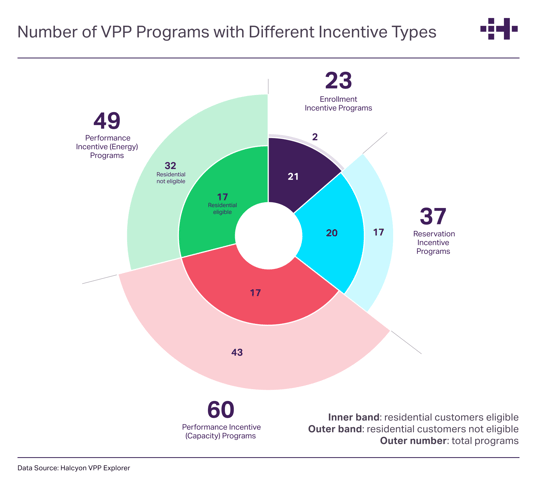
| Maximum Enrollment Incentive | The maximum incentive customers receive for enrolling in the program. |
| Maximum Reservation Incentive | The maximum incentive customers receive for providing flexible capacity, regardless of performance. |
| Maximum Performance Incentive (Capacity) | The maximum incentive customers receive for providing flexible capacity, validated by performance verifications. |
| Maximum Performance Incentive (Energy) | The maximum incentive customers receive for providing verified energy reductions, primarily in $/kWh. |
| Your Own Columns | Add a column with any question, and Halcyon answers it across every program in the dataset, with each answer tied back to the regulatory record. |
Showing a sample of 100+ programs. Updated weekly.
New programs are reshaping what a VPP can be, with utilities and states moving from legacy direct load control toward aggregator access, bring-your-own-device enrollment, and capacity that counts in resource plans and wholesale markets. The Explorer tracks each program from straw proposal through approval, launch, and verified enrollment, so you can see where capacity is actually coming online.
| Loading… |