

Everyone talks abstractly about the grid buildout, transmission constraints, and interconnection queues; much like a microwave oven and non-dairy powdered creamer, “no one really knows how it works.” There is an aura of mystery surrounding our electrical grid that energy professionals don’t necessarily discourage.

If you’re a Real One™, you may have gotten sporadic emails from Be Advised, a low-bandwidth, low-latency email service surfacing hot intel on (mostly) speed-to-power for AI data centers. They have been fun to write—and even more fun to see people share! And now that we’ve sent more than a hundred Be Advised notes, I have some takeaways on how AI compute is actually getting power.

To Catch a Data Center
Most data centers don’t get individually named in public utility commission (PUC) dockets, unless they’re large enough to justify bespoke infrastructure. The transmission service agreements (TSAs), energy service agreements (ESAs), and power purchase agreements (PPAs) that underpin interconnection are typically confidential bilateral contracts.
Air permits, however, are a different story. Most data centers use diesel backup generators to maintain uptime, and those require public-facing air permits. And for those data centers with behind-the-meter power, an air permit is the primary permission for those energy assets. If you count the number of generators (and the kilowatt output of those generators), you can estimate the total building power of the data center! (Note, however, that megawatts measured at the meter are not the same as megawatts of compute.) Those air permits can also help you catch concrete batch plants. Turns out construction crews must mix concrete on-site (or within a few miles), and the diesel-powered mixers need their own air permits. Halcyon currently has air permits for 18 states and counting, starting with the states with the biggest data center buildouts.
However, these air permits (and associated PUC filings for the really big fish) rarely name the actual developer behind the data center. Developers like hiding behind LLC names (think Rizzler Ridge II, LLC) to dodge the exact snooping you and I are doing. But between email slugs, business entity searches on state websites, and good old-fashioned pins on maps, you can piece together the clues for yourself.
Not All On-site Power Is the Same
The data centers that do show up in utility PUC dockets tend to have large, on-site grid assets attached to them: gas generation, battery energy storage, intermittent renewables, bespoke transmission assets. We track these as Data Subscriptions, by the way. The off-grid projects are almost all gas: we’re starting to see more on-site renewables projects, but we haven’t seen one stack enough batteries to keep a data center fully off-grid (yet).
But on-site power varies widely: a lot of these projects trade efficiency (both in fuel and in maintenance costs) for speed-to-power. This means using unconventional gas generation technologies—banks of small turbines, trailer parks of reciprocating engines, solid-oxide fuel cells-–to achieve commercial operating dates (CODs) around 2028 or 2029. But the conventional, high-efficiency, super-large H-class combined cycle gas turbines (CCGTs) are on the way! Sure, the lead times are long, but the first orders were placed back in 2025, so developers are reporting CODs between 2030 and 2032. Right now, two years is a massive head start in the race for compute, so there’s an economic reason to rush. But these power projects have ten-, fifteen-, or twenty-year contracts. Eventually, efficiency will matter to data centers, and H-class CCGTs are the reigning champs on that front.
Developers Are Getting Creative
I have a top-three list for Most Creative Data Center Power Solutions.
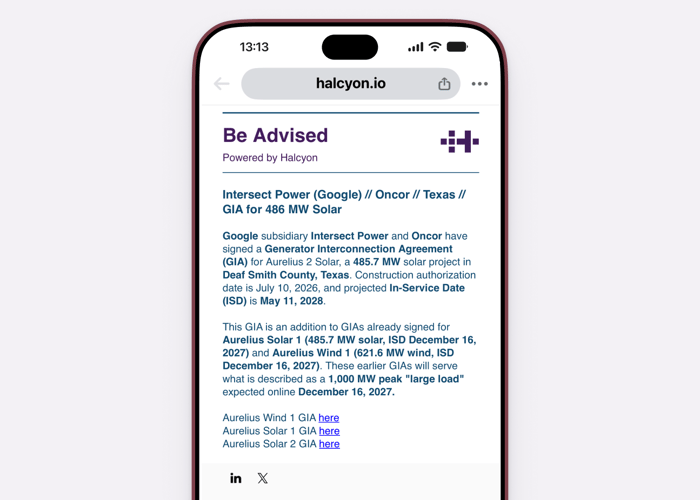
For bronze, I submit the Aurelius/IP Roman site in Deaf Smith County, Texas by Google subsidiary Intersect Power. This project has 622 MW of wind generation, 971 MW of solar generation, and 1,474 MW of gas generation from 640 engines producing 2.6 MW each. The idea is to rely on renewables where you can, and use the gas generators to fill in the gaps. It’s a lot of kit, though.
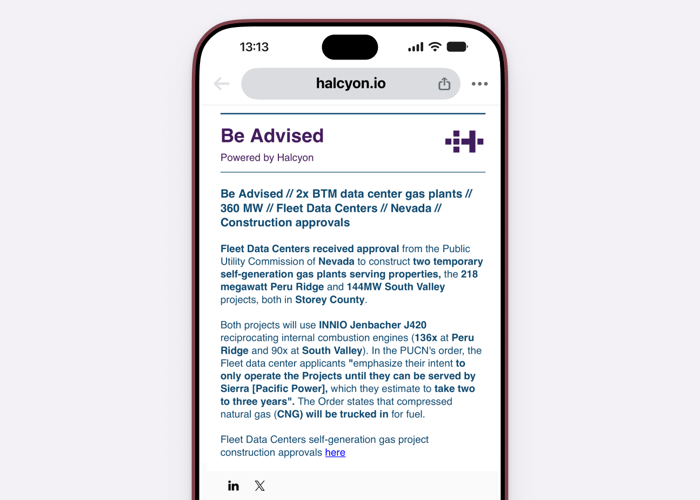
For silver, I submit the Peru Ridge and South Valley sites in Storey County, Nevada by Fleet Data Centers. This is 360 MW of data center power that will be supplied for two to three years by trucked natural gas. We caught this on September 18, a few weeks before news broke on Oracle doing the same thing.
And for gold, my favorite work of creative power supply, I submit Fluidstack’s site in Sullivan County, Indiana. On paper, it has a surprisingly small fleet of diesel generators, a feat the informational website crows about. But the location on its air permit lines up suspiciously well with one Hallador Energy filed for a pair of refurbished F-class gas turbines. Hallador found them in the Philippines, where they’d sat used for 13 years after being bought for an LNG project.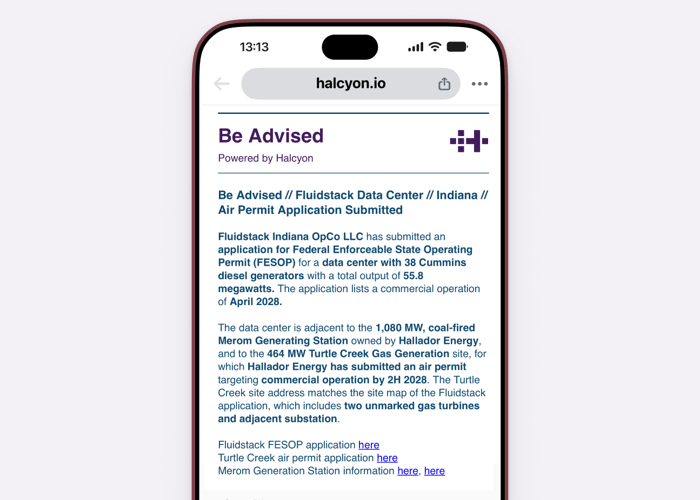
Utilities and PUCs Want the Cash Up Front
This creativity makes sense in context—AI compute has proven to be the highest-value-add use of electricity by a fat margin, so speed-to-power can justify unconventional solutions. But many stakeholders in electric regulation don’t believe the hype. The North Carolina Utilities Commission (NCUC) denied an application for a 255 MW gas plant because it saw the underlying load as “speculative.” Staff at the Public Utility Commission of Texas (PUCT) shot down cost-recovery provisions for a similar-size plant for Meta because they didn’t believe local utility El Paso Electric had done appropriate due diligence.
But money ultimately talks, and both utilities and utility regulators are willing to parley with data center developers if the developers make enough (credible) commitments that existing customers won’t be left holding the bag. These commitments are turning into a standard shape: the large load tariff. The specifics change from utility to utility and state to state, but the broad strokes reflect a universal interest in pinning as much financial risk as possible on the data center developer without convincing that developer to simply build an off-grid energy solution. These tariffs include minimum term lengths (ten, fifteen, twenty years), minimum billing demand (often 80–90% of some peak figure), collateral requirements (sometimes tied to credit ratings), and increasingly, obligations to curtail load during power supply crunches. There's a Data Subscription for these, too.
These tariffs sometimes include generation assets too. Although many data center developers are turning to powered land developers, independent power producers (IPPs), or internal teams to procure power supply, others defer to local electric utilities to find the electrons. This amounts to paying utilities to build new capacity resources separate from the rate base charged to customers. DTE is a good example here: it has put Oracle on the hook for $665 million (and counting) of battery energy storage, and has secured a similar “Clean Capacity Accelerator Agreement” with Google.
RTOs Are Trying Load Flex and BTM
Regional Transmission Organizations (RTOs) have a different angle. Because they are statutorily prohibited from issuing anything like a large load tariff, they must rely on a different set of tools to keep their networks from browning out because of data centers. They’ve also got eyes on them: on June 16, 2026, the Federal Energy Regulatory Commission (FERC), with the demeanor of that coin toss scene in No Country for Old Men, issued a Show Cause Order asking each RTO to justify (or reform) its large load integration policies.
Since the RTOs can’t directly ask data center developers to pay up and are struggling to speed up their generation interconnection queues, they’ve converged on solutions they can implement: load flexibility and expedited interconnection for large loads that bring their own capacity assets.
The Southwest Power Pool (SPP) has been the trailblazer, with a temporary load flexibility program called Conditional High Impact Large Load Service (CHILLS) and a more permanent approach called Price Adaptive Loads (PALs). The Midcontinent ISO (MISO) has adapted a different SPP program into a new Zero-Injection Generator Interconnection Agreement (ZGIA) that aims to speed up interconnection for large loads that bring co-located generation with them. Meanwhile, the beleaguered PJM Interconnection recently had both its load flexibility program, Interim Resource Adequacy Service (IRAS), and its Bring Your Own New Capacity (BYONC) program shot down by FERC. Yes, the RTOs like their acronyms; at least SPP has fun with them.
ERCOT, down in Texas, has the same challenges as the other RTOs. However, it has the statutory authority to leave FERC on read, allowing for fresher approaches. One is a batch study process, which seeks to evaluate multiple large loads at once instead of having multiple load studies stepping on each other’s toes. This starts with Batch Zero, which has already racked up complaints from developers who don’t like where they landed in the process. The Public Utility Commission of Texas (PUCT) has been sympathetic to Batch Zero, but should it collapse for any reason, I think ERCOT is preparing a backup plan.
It starts with Goodnight Wind, a 265.5 MW wind farm on the only real transmission line between Lubbock and Amarillo. Crusoe, under the holding company Ensign Infrastructure, requested net-metering clearance to build a 265.5 MW data center at the same point of interconnection. ERCOT said sure–if Crusoe let ERCOT curtail the data center, at the breakers, with thirty minutes’ notice, without compensation, whenever ERCOT asks. And the PUCT agreed. Crusoe laid the groundwork to build another 260 MW wind farm and 260 MW data center at the same interconnection, and the PUCT slapped the same curtailment conditions on the second data center.
ERCOT had found an angle.
When Hut 8 requested a net metering arrangement for a 180 MW data center and 204 MW solar farm, it got the same curtailment order that Crusoe did. And now that Amazon is requesting a net metering arrangement for a 1,200 MW data center and the 2,400 MW Comanche Peak nuclear power plant, ERCOT is requesting another curtailment order, with the PUCT staff in agreement. In each case, ERCOT argues that the bulk power network needs the transmission and generation capacity more than the co-located data center, even if ERCOT’s own studies don’t identify any problems at the moment. And Hut 8, particularly, didn’t resist this ruling, because it believes the alternative to this curtailment order is a re-study it can’t afford to wait for.
Remember: these curtailment orders are the kind of load flexibility policy that other RTOs want from data centers. But they didn’t require FERC approval, and they have nothing to do with Batch Zero, nothing to do with Texas’s famous SB 6 law on data centers, and nothing to do with the recent elections. This is a regulatory back door that the Public Utility Commission of Texas has allowed ERCOT to spam, and ERCOT will use it to impose curtailment orders on data centers with on-site energy resources–you know, the hot trend in Texas for the past year or more–until someone tells it to stop.
Ensign (now that Crusoe swears it’s no longer involved) has chosen to escalate to a district court. Ensign will look for someone who will tell ERCOT to stop, and it will find allies in that search.
And if you aren't Getting Advised about it yet, drop us a note with your use case, and we'll plug you in.