

What's Happening in Energy highlights the most interesting findings from public utility commission filings.
- A review of export and import dynamics from the first summer of the Extended Day Ahead Market (EDAM) in the West,
- Approved electric service agreements between Google & Oklahoma Gas and Electric in the South; and
- Tens of billions of dollars of proposed transmission upgrades across PJM,
And more.
Subscribe to get these insights delivered straight to your inbox:
What's Happening in Energy — Nov 6
Powered by Halcyon
____
Draft Standard Large Load Interconnection Agreement // SB 6 // Texas
The Public Utility Commission of Texas released the draft Standard Large Load Interconnection Agreement for comment. Large loads that choose to move forward after Batch Zero would be required to sign this agreement.
The agreement can be signed as either a bilateral or a trilateral contract among the large load customer, the retail electric utility, and the transmission service provider. It would set interconnection costs, site control requirements, financial security provisions, and more. Commission Staff requested comments on several questions, including how large loads could reassign their obligations under the agreement, what language to include for MUNIs and co-ops to pass through costs to serve large loads, and more. Comments are due December 14, 2026.
____
EDAM’s First Summer // CAISO // PacifiCorp
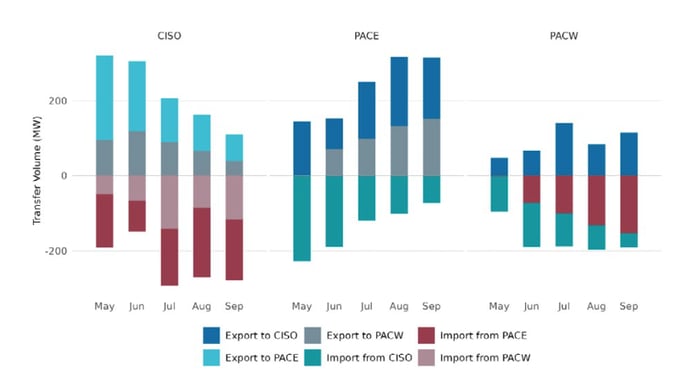
The California Independent System Operator (CAISO) released a concise report on how Extended Day Ahead Market (EDAM) performed in its first summer. The market’s current participants are CAISO and PacifiCorp (PacifiCorp East and PacifiCorp West).
Early this summer, CAISO was a net exporter of excess solar to PacifiCorp. As the summer went on, CAISO became a net importer of energy and reliability products from PacifiCorp. PacificCorp’s wind, gas, and hydro resources helped CAISO balance its market as hotter weather drove demand higher later in the summer. Here’s a chart of the evolving imports and exports between the zones. (PACE = PacifiCorp East; PACW = PacifiCorp West.)
____
Statewide DER Orchestration // California
The California Public Utilities Commission released a draft decision that, if approved, would give Pacific Gas & Electric (PG&E), Southern California Edison (SCE), and San Diego Gas & Electric (SDG&E) 12 months to prepare a “Joint Distributed Energy Resources (DERs) Orchestration Application.” The application proposes a framework to help Investor-Owned Utilities (IOUs) overcome several longstanding barriers to orchestrating DERs (interoperability, communications, and siloed program offerings) and connect needs identified in distribution system planning with DER deployment. To track the docket, open it here and click “Create alert” in the top right.
____
Up and to the Right // 2026 IRP // Arizona Public Service
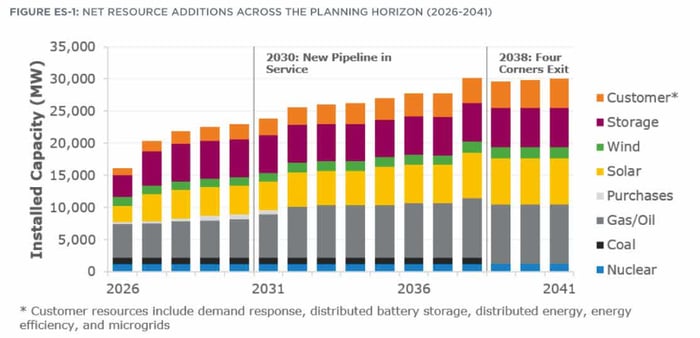
Arizona Public Service filed its 2026 Integrated Resource Plan. Its Preferred Portfolio adds:
- 4 GW of solar
- 500 MW of wind
- 2.7 GW of battery storage
- 4 GW of gas
“Customer” resources from distributed energy resources (DERs) also constitute a growing share of the utility’s portfolio.
Also, be sure to check out the 2026 IRPs from Tucson Electric Power, Arizona Electric Power Cooperative, and UNS Electric.
Halcyon angle: Interested in comparing these IRPs alongside others? Check out Halcyon’s IRP Explorer.
____
$66 Billion of Transmission Proposed // RTEP // PJM
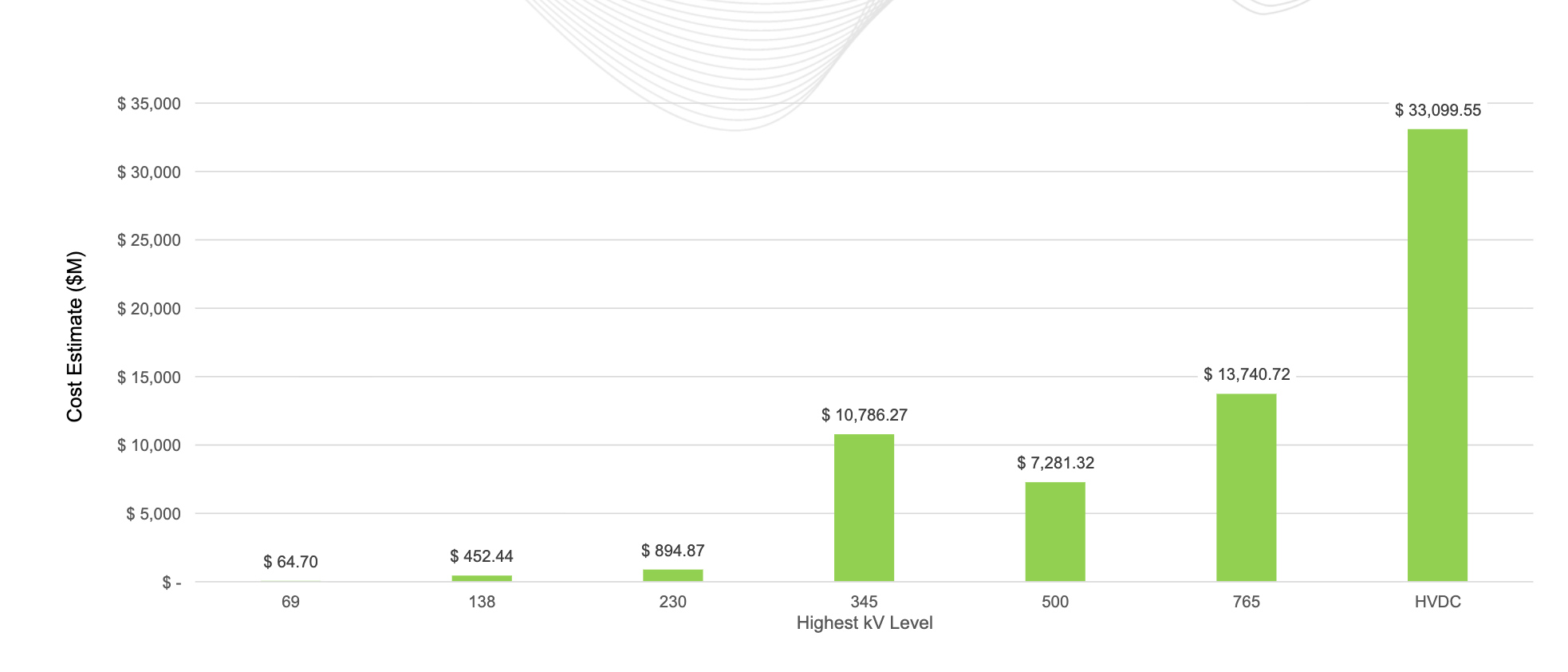
Results from Window 1 of PJM’s 2026 Regional Transmission Expansion Plan (RTEP) include $66 billion of proposals to address reliability needs across PJM over the next five years. The RTO received 72 proposals from incumbent and non-incumbent developers most of which included advanced transmission technologies such as High Voltage Direct Current (HVDC) or advanced conductors.
The ComEd zone had the most proposals (29) and the highest total proposal costs ($49 billion). The charge below breaks down total proposal costs by voltage level. The 11 proposals that included HVDC totaled roughly $33 billion — about half the total cost of all proposals.
Next step: PJM’s Transmission Expansion Advisory Committee will evaluate the proposals through February 2027, and the PJM Board will decide which ones to approve in Q1 2027.
____
Approved Large Load Contracts // Google // Oklahoma Gas & Electric
The Oklahoma Corporation Commission approved three Electric Service Agreements and two 15-year Capacity Purchase Agreements between Oklahoma Gas & Electric (OG&E) and Google to serve the latter’s data center facilities. Under the agreements, Google will directly fund all transmission and distribution upgrades through Contribution in Aid of Construction (CIAC) payments and will pay for the generation OG&E buys from the 400-megawatt High Spring Solar and 200-megawatt Rush Spring Solar projects.
____
Enforceability vs. Planning // Legal Dispute // Reno Power (Tract) // NV Energy
Reno Power, doing business as Tract, filed a motion asking the Public Utilities Commission of Nevada to confirm that “Rule 9” agreements between NV Energy and its customers require NV Energy to plan for the resources needed to serve those customers. According to Tract, NV Energy has asked the Commission to find that Rule 9 agreements are not “electric service agreements.”
Rule 9 agreements are separate from the Large Load Electric Service Agreements (LLESAs) that large load customers in Nevada have signed with NV Energy. Tract claims that more than $1 billion in “Tract-funded” investments are at risk if these legal questions are not resolved by December 10, 2026, the deadline for Phase 2 of the Rule 9 agreements.
____
Cancellation of a CCGT CPCN // Dairyland Power + South Shore Energy // Wisconsin
In 2020, Dairyland Power Cooperative and South Shore Energy received Certificates of Public Convenience and Necessity (CPCNs) to build a 625-megawatt combined-cycle gas plant and its associated gen-tie line. Six years later, they are canceling the CPCNs. Why? No construction has occurred.
____
Revised Merger Commitments // TXNM // Blackstone // New Mexico
TXNM, PNM, and Blackstone’s subsidiary Troy ParentCo filed a matrix of revised commitments in their merger application, under which Blackstone would acquire TXNM, PHM’s parent Company. The matrix is 60 pages long. Some revisions are wording changes, for example,
- From “Troy is a Blackstone Infrastructure portfolio company” in the original application to “Troy is owned and controlled by Blackstone Infrastructure” in the revised application; and
- “The past half decade bears witness” to “The past several years bear witness”
Others are substantive, including changes to rate credits and contributions:
- From “$105 million in rate credit over four years” to “$220 million in rate credits over ten years”.
- From “$35 million in economic development contribution” to “$40 million in workforce development contributions…”
____
Affordability Enhancement Plan // Large Loads // Evergy Kansas
Evergy’s operating companies Evergy Kansas Metro, Evergy Kansas Central, and Evergy Kansas South jointly proposed new riders to complement the already approved Large Load Power Service tariff (LLPS) and recover the costs of serving large load customers in Kansas. The “Affordability Enhancement Plan” has two components: the Vintage Cost Rider (VCR) and the Affordability Payment Plan.
The Affordability Enhancement Plan would charge large load customers for pre-service costs, including of Construction Works in Progress (CWIP) and Operations & Maintenance, to protect Evergy’s credit quality white it builds the generation those customers require. The VCR would then add a premium, based on the Evergy Cost of New Entry (E-CONE), on top of Schedule KKPS demand change so that the full cost of that generation is covered once the load enters service.
The initial VCR is $33.121/kW. The table below compares it to the LLPS demand charges at each of Evergy’s Kansas operating companies. The VCR would increase demand charges by roughly 50–70% across the three companies.

____
New Docket of the Week
-
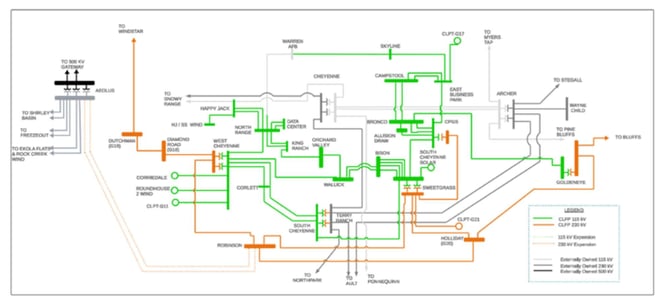
>$600 Million of Transmission // Cheyenne Light Fuel and Power // Wyoming
Cheyenne Light, Fuel, and Power applied for approval to build the $606 million Aeolus Transmission Project near Cheyenne. The project consists of two parallel 230-kV transmission lines that would connect the utility’s Robinson substation to PacifiCorp’s Aeolus substation. All of the project costs would be allocated to large loads through the utility’s Large Customer Transmission Cost Adjustment Mechanism (LCTAM). Check out this graphic of CLFP’s network, with the proposed Aeolus project in dashed yellow lines in the lower left.
Excerpt(s) of the Week
- Ohio Office of Consumer Counsel // State Agreement Approach // PJM // FERC
The Ohio Office of Consumer Counsel commented in the FERC docket on PJM’s study of the transmission facilities needed to serve the Ports Pike data center in Ohio under the State Agreement Approach (SAA).
The SAA would allow PJM to allocate all costs identified in its study to Ohio. The Public Utilities Commission would then allocate those costs directly to SB Energy’s subsidiaries.
“Parties to the SAA assert that the new transmission infrastructure to service the Flagship Project will benefit non-data center consumers and lower electric utility rates in the future. That is great news for Ohioans struggling to pay what seem to be never ending rate increases for essential utility services. But the Flagship Project benefits – at present – are speculative and unquantified. Before any costs of the Flagship Project are allocated to non-data center customers based on purported project benefits, transparent cost/benefit studies should be conducted to determine the correct amount of costs to allocate to non-data center consumers.”
Most clicked from last week’s WHiE