

What's Happening in Energy highlights the most interesting findings from public utility commission filings.
- A new non-firm interconnection service on the menu at MISO,
- A DERMS deployment timeline for one of the biggest utilities in the Southeast,
- A map of the future 765-kV backbone across the Midwest,
And more, more, more.
Subscribe to get these insights delivered straight to your inbox:
What's Happening in Energy — Oct 23
Powered by Halcyon
____
Approval in Part for 2 GW+ of CTs, Solar, BESS, and Wind // Southwestern Public Service // PUCT
Southwestern Public Service requested to amend its Certificate of Convenience and Necessity (CCN) to build seven solar, wind, BESS, and gas facilities totaling over 2 GW of accredited capacity. The Public Utility Commission of Texas approved the request in part. The self-build portfolio includes two gas combustion turbine facilities: the 1,003 MW Gaines County CT and the 854 MW Tolk CT. The only disallowed project was the Plant X BESS project.
____
Large Load Definitions // American Transmission Company // FERC // Wisconsin
MISO’s large load definition sets the minimum threshold at 50 MW. But the Wisconsin Public Service Commission set the minimum retail utilities’ large load tariffs in the state at 100 MW. Wisconsin’s major transmission owner, American Transmission Company (ATC), agreed to revise its large load definition down to MISO’s 50 MW threshold, but it will require only loads interconnecting at or above 100 MW to sign the Large Load Project Commitment Agreement (LLPCA) and a Minimum Transmission Charge Agreement. That leaves a cost allocation gap for loads between 50 and 100 MW. In a deficiency letter, FERC asked ATC to explain how it would allocate costs for those in-between loads. Track the docket here.
____
Virginia SCC Staff // Proposed Conditions on NextEra-Dominion Merger
Staff from the Virginia State Corporation Commission recommended that the Commission deny the NextEra-Dominion merger application in its current form. Staff recommended multiple conditions, including:
- Dominion Energy Virginia’s (DEV) president must be a resident of Virginia,
- DEV must be held in a special purpose vehicle separate from NextEra to protect it from a future Nextera bankruptcy,
- DEV must expand its board from three to seven members, with four being independent and unaffiliated with NextEra.
Read Halcyon’s summary of Staff’s proposals here. Virginia Governor Abigail Spanberger also submitted testimony asking the Commission to triple the ratepayer rebate, freeze rate base increases for six years, increase the debt share of Dominion’s capital structure, and expand disconnection protections.
____
PowerOn Map // 765-kV Backbone // MISO // South Dakota
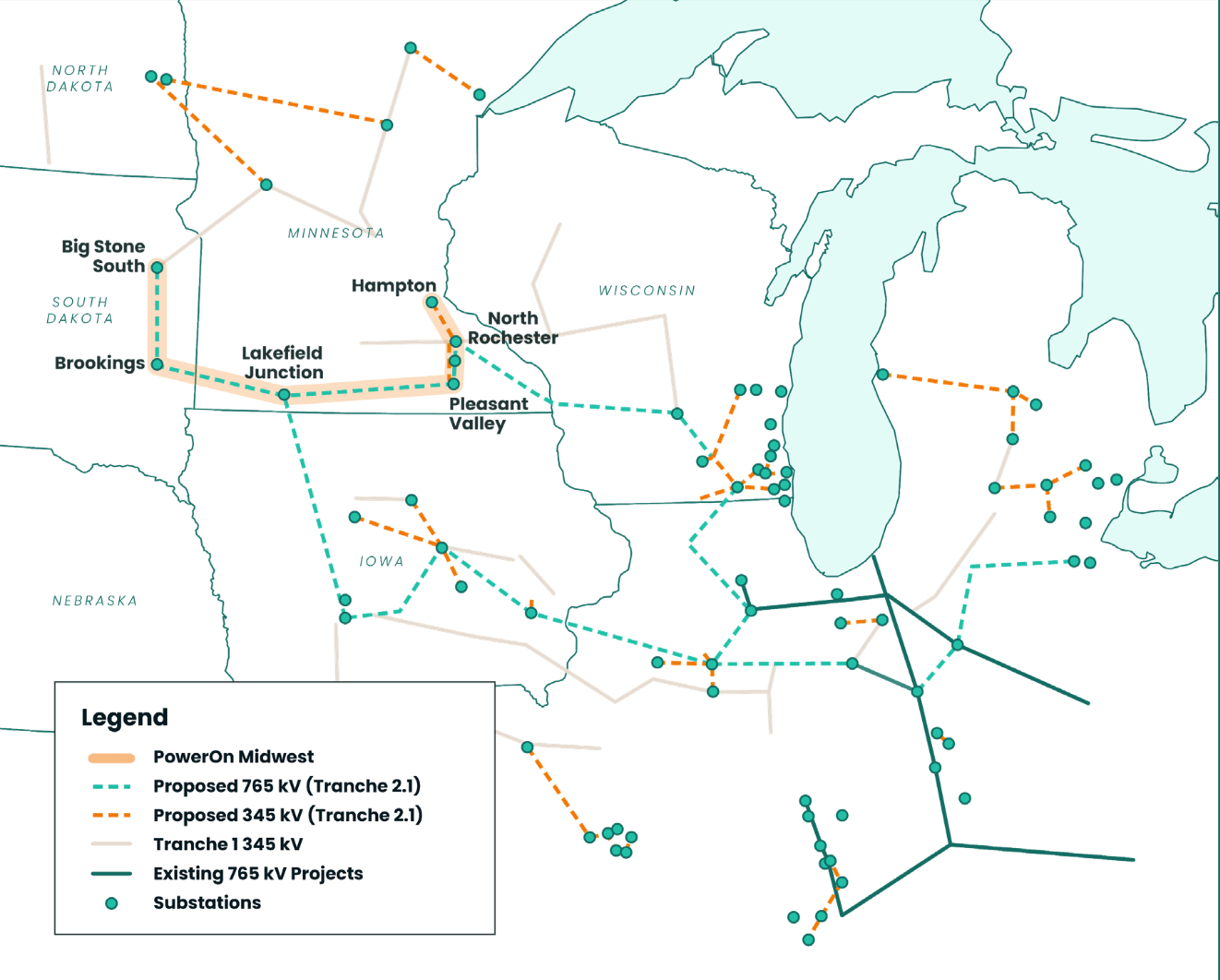
Xcel and Otter Tail Power shared information on their PowerOn Midwest 765/345-kV line backbone at a recent South Dakota Public Utilities Commission public input session. The South Dakota portion would run 80 to 100 miles, connecting the Big Stone South, and the Brookings County substations with the Lakefield Junction Substation in Minnesota. The utilities explained that the PowerOn Midwest projects would deliver reliability, economic efficiency, and the other benefits of regional transmission, including enabling “116 GW” of “primarily carbon-free resources.”
____
Fox North Energy Center // 720 MW CCGT // Wisconsin
Wisconsin Electric submitted an engineering plan and a pre-application memo signaling that it will soon file for a Certificate of Public Convenience and Necessity (CPCN) to construct a 720 MW combined-cycle plant. It would be sited at the existing Fox Energy Center, which currently hosts a roughly 620 MW combined-cycle plant. Construction would begin Q2 2029 and commercial operations would start in Q4 2032.
____
Pathway to DERMS Implementation // Georgia Power // Georgia
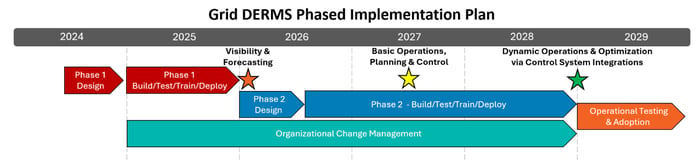
Georgia Power released a report on its progress integrating GE Vernova’s GridOS Distributed Energy Resources Management System (DERMS) platform into its operations. The report included a timeline of its two-phase approach: Phase 1 focuses on visibility, forecasting, and communications, while Phase 2 focuses on dispatching and optimization. If all goes as planned, integration will take roughly five years from Phase 1 design in 2024 through adoption in 2029.
____
3,200 MW of Wind // Pattern Energy // Corona Wind North II Project // New Mexico
____
New Large Load Contract Review Process // Alabama Power
The Alabama Public Service Commission filed its Final Order approving a new review process for contracts between Alabama Power and large load customers (>150 MW). The new process gives the Commission 90 days to review contracts and incorporate feedback from the Attorney General. Previously, under Rate FCR, the Commission had 10 days to review large load contracts, and the Attorney General was not involved. If the Commission does not issue a decision within 90 days, the contract is deemed approved.
____
Batch Zero Classification Dispute // Complaint // Rowan Digital // ERCOT
Rowan Digital Infrastructure subsidiary Rowan Stampede filed a complaint with the Public Utility Commission of Texas (PUCT) over ERCOT’s classification of its proposed Project Stampede data center in Temple, Texas as studied load instead of base load. The classification leaves the project uncertain about its Batch Zero queue position, the system upgrades needed to energize it, the transmission capacity it can secure through Batch Zero, and its overall timeline. Rowan and Oncor were unable to reverse the classification through ERCOT’s dispute resolution process. The complaint tasks the PUCT to expedite discovery so that the Commission can decide by November 19th.
____
GRITS // MISO // FERC Show Cause
Loads seeking permanent non-firm transmission service in MISO can now choose a new acronym from the menu: Grid Responsive Interim Transmission Service (GRITS). Under GRITS, large loads would curtail the non-firm portion of their load when prices exceed a “Net Benefits Price Threshold” (NBPT).
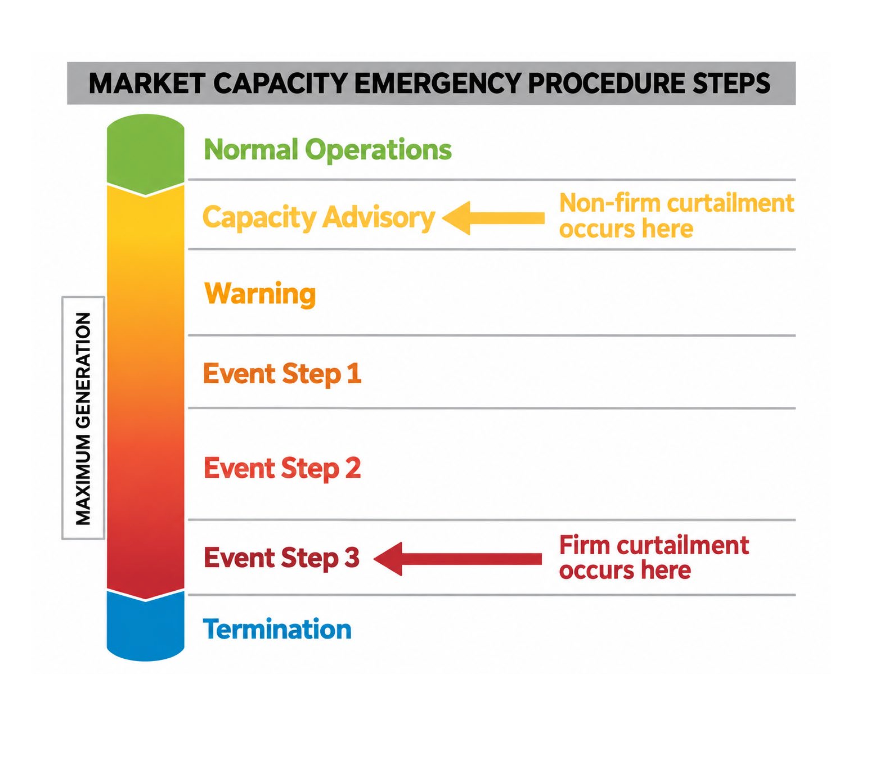
MISO expects this threshold to fall between $35 and $50/MWh. Loads can request this non-firm service as needed for up to one month at a time. MISO would not curtail the firm portion of the load until “Event Step 3” of its Market Capacity Emergency Procedure Steps.
Other non-firm transmission services would be curtailed ahead of GRITS, in priority order, and GRITS loads would be curtailed before loads under MISO’s proposed non-permanent, non-firm option, Flexible Load Interim Transmission Service (FLITS).
____
New Docket of the Week
-
A “Mini” Large Load // Electra // FirstEnergy // PUCO
What would have looked like a large load five years ago no longer seems that large: Electra, a hybrid-electric aircraft company, requested a 240-month “reasonable arrangement” with Ohio Edison Company to build distribution infrastructure and substations to serve its manufacturing facility in Springfield, Ohio. The facility will come online in two phases, at loads in the double digits rather than the triple digits: Phase 1, 14 MW by January 2028; Phase 2, 24 MW by 2031.
Excerpt(s) of the Week
- Comments from Governor Josh Shapiro // Peoples Gas // Pennsylvania
Pennsylvania Governor Josh Shapiro’s office filed comments responding to the Recommended Decision from an Administrative Law Judge in the Peoples Gas rate case. The following argues that the governor’s proposed alternative ROE methodologies are consistent with Supreme Court precedent.
“More importantly, methodologies are not the same as principles. The principles established by Bluefield and Hope are that a utility’s awarded ROE should be based on its cost of equity and that its return should be commensurate with the returns that investors expect to earn on other investments of similar risk and sufficient to assure confidence in the company’s financial integrity, maintain and support the company’s credit, and attract capital. There is no basis to find, as Peoples has suggested, that financial models such as the DCF and CAPM models are the only defensible way to estimate a utility’s cost of equity and satisfy the Bluefield and Hope principles.”
Most clicked from last week’s WHiE